
Things
Association Football
Association football is the game played by two teams of eleven who may use any part of the body except hands and arms - the goalkeeper alone may handle the ball, and only in the penalty area. Its modern form was created in England in 1863, when the Football Association wrote down laws that banned carrying the ball, but the game behind those laws is centuries older: a folk pastime so unruly that kings repeatedly tried to ban it.
At a Glance
- What it is
- A game between two teams of 11 players who move the ball into the opposing goal without using hands or arms; only the goalkeeper may handle it, inside the penalty area
- Folk roots
- Medieval and early modern folk football: whole towns or villages, local customs, minimal rules - banned in London in 1314 and repeatedly thereafter
- The founding moment
- 26 October 1863: London clubs meet at the Freemasons' Tavern and form the Football Association; its printed laws prohibit carrying the ball
- The split
- Clubs that wanted handling and hacking stayed outside the FA; the handling game organised separately as rugby, with the Rugby Football Union formed in 1871
- First international
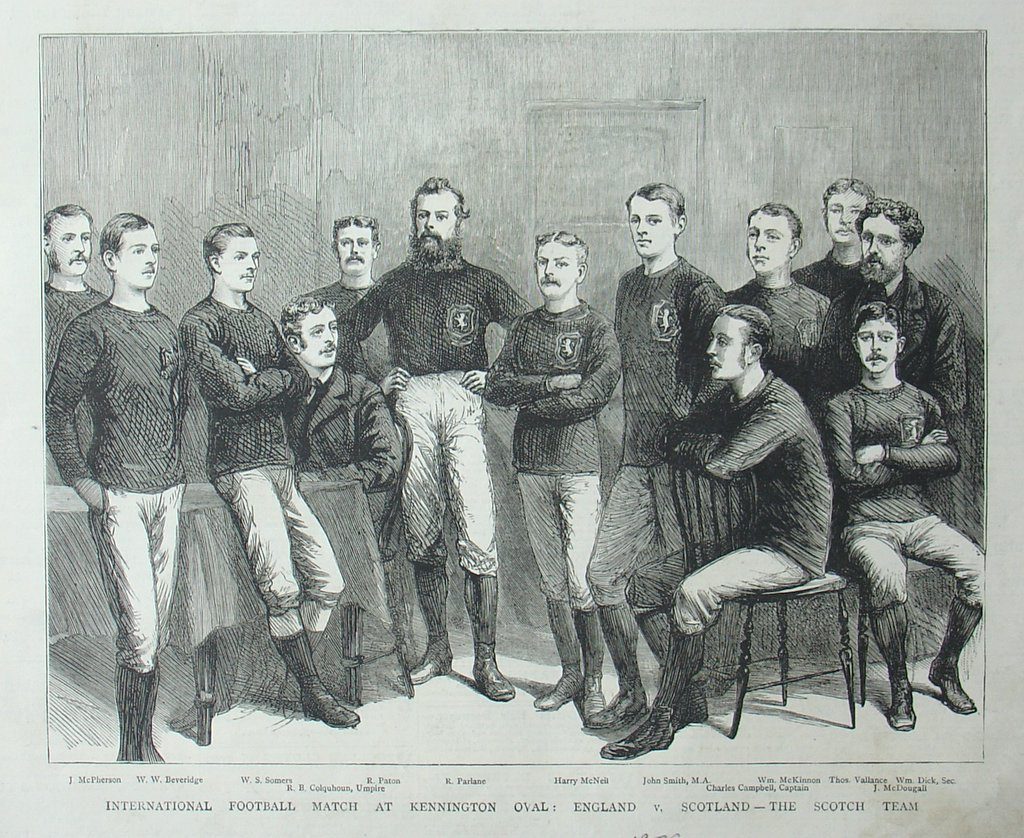
- Scotland 0-0 England, 30 November 1872, at Hamilton Crescent, Partick, Glasgow - recognised by FIFA as the first official international
- The world body
- FIFA founded in Paris on 21 May 1904 by seven associations; its first World Cup was played in Uruguay in 1930 and won by the hosts
- Scale
- FIFA estimated about 250 million players at the turn of the 21st century; Britannica calls football the world's most popular ball game
Introduction
Every football match played today - eleven against eleven, a goalkeeper the only player allowed to handle the ball - descends from a set of printed laws agreed in a London tavern in the autumn of 1863. Before that moment there was no single game of football. There were dozens: village against village, school against school, each with its own customs, and behind them a folk pastime that English and Scottish kings had been trying, and failing, to suppress for five hundred years.
This page traces that documented history: the folk game and its bans, the public schools that tamed it into competing codes, the 1863 meetings that split football in two, and the speed with which the association game then spread across the world.
Folk Football and the Bans
Folk football was played in towns and villages from at least medieval times, according to local custom and with a minimum of rules, as Britannica puts it. Matches could involve whole communities, goals set far apart, and play that contemporaries themselves described as violent. Shrove Tuesday was a traditional day for such games in Britain.
The authorities responded early and often. In 1314 the Lord Mayor of London, acting for Edward II, banned the game in the city because of the great noise caused by hustling over large balls, on pain of imprisonment. Edward III prohibited football among other idle games in 1363, and later medieval legislation repeatedly linked the bans to archery: men were to practise with the bow, on which national defence depended, instead of chasing a ball. Scotland's James I banned fute-ball in 1424. Between 1314 and 1667, by one widely cited count, football was officially banned in England alone by more than thirty royal and local laws. None of them worked for long.
Schools, Competing Codes and the Split of 1863
What saved football was the school and the university. In the early 19th century the game was taken up as a winter game between houses at public schools such as Winchester, Charterhouse and Eton, but each school played its own version - some allowed limited handling, others did not. Boys who went up to university found they could barely play together. An attempt to standardise the rules was made at Cambridge as early as 1843, and in 1848 Cambridge students adopted the Cambridge rules, which Cambridge graduates then carried into the clubs they founded. In Sheffield, a separate code - the Sheffield Rules, drawn up after Sheffield FC's founding in 1857 - governed a thriving northern game.
In 1863 a series of meetings of clubs from metropolitan London and the surrounding counties, beginning on 26 October at the Freemasons' Tavern, formed the Football Association and produced printed laws that prohibited carrying the ball. The handling game therefore remained outside the new FA: Blackheath, the club that had fought hardest to keep hacking - kicking an opponent's shins - withdrew, and the handling tradition organised itself separately, forming the Rugby Football Union in 1871. By 1870 the FA had prohibited all handling except by the goalkeeper. Association football - shortened by Oxford students in the 1880s from assoc. to soccer - and rugby football have been separate sports ever since.
Timeline
- 1314
London bans football within the city, for Edward II, complaining of the noise of hustling over large balls; imprisonment is the penalty.
- 1363
Edward III prohibits football and other idle games, part of a long run of bans tied to compulsory archery practice.
- 1424
Scotland's James I bans fute-ball by act of parliament.
- 1848
Cambridge students adopt the Cambridge rules, an early attempt at one common code for players from different schools.
- 1857
Sheffield FC is founded; its Sheffield Rules govern the northern game until the codes are unified in the 1870s.
- 26 October 1863
London clubs meet at the Freemasons' Tavern and form the Football Association; its laws ban carrying the ball.
- 1871
Fifteen FA clubs enter the first FA Cup competition; the Rugby Football Union is formed the same year, completing the split.
- 30 November 1872
Scotland and England draw 0-0 at Hamilton Crescent, Partick - the first official international match.
- 21 May 1904
FIFA is founded in Paris by seven national associations.
- 1930
Uruguay hosts and wins the first FIFA World Cup, beating Argentina 4-2 in the final in Montevideo.
The Game Goes Global
Once there was one code, the game could travel. The FA Cup, first contested in 1871-72, gave it a flagship competition; by 1877 the associations of Great Britain had agreed a uniform code, and professionalism was legalised in England in 1885, with the Football League following in 1888. British workers, sailors, teachers and engineers carried the game abroad, and it took root fastest where those networks reached - continental Europe and South America above all.
International football followed the same path. After the 1872 match in Partick, Wales joined the fixture list in 1876 and Ireland in 1884; FIFA's Museum notes that the rest of the world joined in from 1902, with FIFA itself founded in Paris in 1904. FIFA staged its own world championship in 1930: thirteen teams travelled to Uruguay, and the hosts beat Argentina 4-2 in the final. The World Cup became, in Britannica's words, likely the most popular sporting event in the world, and football itself the world's most popular ball game in participants and spectators.
Significance
Association football's significance is partly a story about rules. Folk football survived centuries of bans but could never spread beyond its own parish, because every place played it differently. The achievement of 1863 was not inventing a game but agreeing one: a short, portable code that strangers could share. Everything else - leagues, cups, internationals, a world governing body, a World Cup - is built on that act of standardisation.
It is also a story about who played. A pastime of festivals and mobs became, through schools, universities, factory towns and migration, the common sporting language of the planet - simple in its principal rules and essential equipment, as Britannica notes, and playable almost anywhere, from official pitches to streets, parks and beaches.
Myths and disputes
Did China invent football? FIFA's own history writing calls the Chinese game of cuju - kicking a leather ball, described as an exercise in a military work of the 3rd to 2nd century BC - the very earliest form of the game for which there is scientific evidence, and in 2004 FIFA president Sepp Blatter announced in Beijing that football originated in China, naming Linzi, capital of the ancient state of Qi, as its birthplace. This page presents that as what it is: FIFA's attributed position, not a settled lineage. Cuju faded during the Ming dynasty, and no documented line of transmission connects it to the English folk game from which the modern sport demonstrably descends. An early kicking game in China and the invention of the modern game in England are both true statements; they are not the same statement.
A second caution concerns 1863 itself. The FA laws did not conquer Britain overnight: Sheffield played its own rules for years, the handling clubs walked away rather than submit, and a uniform British code was only agreed in 1877. The split with rugby was not a misunderstanding but a deliberate parting over two questions - may a player carry the ball, and may he hack? - on which neither side would yield.
Legacy
The legacy of 1863 is the fixture list the world now lives by: league seasons, cup finals, and a World Cup every four years watched, for the 2022 final alone, by a global audience exceeding 1.4 billion people on FIFA's and Britannica's figures. The folk game that Edward II tried to silence for making too much noise in London became the loudest sport on earth - and it did so not by escaping rules, but by finally agreeing to share them.
Sources
- Encyclopaedia Britannica - Football (soccer)
- FIFA Museum - Scotland v. England: 150 years of international football
- Encyclopaedia Britannica - Why Do Some People Call Football Soccer?
- China Daily - Did soccer originate in China?
- 1911 Encyclopaedia Britannica - Football (Wikisource)
The facts on this page were checked against these sources on 19 November 2026. The History Trail's permanent pages are researched and written for this site; the live profiles elsewhere on The History Trail are assembled automatically from Wikipedia and Wikidata.
About the Author
Researched and written by the The History Trail Editorial Team — the accountable editorial function behind this site's permanent story pages. The team works from the published sources cited on each page; it does not invent historians, reviewers or credentials, and it corrects errors openly.
Fact Check
Every load-bearing fact on this page traces to one of the sources listed above, and significant claims link to their source in the text. Our checking method is described on the methodology page; errors can be reported via the corrections page.
Sources & Citations
Cite this page as: The History Trail Editorial Team, The History Trail — this article's title, publication and update dates are shown beneath its headline. The full source list appears under Sources above; the site's source standards are on the sources page.