
Things
Code of Justinian
The Code of Justinian is the codification of Roman law ordered by the Byzantine emperor Justinian I and issued between 529 and 534: the Codex, a collection of imperial constitutions; the Digest, fifty books of excerpts from the classical jurists; the Institutes, a student textbook given the force of law; and the Novels, Justinian's own later legislation. Together - later called the Corpus Juris Civilis - they repealed everything they did not include, preserved classical Roman law, and after their revival at Bologna became the foundation of civil-law systems across Europe and much of the world.
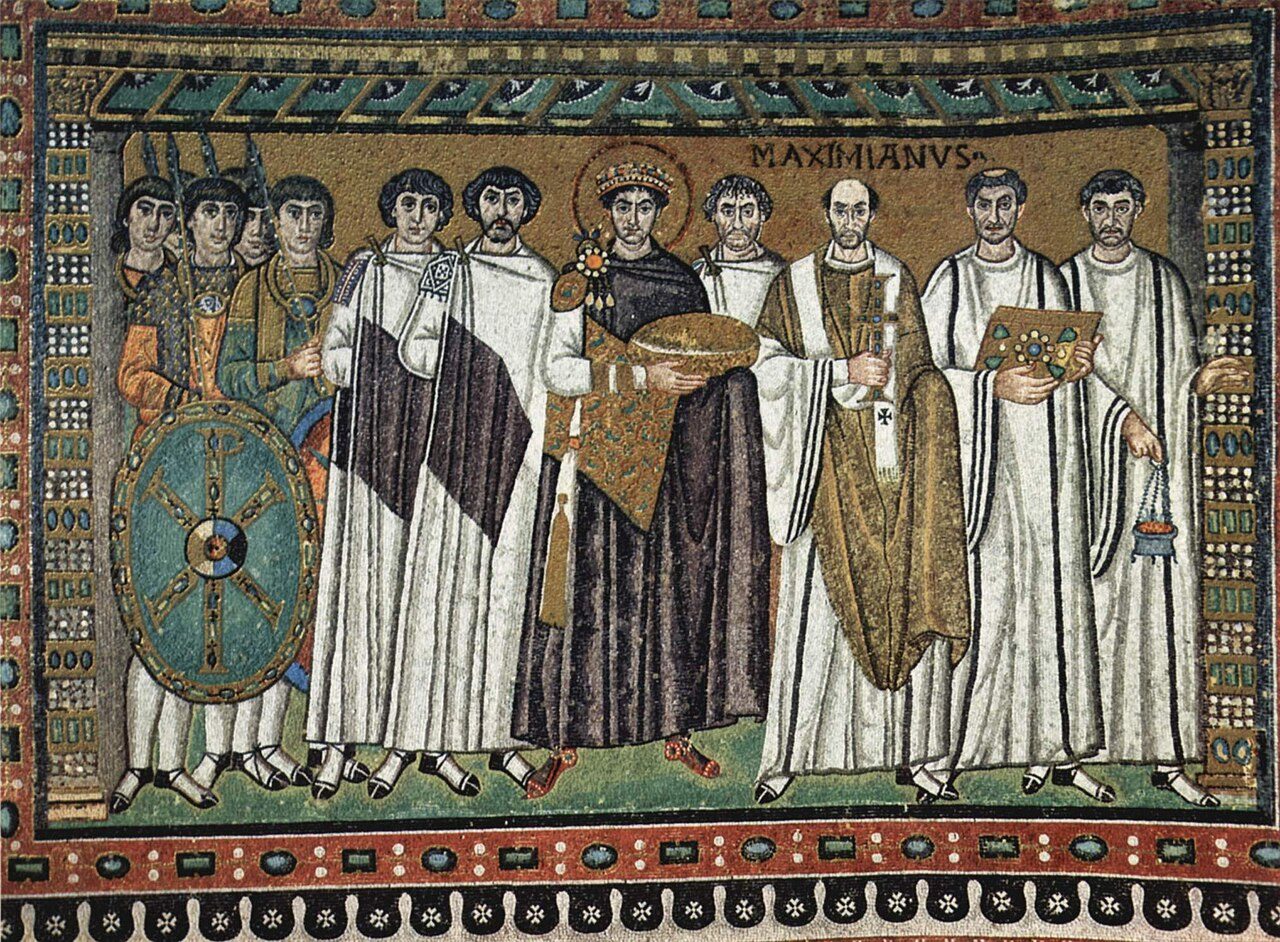
At a Glance
- The emperor
- Justinian I, Eastern Roman emperor 527-565, ruling from Constantinople
- The director
- Tribonian, Justinian's quaestor and minister of justice, who chaired the commissions
- The four parts
- Codex (imperial constitutions; final edition 534, twelve books, over 4,600 constitutions), Digest (fifty books of jurists' writings), Institutes (a four-book textbook with the force of law), Novels (Justinian's laws after 534, mostly in Greek)
- The scale
- The Digest commission screened almost 2,000 books and more than three million lines of juristic writing; about a third of what it kept is Ulpian
- The name
- Corpus Juris Civilis, 'body of civil law', became the standard name only with Dionysius Gothofredus's printed edition of 1583
- The revival
- Lost to the West for centuries, the texts were taught again at Bologna from the late 11th century and spread across Europe's universities
- The legacy
- Foundation of Byzantine law until 1453, and the root of the civil-law tradition used in continental Europe, Latin America and much of the world
Introduction
In February 528, barely six months after becoming emperor, Justinian I appointed a commission of lawyers in Constantinople and set them an impossible task: to reduce the whole of Roman law - a thousand years of imperial edicts and jurists' opinions, repetitive, contradictory and half-obsolete - to a single consistent body of law courts could use. The work they produced in six years is the Code of Justinian - strictly the Codex within it, but the name serves for the whole compilation: Codex, Digest, Institutes and Novels, later bound together as the Corpus Juris Civilis, the 'body of civil law'.
Britannica is careful on one point: strictly speaking, these were not a new legal code. The committees wrote almost nothing from scratch; their genius was editorial - selecting, cutting, harmonising, repealing. Everything left out lost its authority and could no longer be cited in court. In that act of selection, a millennium of Roman legal thought was compressed into the form in which it would survive its empire and shape modern Europe's legal systems - and every country that inherited them.
A Thousand Years of Law in Disorder
By the sixth century Roman law had two great layers, both unmanageable. The first was the constitutions: edicts, rescripts and rulings issued by emperors since the second century, in enormous numbers. The second was the writing of the classical jurists - Ulpian, Papinian, Paul, Gaius, Modestinus - whose opinions carried authority in court but frequently contradicted one another. A litigant could face two venerable texts pointing in opposite directions, with no certain way to choose.
Earlier emperors had ordered the first layer only: private Gregorian and Hermogenian collections in the 290s, then the official Theodosian Code of 438. None touched the jurists' writings, and by 527 even the Theodosian Code had been overtaken by a century of new legislation. Justinian wanted the law restored with the rest of his programme of restoration: one empire, one faith, one law.
Tribonian's Commissions: Code, Digest, Institutes
The project's leading figure was Tribonian, the emperor's quaestor - effectively his minister of justice. The first commission of ten, appointed early in 528, weeded the constitutions of the contradictory and obsolete; their Codex, promulgated in April 529, repealed every imperial law it left out. Justinian's own new legislation, including the Fifty Decisions of 530-531 settling long-disputed points, soon overtook it, and in November 534 a revised Codex replaced it. The second edition - twelve books, more than 4,600 constitutions from Hadrian to Justinian - is the Code that survives.
The bolder work was the Digest. In December 530 a new commission under Tribonian was charged with condensing the classical jurists themselves. The commissioners, on the Max Planck Institute's account, screened almost 2,000 books containing more than three million lines and reduced them to fifty books of excerpts, each fragment still labelled with its author and source. About a third of what they kept is Ulpian. The Digest was promulgated in December 533, and with it the Institutes, a four-book textbook by Tribonian with the professors Theophilus and Dorotheus, modelled on Gaius, which Justinian gave the force of law. Justinian legislated for thirty more years; those later laws, the Novels, mostly in Greek rather than Latin, were never officially collected.
Timeline
- 438
The Theodosian Code gathers the laws of the Christian emperors - the last great compilation before Justinian.
- February 528
A commission of ten is appointed to collect the valid imperial constitutions into one code.
- April 529
The first Codex is promulgated; imperial laws not included in it are repealed.
- 530-531
The Fifty Decisions settle disputed points; in December 530 the Digest commission begins under Tribonian.
- 533
The Institutes are issued in November and the Digest promulgated in December, both with the force of law.
- November 534
The revised Codex, in twelve books, replaces the first edition; this is the Code that survives.
- 534-565
Justinian's new constitutions, mostly in Greek, are issued; never officially collected, they survive as the Novels.
- 554
The compilation is introduced into Italy, reconquered by Justinian's armies, by the Pragmatic Sanction.
- c. 900
Under Leo VI the Corpus is reworked in Greek as the Basilika, the foundation of later Byzantine law.
- Late 11th century
Irnerius begins teaching Justinian's texts at Bologna; the study of Roman law revives and spreads across Europe.
- 1583
Dionysius Gothofredus's printed edition establishes the name Corpus Juris Civilis for the whole collection.
Significance
The Corpus preserved what it selected and condemned the rest to silence: once the Digest existed, the jurists' original writings ceased to be copied, so the Digest is, in the Max Planck Institute's words, the main source of our knowledge of classical Roman law. Papinian and Ulpian survive because Tribonian's clerks excerpted them. Justinian reformed legal education around his books and banned commentaries on the Digest, intending his text to end argument. It did the opposite: it gave Europe one authoritative legal text to argue about for a thousand years.
When the revival came, it remade European law. From Bologna the glossators' study spread to universities everywhere; the Church adopted Roman concepts wholesale - 'the church lives by Roman law', said the canon lawyers - and the Institutes' structure, dividing law into persons, things and actions, left its mark on almost every modern codification of private law. Britannica's summary is blunt: Roman law provided the foundation for civil law, the legal code used in continental Europe and throughout Latin America, while common law, its great counterpart, grew up separately in England.
Myths and disputes
Did Justinian write a code? Not in the modern sense, and not alone. The compilation is mostly other men's words - emperors' edicts and dead jurists' opinions - edited by commissions under Tribonian. Nor did he issue it under the famous title: the parts appeared separately in 529-534, the Novels were never officially collected, and the name Corpus Juris Civilis became standard only with a printed edition of 1583.
Are the Digest's texts purely classical? No, and scholars have argued for centuries about how impure they are. Tribonian's mandate expressly allowed the compilers to remove obsolete rules, resolve contradictions and alter the classical texts where necessary. These alterations, the interpolations, are beyond question as a fact; their extent in any given passage has been, in the Max Planck Institute's words, doubtful and hotly debated, with an early twentieth-century hunt for them so exhaustive it needed a three-volume Index of Interpolations, before trust in the transmitted text prevailed.
How was the Digest found again? Even that is disputed: knowledge of it almost vanished in the medieval West, and historians disagree about its recovery in northern Italy around 1070 - chance rediscovery of a manuscript, or scholars sent looking by a reviving commercial and ecclesiastical world? A famous sixth-century copy, the Littera Florentina, survived at Pisa; rival tradition places a discovery at Amalfi in 1135. By 1100, certainly, the book was open again and being lectured on.
Legacy
In the East it underpinned Byzantine law for nine hundred years, reworked in Greek as Leo VI's Basilika, until Constantinople fell in 1453. In the West its second life proved longer than its first. Received into the universities, it became the ius commune, Europe's common learned law; through the great modern codifications its influence runs into the French Civil Code of 1804 and the German Civil Code of 1900, and so into the civil-law systems under which most of the world now lives.
Its most quoted sentence may be its oldest borrowing: Ulpian's definition of justice, preserved by the editors - 'the steady and lasting will to give each person what is due to him'. An emperor who set out to restore a vanished empire instead built its most durable monument - not Hagia Sophia, but a library of law that outlived the empire by a millennium and counting.
Sources
- Encyclopaedia Britannica - Code of Justinian
- Max-EuP 2012 (Max Planck Institute) - Corpus Juris Civilis, by Reinhard Zimmermann
- World History Encyclopedia - Corpus Juris Civilis
- BiblicalTraining Library - Justinian Code
The facts on this page were checked against these sources on 19 November 2026. The History Trail's permanent pages are researched and written for this site; the live profiles elsewhere on The History Trail are assembled automatically from Wikipedia and Wikidata.
About the Author
Researched and written by the The History Trail Editorial Team — the accountable editorial function behind this site's permanent story pages. The team works from the published sources cited on each page; it does not invent historians, reviewers or credentials, and it corrects errors openly.
Fact Check
Every load-bearing fact on this page traces to one of the sources listed above, and significant claims link to their source in the text. Our checking method is described on the methodology page; errors can be reported via the corrections page.
Sources & Citations
Cite this page as: The History Trail Editorial Team, The History Trail — this article's title, publication and update dates are shown beneath its headline. The full source list appears under Sources above; the site's source standards are on the sources page.