
Things
Chess
Chess descends from chaturanga, an Indian war game flourishing by the 7th century whose pieces mirrored an army. Carried through Persia as shatranj and transformed in Europe — above all by the invention of the powerful queen — it became the world's most enduring board game, surviving even the arrival of computers stronger than any human.
At a Glance
- Earliest precursor
- Chaturanga, northwestern India, flourishing by the 7th century
- Route to Europe
- Via Persia (shatranj) and the Islamic world; in North Africa, Sicily and Spain by the 10th century
- The decisive rule change
- After 1475 the weak counsellor becomes the queen, the strongest piece on the board
- Standard set
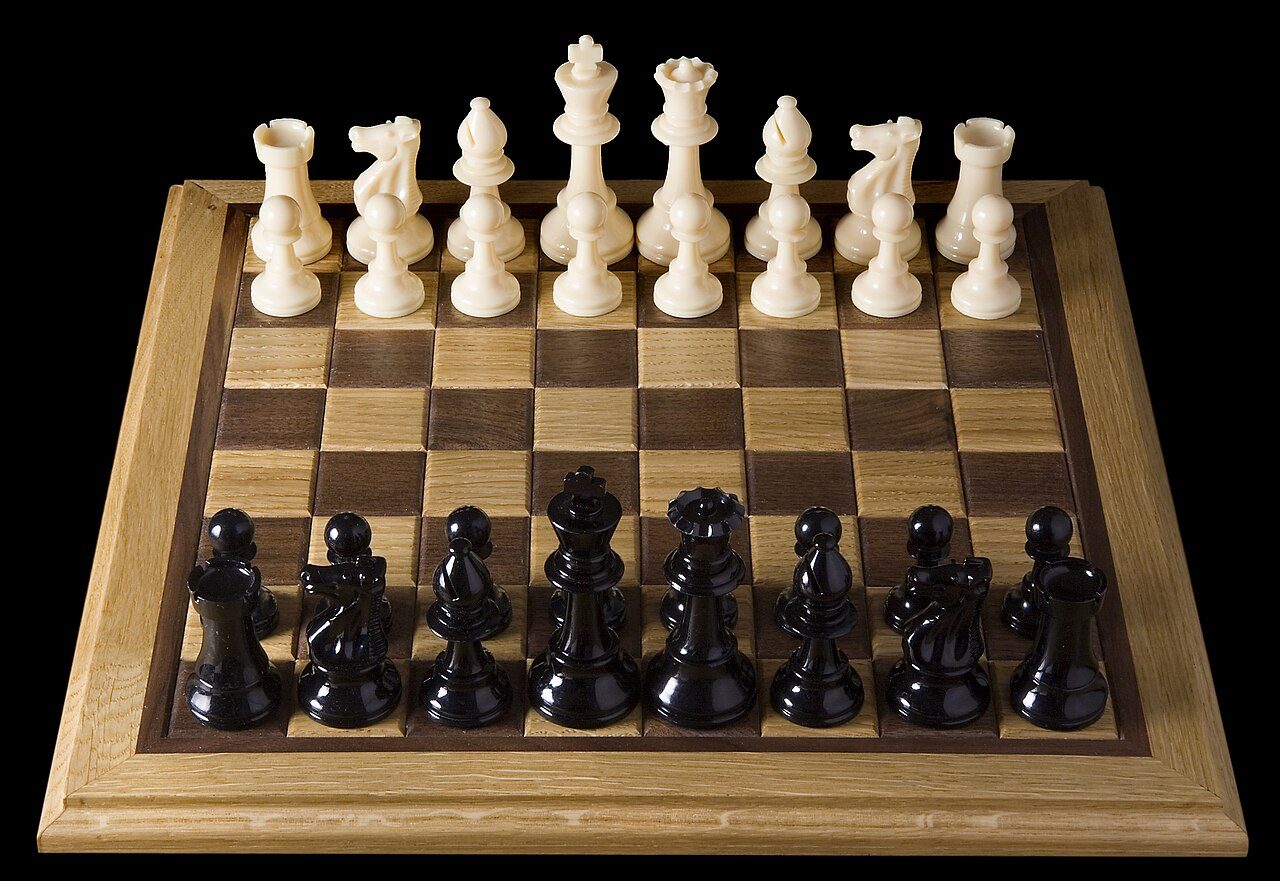
- The Staunton pattern, designed by Nathaniel Cook and patented in 1849
- First official world championship
- 1886 — Wilhelm Steinitz defeats Johannes Zukertort
- Governing body
- FIDE, the international chess federation, founded in Paris in 1924
- Youngest world champion
- Gukesh Dommaraju of India, aged 18, in 2024
A Game That Began as a Model Army
Chess began as chaturanga, a war game flourishing in northwestern India by the 7th century. Its name is Sanskrit for a battle formation, and its pieces represented the four divisions of an Indian army — infantry, cavalry, elephants and chariots — commanded by a king. Two features make chaturanga the earliest clear precursor of modern chess: its pieces had different powers, unlike the uniform pieces of checkers or go, and victory turned on the fate of a single piece, the king.
From India the game travelled west into Persia, where it became shatranj, and east along the Silk Road, where it developed into quite different games such as Chinese chess. Shatranj kept the king at its centre but added a new piece, the firzan, or counsellor, who stood beside the king and moved just one square diagonally. Games could be won by capturing the king or by stripping the opponent of every other piece — baring the king — and play was slow by modern standards.
The Royal Game Reaches Europe
A form of shatranj reached Europe by way of Persia, the Byzantine Empire and, most importantly, the expanding Islamic world: Muslim players brought chess to North Africa, Sicily and Spain by the 10th century, while Vikings carried it as far as Iceland and England. The walrus-ivory Lewis chessmen, found on the Isle of Lewis in 1831 and dated to the 11th or 12th century, survive as the most famous early European set. Chess was periodically banned by kings and churchmen, yet its association with wealth, knowledge and power made it the royal game by the 15th century.
For centuries the rules varied from place to place. The pawn gained its two-square first move by about 1300, but the transformation came after 1475, when two linked changes swept Europe. The counsellor changed sex and power at once, becoming the queen — able to move any distance in any direction, and by far the strongest piece on the board — while the old elephant piece became the bishop, with more than double its former range. Checkmate, once rare, could now arrive in as few as two moves, and the slow war of attrition became the fast, tactical game we recognise.
Timeline
- By the 7th century
Chaturanga, a war game whose pieces mirror the divisions of an Indian army, is flourishing in northwestern India.
- After 600
The game develops into shatranj across Persia and the Islamic world, gaining the firzan, or counsellor, beside the king.
- By the 10th century
Muslim players have carried chess to North Africa, Sicily and Spain; the oldest recorded game survives in a 10th-century manuscript from Baghdad.
- After 1475
The counsellor becomes the all-powerful queen and the elephant becomes the modern bishop, creating the fast, recognisable game of modern chess.
- 1849
Nathaniel Cook's chess set design is patented and promoted by Howard Staunton; the Staunton pattern becomes, and remains, the only design allowed in international competition.
- 1851
Staunton organises the first international chess tournament, in London; Germany's Adolf Anderssen wins it.
- 1886
Wilhelm Steinitz defeats Johannes Zukertort in the first match explicitly designated as being for the world championship.
- 1924
Representatives of 15 countries found FIDE, the permanent international chess federation, in Paris.
- 1972
Bobby Fischer of the United States defeats the Soviet Union's Boris Spassky to become world champion, ending decades of Soviet dominance and making chess front-page news worldwide.
- 1992
The Internet Chess Server enables live online play against opponents anywhere in the world; web platforms follow and grow through the 2010s.
- 1997
IBM's Deep Blue defeats world champion Garry Kasparov 3½–2½ in a six-game rematch — the first time a computer beats a reigning champion in a match under tournament conditions.
- 2020
Confined at home during the pandemic, millions take up online chess; platform registrations surge, boosted by the Netflix series The Queen's Gambit, and leading players become full-time streamers.
Champions, Federations and a Cold War Board
Competitive chess organised itself slowly. The world championship was an unofficial title until Steinitz's 1886 match, and champions long set their own terms for defences. FIDE, founded in 1924, only took control of the championship after Alexander Alekhine died holding the title in 1946; from 1948 it ran regular three-year cycles of qualifying competitions. FIDE also built the modern infrastructure of the game — ratings, the grandmaster title, Olympiad team championships and a women's world championship dating to 1927, first won by Vera Menchik.
From 1951 to 1969 every world champion and challenger was a Soviet citizen, and chess became a Cold War proxy. That is why Fischer's 1972 victory over Spassky landed so hard: an American individualist beating the Soviet chess machine, with a prize fund larger than all previous title matches combined. Membership of the US Chess Federation jumped from 2,100 in 1957 to more than 70,000 in 1973. Fischer then refused to defend his title and lost it by default in 1975 — the first champion to do so — but the boom he started never entirely faded.
Myths and disputes
Where chess was invented is often stated with more confidence than the evidence allows. Britannica is blunt: the origin of chess remains a matter of controversy, and there is no credible evidence that chess existed in a form approaching the modern game before the 6th century. Game pieces unearthed in Russia, China, India, Central Asia and Pakistan and once claimed to be far older are now regarded as belonging to earlier, only distantly related board games, often played with dice on boards of a hundred squares or more.
Even the Indian origin story has a gap in it. How chaturanga evolved is unclear: historians think it may have been played with dice on a 64-square board before gradually transforming into two-player shatranj, but the steps are not documented. What the record does support is a lineage — chaturanga to shatranj to the European game — rather than a single inventor, a single place or a single moment of creation.
The Engine Era and the Online Board
Deep Blue's 1997 victory closed a quest computer science had pursued since Claude Shannon's foundational work around 1950: a machine had beaten the best human at the game long treated as the supreme test of intellect. Today's engines, descendants of that project, are far stronger than any human player, and grandmasters now prepare with them as a matter of routine. Far from killing the game, the engines changed its study — and the internet changed its audience, turning chess into streamed entertainment watched by millions.
The championship line still runs: Magnus Carlsen held the title from 2013 until he declined to defend it, Ding Liren succeeded him in 2023, and in 2024 Gukesh Dommaraju of India became, at 18, the youngest world champion in the game's history — a champion from the country where chaturanga began, winning in the online era. Fifteen centuries after an Indian army was first arranged on a board, chess is played by more people, in more places, than ever before.
Sources
- Encyclopaedia Britannica — Chess: History
- Stanford University (EE380 Colloquium) — Computer Chess: The Deep Blue Saga, IBM T. J. Watson Research Center
- Campbell, Hoane & Hsu — Deep Blue, Artificial Intelligence journal (IBM Research)
- Wikipedia — Online chess
The facts on this page were checked against these sources on 19 November 2026. The History Trail's permanent pages are researched and written for this site; the live profiles elsewhere on The History Trail are assembled automatically from Wikipedia and Wikidata.
About the Author
Researched and written by the The History Trail Editorial Team — the accountable editorial function behind this site's permanent story pages. The team works from the published sources cited on each page; it does not invent historians, reviewers or credentials, and it corrects errors openly.
Fact Check
Every load-bearing fact on this page traces to one of the sources listed above, and significant claims link to their source in the text. Our checking method is described on the methodology page; errors can be reported via the corrections page.
Sources & Citations
Cite this page as: The History Trail Editorial Team, The History Trail — this article's title, publication and update dates are shown beneath its headline. The full source list appears under Sources above; the site's source standards are on the sources page.