
Things
Aurora
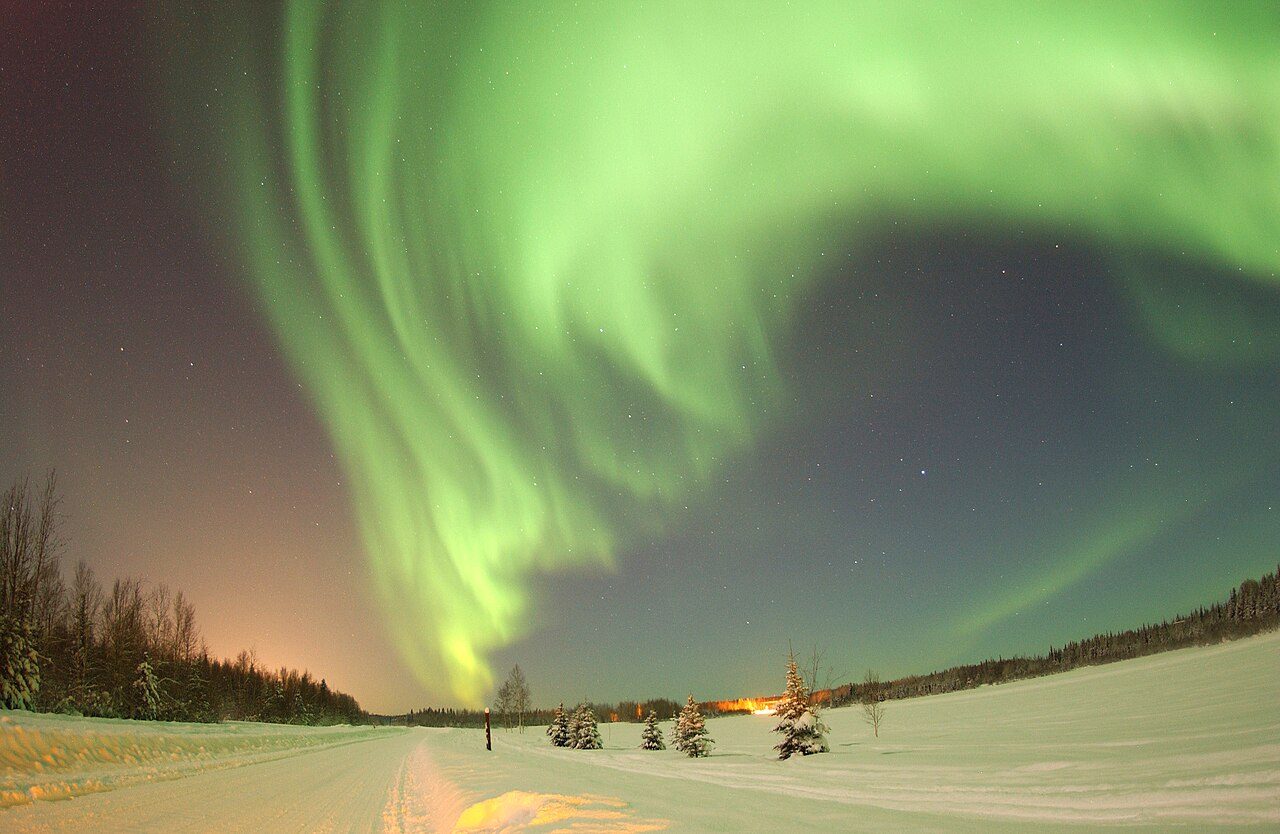
An aurora is a natural display of light in the upper atmosphere, caused when charged particles from the Sun, guided by Earth's magnetic field toward the poles, collide with oxygen and nitrogen high above the ground. In the north it is the aurora borealis, or northern lights; in the south, the aurora australis. For thousands of years people read the lights as spirits, omens and bridges to the gods. In the last three centuries science has replaced the omens with solar physics - without making the sight any less strange.
At a Glance
- What it is
- A luminous display in Earth's upper atmosphere, in curtains, arcs, bands and patches, caused by energetic solar particles colliding with atmospheric gases
- Where it happens
- In oval-shaped zones around Earth's magnetic poles; emissions typically occur at about 100 km altitude, anywhere between 80 and 250 km, according to Britannica
- The colours
- Oxygen gives green and red light; nitrogen gives blue and purple, so colour records which gas was struck and at what height
- The name
- Aurora borealis - Aurora, Roman goddess of the dawn, plus Boreas, the Greek north wind; the name is commonly credited to Galileo Galilei in 1619
- The greatest storm
- The Carrington Event of September 1859, the largest geomagnetic storm ever recorded, lit auroras as far south as the tropics and set telegraph equipment sparking
- The southern twin
- Aurora australis, the southern lights, mirrors the northern display around the south magnetic pole, over Antarctica and the far southern oceans
Introduction
Britannica defines an aurora as a luminous phenomenon of Earth's upper atmosphere that occurs primarily in high latitudes of both hemispheres. NASA describes the mechanism plainly: the Sun bathes Earth in a steady stream of energetic particles, and when that solar wind stirs Earth's magnetic field, particles trapped around the planet are accelerated down into the upper atmosphere, where their collisions with oxygen and nitrogen make the auroral light. The display is therefore not weather in the ordinary sense. It is space weather made visible - the one part of the Sun-Earth connection that can be seen with the naked eye.
Because the particles follow magnetic field lines toward the poles, auroras are normally confined to ovals around the magnetic poles: Scandinavia, Iceland, Alaska, northern Canada and Siberia in the north; mostly empty ocean and Antarctica in the south. Only in intense solar activity do the ovals expand to middle latitudes - and, in the greatest storms, to the tropics.
Folklore: Spirits, Omens and a Bridge to the Gods
Every northern culture explained the lights in its own terms, and the explanations were rarely comfortable. In Sami tradition, the aurora was widely regarded as the souls of the dead, a presence to be treated with respect and a degree of fear: people avoided whistling at the lights or drawing their attention. Elsewhere the lights were read as omens of war, plague or weather to come. These were not decorations. They were messages, and usually warnings.
The most famous proposed link is to Bifrost, the burning bridge of Norse mythology that connects Midgard, the world of mortals, to Asgard, the realm of the gods, guarded by the god Heimdall. Some scholars have suggested that the shimmering, coloured, arching aurora inspired the bridge. As the myths section below explains, that identification is a proposal, not a settled fact - but it shows how naturally the lights invited the idea of a road between earth and heaven.
From Wonder to Measurement: Halley, Galileo's Name and Birkeland's Terrella
The name itself is early modern. Aurora borealis - the dawn of the north - is commonly credited to Galileo Galilei, who used it in 1619, pairing Aurora, the Roman goddess of dawn, with Boreas, the Greek god of the north wind. The scientific turn came a century later. In 1716 the English astronomer Edmund Halley, watching a great aurora from London, related the display to Earth's magnetic field - the first step toward a physical explanation. In 1733 Jean-Jacques de Mairan proposed that the Sun's atmosphere interacted with Earth's, and in 1779 Benjamin Franklin suggested the lights were electrical discharges. Each guess captured part of the truth.
The man who came closest was the Norwegian physicist Kristian Birkeland. Around the turn of the twentieth century Birkeland argued that electrons streamed from the Sun and were guided by Earth's magnetism to the poles. To test the idea he built a terrella - a magnetised metal sphere in a vacuum chamber - and fired electron beams at it; glowing rings formed around the sphere's poles, a miniature aurora on a laboratory bench. Birkeland's theory was largely dismissed in his lifetime, partly because Lord Kelvin had declared the Sun-aurora connection unreal. Spacecraft measurements in the space age proved Birkeland essentially right, and the field-aligned currents he predicted are now called Birkeland currents.
The Carrington Event, 1859: The Storm That Lit the Telegraph Age
On 1 September 1859 the English astronomer Richard Carrington, sketching sunspots, saw a sudden flash of intense white light - the first recorded white-light solar flare. About seventeen hours later, NOAA records, the night sky in North America and as far south as Panama lit up like daytime; people read newspapers by auroral light, and gold miners in the Rocky Mountains woke at 1 a.m. and cooked breakfast, mistaking the glow for dawn. Britannica calls the storm of 2 September 1859 the largest geomagnetic storm ever recorded, producing intense auroral displays as far south as the tropics.
The storm also announced a new vulnerability. Currents induced by the disturbance surged through telegraph systems; operators reported sparks and fires as the current ignited recording tape, and messages could not be sent. Carrington noted the coincidence between his flare and the storm without claiming a direct connection - but the pairing of a solar event, a magnetic storm and a technological failure within two days effectively founded the discipline now called space weather.
Timeline
- 1619
The name aurora borealis, pairing the Roman dawn goddess with the Greek north wind, is commonly credited to Galileo Galilei.
- 1716
Edmund Halley relates a great aurora seen from London to Earth's magnetic field, the first physical line of explanation.
- 1733
Jean-Jacques de Mairan proposes that interactions between the atmospheres of the Sun and Earth cause auroras.
- 1779
Benjamin Franklin suggests auroras are electrical discharges in the upper atmosphere.
- 1-2 September 1859
Carrington observes a white-light solar flare; some seventeen hours later the greatest geomagnetic storm on record drives auroras to the tropics and disrupts telegraphs worldwide.
- Early 1900s
Kristian Birkeland's terrella experiments produce miniature auroras around a magnetised sphere, supporting his theory of electrons streaming from the Sun.
- 6 April 1996
NASA's Polar spacecraft images Earth's full north polar auroral oval in ultraviolet light over northern Canada.
- 21 April 2018
The VIIRS instrument on the Suomi NPP satellite images the aurora borealis over North America after a strong blast of solar wind stirs Earth's magnetic field.
- May 2024
The strongest geomagnetic storm in more than two decades - later named the Gannon storm - carries auroras to unusually low latitudes around the world.
Significance
The aurora matters scientifically because it is the visible end of a chain that now runs through modern infrastructure. The same geomagnetic storms that expand the auroral ovals drive currents in power grids, degrade satellite operations and radio communication, and disturb navigation signals. NOAA's account of the Carrington Event is written as a warning: in 1859 the only electrical network to damage was the telegraph; a comparable storm today would threaten satellites, communications and power systems across whole continents. That is why agencies such as NOAA and NASA now monitor the Sun continuously and forecast space weather as they forecast storms on Earth.
Myths and disputes
Was Bifrost the aurora? Possibly, but this page flags the claim as disputed. Scholars have proposed three different natural originals for the Norse bridge: the rainbow, which Snorri Sturluson's Prose Edda appears to describe; the Milky Way; and the aurora, whose shimmering movement and fiery colours fit some descriptions better than a stable rainbow does. Old Norse also had its own ordinary word for the northern lights, nordrljos, which weakens any simple equation of Bifrost with the aurora. The honest statement is that the bridge may draw on several sky phenomena, and no identification is proven.
Even the name has two claimants. Aurora borealis is commonly credited to Galileo in 1619, but the term is also found in Pierre Gassendi's 1649 description of the great auroral display seen across France in 1621. What is not disputed is the name's meaning - northern dawn - or why it was chosen: to observers far from the Arctic, a faint aurora low on the northern horizon looks exactly like daybreak in the wrong place.
Legacy
The aurora's legacy runs in two directions. In culture, the lights have become one of the world's great natural spectacles, drawing travellers to Iceland, Norway, Finland, Alaska and Canada every winter. In science, they created a field: the line from Halley's magnetic guess, through Carrington's flare and Birkeland's terrella, leads directly to today's space-weather forecast centres, which exist because a beautiful light in the sky turned out to be a hazard report.
The lights still produce new science. NASA notes that citizen observers reporting auroras through the Aurorasaurus project helped identify a related phenomenon, STEVE - a thin purple ribbon of light that appears with auroras but is physically distinct.
Sources
- NASA - Behold the Northern Lights
- NOAA NESDIS - What Was the Carrington Event?
- Encyclopaedia Britannica - Aurora
- Encyclopaedia Britannica - Geomagnetic storm of 1859
- American Meteorological Society / University of Chicago Press - The AMS Weather Book: Space Weather, A Twentieth-Century Discovery
The facts on this page were checked against these sources on 19 November 2026. The History Trail's permanent pages are researched and written for this site; the live profiles elsewhere on The History Trail are assembled automatically from Wikipedia and Wikidata.
About the Author
Researched and written by the The History Trail Editorial Team — the accountable editorial function behind this site's permanent story pages. The team works from the published sources cited on each page; it does not invent historians, reviewers or credentials, and it corrects errors openly.
Fact Check
Every load-bearing fact on this page traces to one of the sources listed above, and significant claims link to their source in the text. Our checking method is described on the methodology page; errors can be reported via the corrections page.
Sources & Citations
Cite this page as: The History Trail Editorial Team, The History Trail — this article's title, publication and update dates are shown beneath its headline. The full source list appears under Sources above; the site's source standards are on the sources page.