
People
Mahatma Gandhi
A shy, mediocre schoolboy from Porbandar became the leader of India's independence movement by refusing to fight on his opponent's terms. Gandhi's method — satyagraha, nonviolent resistance grounded in truth — mobilised millions, embarrassed an empire, and left a template that protest movements still borrow today.
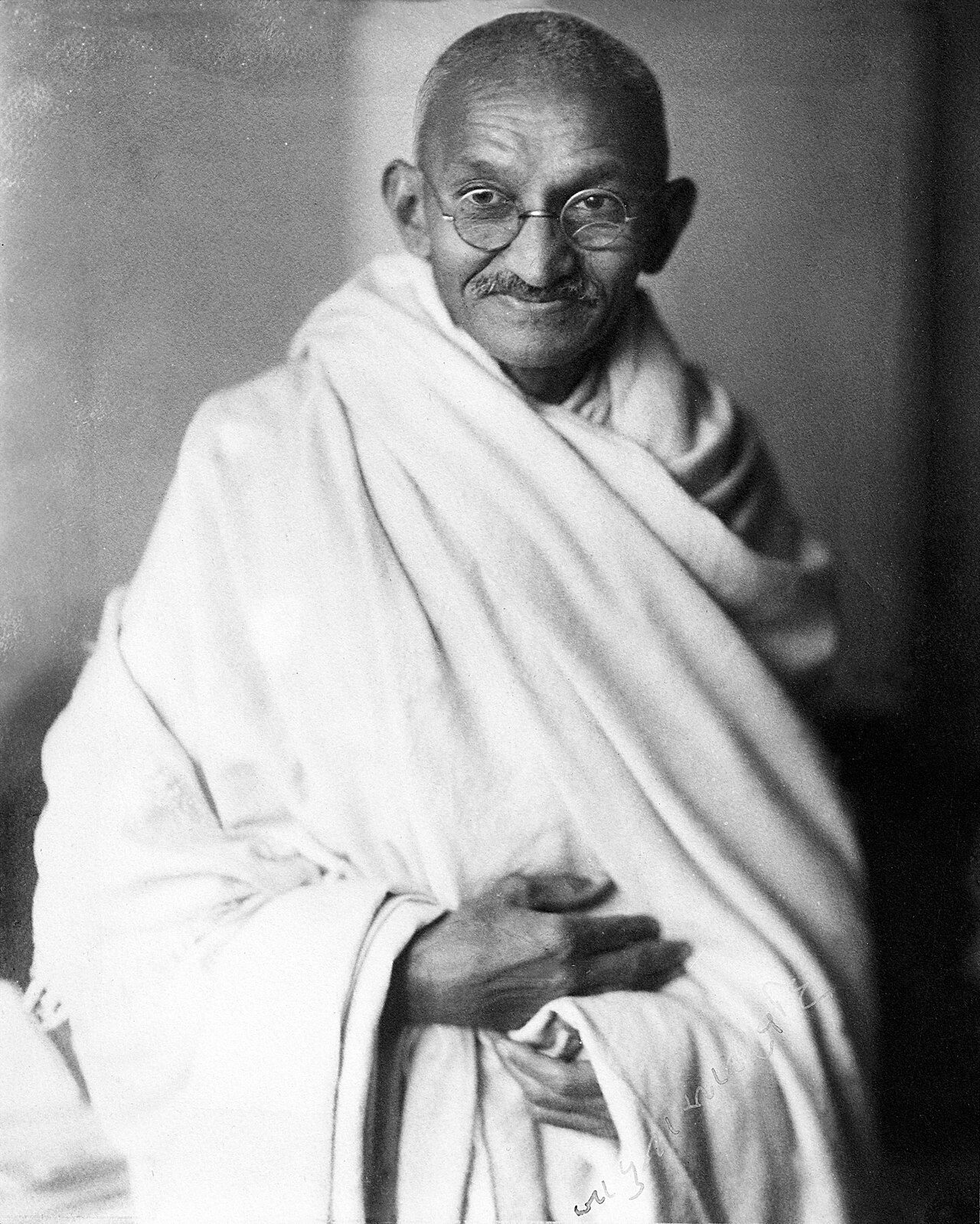
At a Glance
- Born
- 2 October 1869, Porbandar, India
- Died
- 30 January 1948, Delhi — assassinated
- Trained as
- Barrister, Inner Temple, London (from 1888)
- Method
- Satyagraha — nonviolent protest to achieve political and social progress
- Signature campaigns
- Noncooperation movement, Salt March, Quit India Movement
- Known as
- Mahatma — 'Great Soul'; considered the father of the nation in India
- Family
- Married Kasturba at 13; they had five children, the first of whom died in infancy
Introduction
Mohandas Karamchand Gandhi was born on 2 October 1869 in Porbandar, a small princely state in western India, the youngest child of his father's fourth wife. His father, Karamchand, was dewan — chief minister — of Porbandar and later of Rajkot, an able administrator with little formal education. His mother, Putlibai, was absorbed in religion, fasting frequently and dividing her time between home and temple. The household practised Vaishnavism, worship of the Hindu god Vishnu, with a strong tinge of Jainism, whose chief tenets are nonviolence and the belief that everything in the universe is eternal.
From that upbringing Gandhi took for granted ahimsa — non-injury to all living beings — along with vegetarianism, fasting for self-purification and tolerance between creeds. At school he was, by his own record, mediocre: one report rated him good at English, fair in arithmetic and weak in geography, with very good conduct and bad handwriting. He was married at thirteen, lost a year of schooling to it, and shone neither in the classroom nor on the playing field. Nothing in the boy predicted the man whose name would become one of the most universally recognised on earth.
Background
In 1887 Gandhi scraped through the matriculation examination of the University of Bombay and started at Samaldas College, struggling with the switch from Gujarati to English. The family decided he should qualify as a barrister to keep up its tradition of high office, which meant England. His mother relented only when he vowed to touch neither wine, women nor meat abroad, and he overrode his subcaste's decree forbidding the voyage. He sailed in September 1888 and joined the Inner Temple in London ten days after arriving.
Gandhi went to South Africa in 1893 to practise law, and his family joined him there in 1897, Kasturba assisting him in the activism that grew out of his legal work. His campaigns began by combating the second-class status Indians received under British rule, in South Africa and then, after the family returned to India in 1915, at home. The focus widened from reform to ending British rule altogether — a goal attained in the years directly after the Second World War, though victory was marred by sectarian violence that split the subcontinent into two independent states, India and Pakistan, instead of the single unified India he wanted.
Timeline
- 2 October 1869
Gandhi is born in Porbandar, western India, youngest child of Karamchand Gandhi, a chief minister, and the devout Putlibai.
- September 1888
After vowing to his mother to avoid wine, women and meat, Gandhi sails for England and joins the Inner Temple to train as a barrister.
- 1893
Gandhi travels to South Africa to practise law; his family joins him there four years later, and Kasturba assists in his activism.
- 1915
The Gandhi family returns to India, where his campaigns against British rule move from reform toward full independence.
- 1930
The Salt March: Gandhi leads a mass campaign of civil disobedience against the British salt laws, drawing worldwide attention.
- 1942
The Quit India Movement demands an immediate end to British rule, in the middle of the Second World War.
- 1947
India wins independence — but partitioned into India and Pakistan amid sectarian violence, against Gandhi's hope of unity.
- 30 January 1948
On his way to an evening prayer meeting in Delhi, Gandhi is shot at close range by Nathuram Godse, a young Hindu fanatic.
Significance
Gandhi is internationally esteemed for satyagraha, his doctrine of nonviolent protest to achieve political and social progress. He organised mass campaigns — the noncooperation movement, the Salt March and the Quit India Movement — designed to disrupt British rule and press for self-governance without answering violence with violence. Yet the method worked on an empire that claimed to rule by law and conscience: it made repression look shameful and obedience look optional.
His influence ran well beyond India. Within the country, reformers such as Vinoba Bhave carried his philosophy forward. Abroad, Martin Luther King Jr. borrowed heavily from Gandhi's practice of nonviolence and civil disobedience for the American civil rights movement. Perhaps most consequentially, the freedom his movement won for India sounded a death knell for Britain's other colonial enterprises in Asia and Africa, where independence movements swept forward with his example bolstering existing campaigns and igniting new ones. The United Nations later declared his birthday, 2 October, the International Day of Non-Violence, and India marks it as the national holiday Gandhi Jayanti.
Legacy
Gandhi was cremated at Raj Ghat in New Delhi, where India's president and service chiefs still pay tribute every Martyrs' Day, the anniversary of his assassination. In the eyes of millions of Indians he remains the Mahatma, the Great Soul, and the father of the nation.
The shadow in the legacy is partition. Gandhi won independence but not the united India he had worked for, and he was murdered not by the empire he opposed but by a fellow Hindu who considered him too conciliatory. His methods survive him more completely than his hopes did — which may be the most honest measure of the man: the campaigns are studied and copied worldwide, while the unity he fasted for remains the unfinished part of his story.
Sources
- Encyclopaedia Britannica — Mahatma Gandhi
- Encyclopaedia Britannica — Mohammed Ali Jinnah (partition context)
- Encyclopaedia Britannica — Nelson Mandela (the movement Gandhi inspired)
The facts on this page were checked against these sources on 19 November 2026. The History Trail's permanent pages are researched and written for this site; the live profiles elsewhere on The History Trail are assembled automatically from Wikipedia and Wikidata.
About the Author
Researched and written by the The History Trail Editorial Team — the accountable editorial function behind this site's permanent story pages. The team works from the published sources cited on each page; it does not invent historians, reviewers or credentials, and it corrects errors openly.
Fact Check
Every load-bearing fact on this page traces to one of the sources listed above, and significant claims link to their source in the text. Our checking method is described on the methodology page; errors can be reported via the corrections page.
Sources & Citations
Cite this page as: The History Trail Editorial Team, The History Trail — this article's title, publication and update dates are shown beneath its headline. The full source list appears under Sources above; the site's source standards are on the sources page.