
People
Cleopatra
Cleopatra VII was the last queen of the Ptolemaic dynasty that had ruled Egypt for nearly three centuries. For 22 years she played Roman power politics better than anyone in the Mediterranean — until the one Roman she could not charm, Octavian, beat her fleet at Actium.
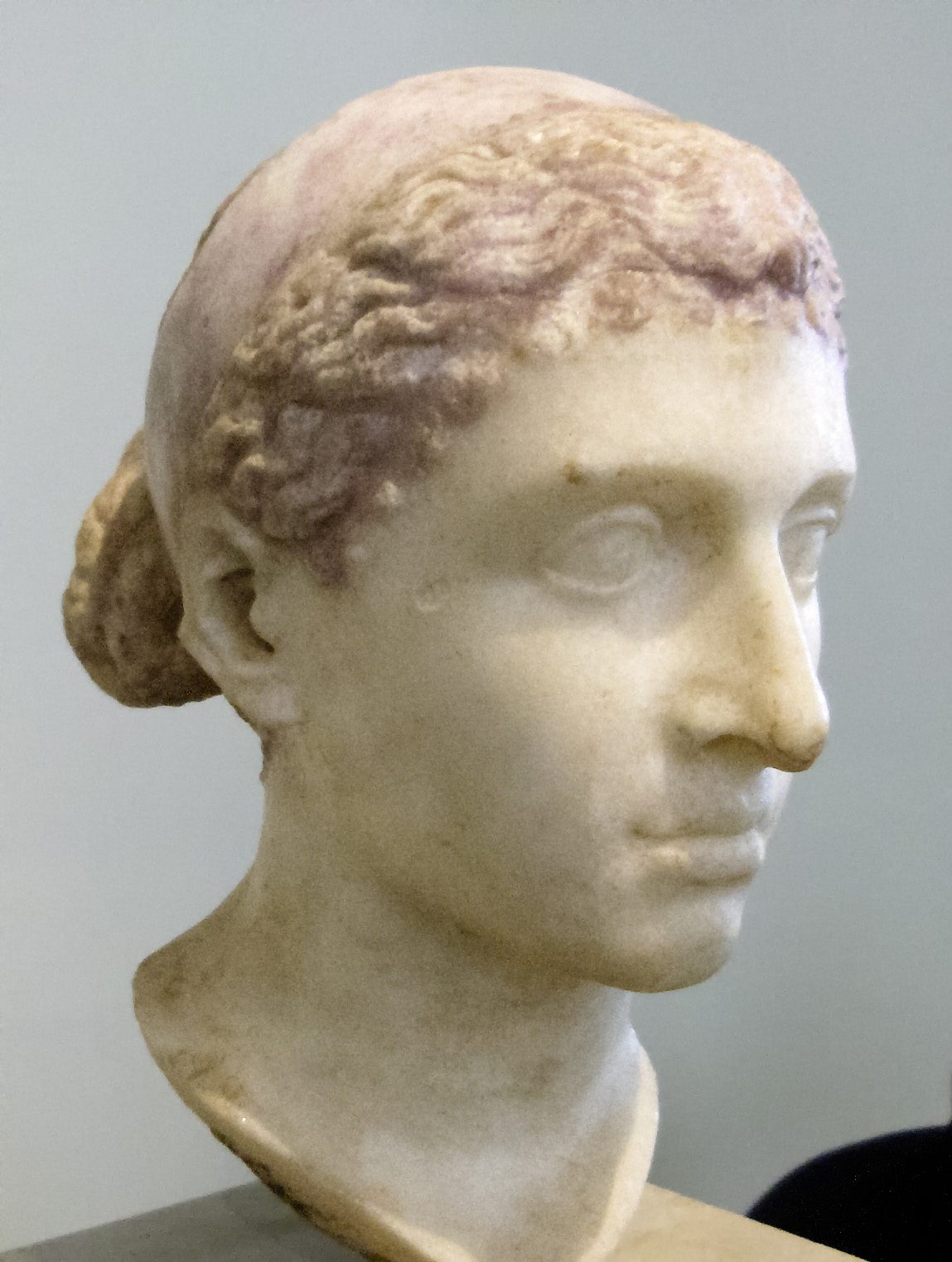
At a Glance
- Born
- 70/69 BCE
- Died
- 30 BCE, Alexandria, aged 39
- Reign
- Queen of Egypt, 51–30 BCE — successively with Ptolemy XIII, Ptolemy XIV and her son Ptolemy XV Caesar (Caesarion)
- Dynasty
- The Ptolemies, a Macedonian dynasty ruling Egypt since the death of Alexander the Great in 323 BCE
- Languages
- The only member of her house, according to Plutarch, who took the trouble to learn Egyptian
- Final defeat
- Battle of Actium, 2 September 31 BCE, against Octavian
Introduction
Cleopatra, in full Cleopatra VII Thea Philopator, was an Egyptian queen of the Ptolemaic dynasty, famous in history and drama as the lover of both Julius Caesar and, later, Mark Antony. She became queen on the death of her father, Ptolemy XII, in 51 BCE, and ruled successively with her two brothers and then with her son. After the Roman armies of Octavian defeated their combined forces, Antony and Cleopatra died by suicide, and Egypt fell under Roman domination.
The romance is the least interesting part of the record. Cleopatra actively influenced Roman politics at a crucial period — the decades in which the Roman Republic tore itself apart — and she did it as the ruler of the richest kingdom in the Mediterranean, deploying Egypt's wealth, grain and fleet as instruments of policy. She came to represent, as no other woman of classical antiquity did, the prototype of the romantic femme fatale; the sources underneath the legend show a working monarch.
Background
Cleopatra was destined to become the last queen of the Ptolemaic dynasty, the Macedonian house that ruled Egypt between the death of Alexander the Great in 323 BCE and its annexation by Rome. Although she probably had little, if any, Egyptian blood, the classical author Plutarch wrote that she alone of her house took the trouble to learn Egyptian. For political reasons she styled herself as the new Isis, presenting herself to her Egyptian subjects as the living embodiment of the goddess.
When Ptolemy XII died in 51 BCE, the throne passed to his young son Ptolemy XIII and to Cleopatra, then eighteen and about eight years older than her brother. She quickly became the dominant ruler — too dominant: by about 50 BCE she was forced to flee Egypt for Syria, where she raised an army and returned in 48 BCE to face her brother at Pelusium, on Egypt's eastern border. The murder of the Roman general Pompey, who had sought refuge with Ptolemy XIII, and the arrival of Julius Caesar changed everything.
Timeline
- 51 BCE
Ptolemy XII dies; Cleopatra becomes queen jointly with her brother Ptolemy XIII and soon dominates the government.
- c. 50 BCE
Forced to flee to Syria, Cleopatra raises an army and returns to contest the throne.
- 48 BCE
Caesar arrives in Egypt in pursuit of Pompey; Cleopatra secures his support and they become lovers, spending a winter besieged in Alexandria.
- 47 BCE
Ptolemy XIII flees and drowns in the Nile; Cleopatra is restored to the throne and gives birth to her son, known as Caesarion.
- 44 BCE
Caesar is assassinated in Rome while Cleopatra is visiting; she returns to Egypt and rules with her infant son, Ptolemy XV Caesar.
- 41 BCE
Summoned by Mark Antony to Tarsus, Cleopatra arrives by barge dressed as the new Isis; Antony follows her to Alexandria as her partner and ally.
- 40 BCE
Cleopatra gives birth to Antony's twins, Alexander Helios and Cleopatra Selene.
- 34 BCE
At the Donations of Alexandria, Antony proclaims Caesarion Caesar's son and hails Cleopatra as queen of kings — a direct challenge to Octavian.
- 2 September 31 BCE
Octavian defeats the combined forces of Antony and Cleopatra at the naval Battle of Actium; they flee to Egypt.
- 30 BCE
Antony dies by suicide on false news of her death; Cleopatra buries him and dies herself, and Egypt passes under Roman rule.
Significance
Cleopatra's statecraft was aimed at a single goal: keeping Egypt independent and, if possible, restoring the glories of the first Ptolemies. Each alliance served it. Caesar's support regained her throne and produced Caesarion, a son she could present as Caesar's heir. Antony's need for money for his Parthian campaign was traded for the return of much of Egypt's eastern empire, including large portions of Syria and Lebanon and the rich balsam groves of Jericho. For two decades it worked: Egypt grew richer and larger while Rome fought itself.
The Donations of Alexandria in 34 BCE were the high point and the provocation. Antony proclaimed Caesarion to be Caesar's true son — relegating Octavian, Caesar's adopted heir, to legal illegitimacy — and Cleopatra was hailed as queen of kings. Octavian seized on it, waging a propaganda war in Rome against the foreign woman who had supposedly bewitched a Roman triumvir, and the Roman Senate declared war against Cleopatra. Actium settled it in a day.
Legacy
Cleopatra was 39 when she died, had been a queen for 22 years and Antony's partner for 11. They were buried together, as both had wished — and, as Britannica puts it, with them was buried the Roman Republic: Octavian became Augustus, the first emperor, and Egypt became a Roman province. Her afterlife in art has been longer than her dynasty. Plutarch's Parallel Lives, translated into English by Sir Thomas North in 1579, inspired Shakespeare's Antony and Cleopatra, and the queen who learned Egyptian to rule Egyptians has been reimagined by every century since — usually as a seductress, which is exactly the version her Roman enemies wanted posterity to keep.
Sources
- Encyclopaedia Britannica — Cleopatra, queen of Egypt
- Encyclopaedia Britannica — Cleopatra summary
- The Metropolitan Museum of Art — Heilbrunn Timeline: List of Rulers of Ancient Egypt and Nubia
The facts on this page were checked against these sources on 19 November 2026. The History Trail's permanent pages are researched and written for this site; the live profiles elsewhere on The History Trail are assembled automatically from Wikipedia and Wikidata.
About the Author
Researched and written by the The History Trail Editorial Team — the accountable editorial function behind this site's permanent story pages. The team works from the published sources cited on each page; it does not invent historians, reviewers or credentials, and it corrects errors openly.
Fact Check
Every load-bearing fact on this page traces to one of the sources listed above, and significant claims link to their source in the text. Our checking method is described on the methodology page; errors can be reported via the corrections page.
Sources & Citations
Cite this page as: The History Trail Editorial Team, The History Trail — this article's title, publication and update dates are shown beneath its headline. The full source list appears under Sources above; the site's source standards are on the sources page.