
On This Day
October 18 in History
On 18 October 1867, at Sitka on Alaska's panhandle, the Russian flag came down and the flag of the United States went up: the formal transfer of Alaska, bought from the Russian Empire for $7.2 million in the deal mocked as 'Seward's Folly' and now reckoned among the great bargains of history. October 18 is also the day Moby-Dick was first published, the BBC was founded, and Thomas Edison died.
Choose another date: open the On This Day calendar to browse events, births and deaths for any day of the year.
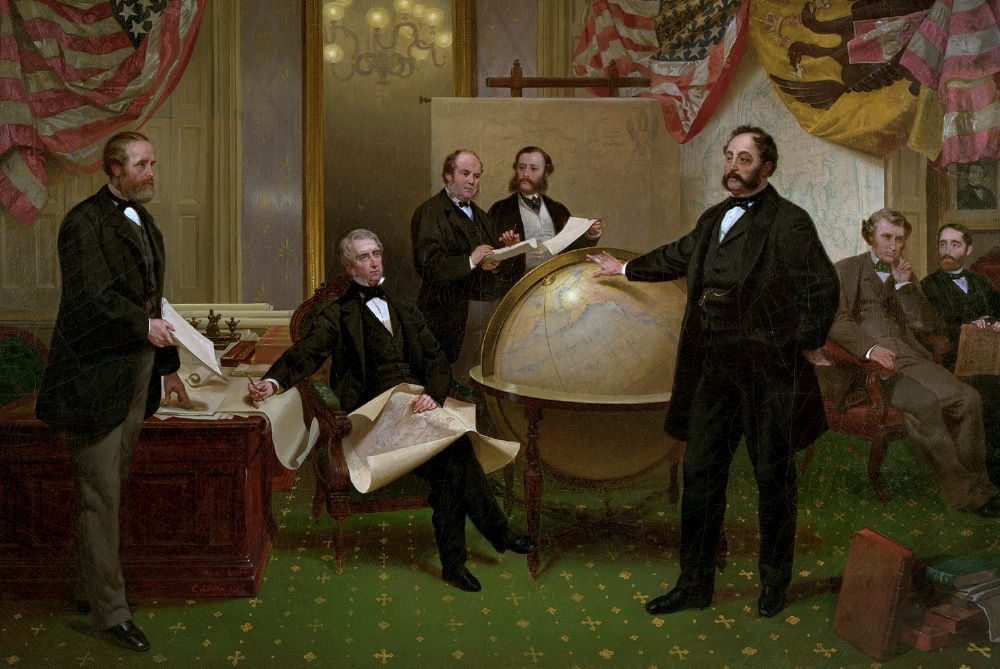
At a Glance
- The negotiators
- U.S. Secretary of State William H. Seward and Russian minister Eduard de Stoeckl
- The treaty
- Signed in Washington in the small hours of 30 March 1867, after an all-night final negotiation
- The price
- $7.2 million for some 586,000 square miles — about two cents an acre
- The transfer
- 18 October 1867 at Sitka, then called New Archangel, capital of Russian America; the date is still Alaska Day, a state holiday
- The mockery
- Critics dubbed the purchase 'Seward's Folly' and Alaska 'Johnson's polar bear garden'
- The vindication
- Gold in the 1890s, then oil at Prudhoe Bay in 1968 — the largest oil field in North America; statehood followed in 1959
Events on this day
- 1009The Fatimid caliph al-Hakim has Jerusalem's Church of the Holy Sepulchre, Christianity's holiest shrine, destroyed down to its foundations.
- 1685Louis XIV revokes the Edict of Nantes, stripping France's Protestants of their religious freedoms and driving tens of thousands of Huguenots into exile.
- 1851Herman Melville's Moby-Dick is published in London under the title The Whale; the American edition follows a month later.
- 1867The United States formally takes possession of Alaska at Sitka, completing the $7.2 million purchase from Russia — the featured story above.
- 1898The United States takes formal possession of Puerto Rico from Spain at the end of the Spanish-American War.
- 1922The British Broadcasting Company — the future BBC — is founded in London by a consortium of radio manufacturers.
- 1954Texas Instruments announces the Regency TR-1, the first mass-produced transistor radio.
- 1963Félicette, a Parisian stray cat, becomes the first and only cat in space, surviving her French suborbital flight.
- 1967The Soviet probe Venera 4 enters the atmosphere of Venus, returning the first direct measurements from another planet's air.
- 1968At the Mexico City Olympics, Bob Beamon long-jumps 8.90 metres, smashing the world record by an almost unbelievable 55 centimetres.
- 1988The sitcom Roseanne premieres on ABC, bringing an unglamorous working-class family to the centre of American television.
- 2007Former prime minister Benazir Bhutto returns to Pakistan after eight years of exile; bombers strike her Karachi motorcade that night, killing scores, two months before her assassination.
- 2019NASA astronauts Christina Koch and Jessica Meir perform the first all-woman spacewalk, replacing a power unit outside the International Space Station.
Born on this day
- 1919Pierre Trudeau — Canadian lawyer and politician who led Canada for fifteen years as prime minister.
- 1926Chuck Berry — American guitarist and songwriter whose riffs and lyrics founded rock and roll.
- 1939Lee Harvey Oswald — the warehouse worker who assassinated President John F. Kennedy in 1963.
- 1960Jean-Claude Van Damme — Belgian martial artist and action-film star.
- 1956Martina Navratilova — Czech-American tennis champion, winner of 59 Grand Slam titles across singles and doubles.
Died on this day
- 1931Thomas Edison — American inventor of the phonograph and the practical light bulb, holder of more than a thousand patents.
- 1973Leo Strauss — German-American political philosopher whose writings shaped a school of American conservatism.
- 1978Ramón Mercader — Spanish communist agent who murdered Leon Trotsky with an ice axe in Mexico City in 1940.
The featured story: Alaska is transferred to the United States, 18 October 1867
Russia's American empire had always been a fur trade stretched too thin. After defeat in the Crimean War, St Petersburg concluded that Alaska — indefensible against Britain, unprofitable for the Russian-American Company — was worth more sold to the United States than lost for nothing. Secretary of State William Seward, an expansionist who dreamed of an American Pacific, needed little persuading. When the Russian minister Eduard de Stoeckl received his final authorisation in March 1867, the two men settled the treaty in a single all-night session, signing at about four in the morning on 30 March: $7.2 million for roughly 586,000 square miles of territory, at about two cents an acre.
The Senate consented in April — Charles Sumner's three-hour speech in favour, marshalling the geography and resources of the north, became famous — and the treaty was proclaimed in June. What remained was the handover itself. At Sitka, the little capital of Russian America perched on the Pacific edge of the territory, the ceremony took place on 18 October 1867: Russian troops lowered the imperial flag — it snagged on the flagpole on the way down, by long local tradition — and American soldiers under General Jefferson C. Davis raised the Stars and Stripes over Castle Hill, with a salute of cannon. Most of Sitka's Russian residents soon sailed home; the Tlingit people, on whose land the ceremony took place and who had never sold it, were not consulted at all.
Payment lagged behind possession: Congress, distracted by the impeachment of President Andrew Johnson, did not appropriate the money until the summer of 1868, and the Treasury's cheque for $7.2 million — preserved today in the National Archives — is dated 1 August 1868, nearly a year after the transfer. In the meantime the purchase was widely ridiculed as 'Seward's Folly': a frozen wasteland, 'Johnson's polar bear garden', bought sight unseen.
The folly aged well. Alaska yielded furs, then salmon, then gold in the Klondike era, then strategic value in the Second World War and the Cold War, and in 1968 the largest oil field in North America at Prudhoe Bay. It entered the Union as the 49th state in 1959, and 18 October is kept as Alaska Day — though the fuller history now told includes the Alaska Native peoples whose lands were transferred between two empires without their consent, a wrong partly addressed only in the Alaska Native Claims Settlement Act of 1971.
Why this date matters
October 18 is a day for changing flags and changing hands. Alaska passes between empires with a salute of guns; Puerto Rico follows thirty-one years later; the Church of the Holy Sepulchre is levelled and the rights of France's Protestants revoked — possession and dispossession in the same square of the calendar. The gentler entries rhyme: a great whale of a novel is launched to indifference, a broadcasting company and a transistor radio begin the century of portable voices, a cat goes to space, and two women walk outside a space station together for the first time. Territory, on this date, is always being redefined.
Sources
- Encyclopaedia Britannica — On This Day: October 18
- National Archives — Original Alaska Purchase Documents (Pieces of History)
- State of Alaska — Alaska Day proclamation
- Wikimedia — On This Day feed: October 18
The facts on this page were checked against these sources on 19 November 2026. The History Trail's permanent pages are researched and written for this site; the live profiles elsewhere on The History Trail are assembled automatically from Wikipedia and Wikidata.
About the Author
Researched and written by the The History Trail Editorial Team — the accountable editorial function behind this site's permanent story pages. The team works from the published sources cited on each page; it does not invent historians, reviewers or credentials, and it corrects errors openly.
Fact Check
Every load-bearing fact on this page traces to one of the sources listed above, and significant claims link to their source in the text. Our checking method is described on the methodology page; errors can be reported via the corrections page.
Sources & Citations
Cite this page as: The History Trail Editorial Team, The History Trail — this article's title, publication and update dates are shown beneath its headline. The full source list appears under Sources above; the site's source standards are on the sources page.