
On This Day
October 17 in History
On 17 October 1777 British general John Burgoyne surrendered his entire army — some 5,000 to 6,000 men — to the American general Horatio Gates at Saratoga, New York: the first time a British field army had ever laid down its arms, and the victory that persuaded France to join the American Revolution. October 17 is also the day Mother Teresa won the Nobel Peace Prize, Einstein arrived in America, and the Loma Prieta earthquake struck California.
Choose another date: open the On This Day calendar to browse events, births and deaths for any day of the year.
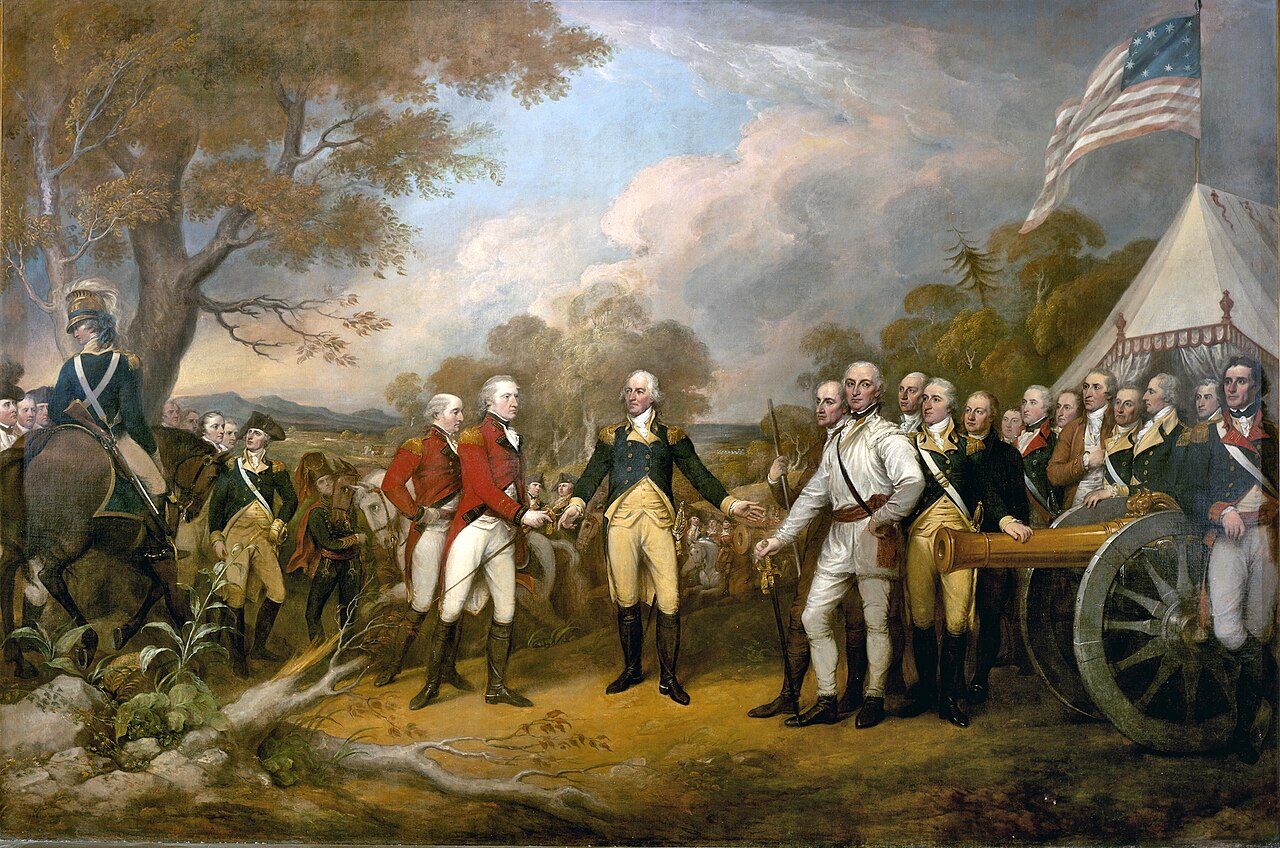
At a Glance
- The plan
- Britain's 1777 strategy: Burgoyne would march south from Canada down the Hudson to sever New England from the other colonies
- The battles
- Saratoga, 19 September and 7 October 1777 — American forces blocked and then mauled Burgoyne's advance
- The surrender
- 17 October 1777 at Saratoga (now Schuylerville), New York; the British marched out and grounded their arms at 10 a.m.
- The terms
- The 'Convention of Saratoga' promised the army passage to Britain on condition it not serve again in North America — terms Congress later refused to honour in full
- The consequence
- France, convinced the Americans could win, signed treaties of alliance and commerce with the United States in February 1778
- The verdict of history
- The National Park Service calls Saratoga the turning point of the American Revolution
Events on this day
- 1777General John Burgoyne surrenders his British army to Horatio Gates at Saratoga, New York — the featured story above.
- 1814The London Beer Flood: a vast vat at the Meux brewery in St Giles bursts, sending a wave of porter through the slum streets and killing eight people.
- 1854French and British forces begin the siege of Sevastopol, the great Russian naval base of the Crimean War.
- 1860The first Open Championship of golf is played at Prestwick in Scotland, with eight professionals competing.
- 1907Marconi opens the first commercial transatlantic wireless service, between Ireland and Nova Scotia.
- 1912Serbia and Greece declare war on the Ottoman Empire, joining Montenegro in the First Balkan War.
- 1931A Chicago jury convicts Al Capone of tax evasion — the charge that finally brings down America's most famous gangster.
- 1933Albert Einstein arrives in the United States, a refugee from Nazi Germany, to take up his post at Princeton; he never returns to Europe.
- 1945Mass demonstrations in Buenos Aires force the release of the detained colonel Juan Perón — 'Loyalty Day', the founding moment of Peronism.
- 1956Queen Elizabeth II opens Calder Hall in Cumbria, the world's first commercial-scale nuclear power station.
- 1973Arab members of OPEC announce an oil embargo against countries supporting Israel in the Yom Kippur War, triggering the 1970s energy crisis.
- 1979Mother Teresa is named the winner of the Nobel Peace Prize for her work among the poorest of Calcutta.
- 1989The Loma Prieta earthquake, magnitude 6.9, strikes the San Francisco Bay Area during the World Series, killing 63 people.
- 2018Canada legalises the recreational use of cannabis, the first major industrialised country to do so nationwide.
Born on this day
- 1817Syed Ahmad Khan — Indian Muslim educator and reformer who founded the institution that became Aligarh Muslim University.
- 1912John Paul I — Italian pope whose reign in 1978 lasted only 33 days.
- 1915Arthur Miller — American playwright of Death of a Salesman and The Crucible.
- 1918Rita Hayworth — American dancer and actress, the wartime pin-up star of Gilda.
- 1938Evel Knievel — American motorcycle daredevil whose televised jumps made him a 1970s folk hero.
- 1956Mae Jemison — American physician and astronaut, the first African American woman in space.
- 1972Eminem — American rapper, born Marshall Mathers, among the best-selling music artists of all time.
Died on this day
- 1586Philip Sidney — English courtier, poet and soldier, dead of wounds received fighting the Spanish at Zutphen.
- 1849Frédéric Chopin — Polish composer and pianist, dead in Paris at 39 after years of tuberculosis.
- 1967Puyi — the last emperor of China, who ascended the throne at two, abdicated at six, and died a gardener and citizen of the People's Republic.
- 1979S. J. Perelman — American humorist and screenwriter, the Marx Brothers' writer and The New Yorker's wittiest byline.
The featured story: Burgoyne surrenders at Saratoga, 17 October 1777
The British plan for 1777 was elegant: three forces would converge on Albany, New York, and cut rebellious New England off from the colonies to the south. Only one of them arrived. General John Burgoyne — 'Gentleman Johnny', a playwright as well as a soldier — marched south from Canada with some 7,000 British and German troops, recaptured Fort Ticonderoga, and then ground slowly through wilderness roads that American axemen felled trees across faster than his men could clear them. Supplies thinned, a foraging expedition was destroyed at Bennington, and the expected columns from New York and the Mohawk Valley never came.
Twice the armies met at Saratoga, on 19 September and again on 7 October 1777. The second battle broke Burgoyne: Benedict Arnold, officially relieved of command, rode into the fighting anyway and led the assault that carried the German redoubt before falling wounded. Burgoyne retreated eight miles north to Saratoga village — modern Schuylerville — where Horatio Gates's army, swollen to perhaps 20,000 men, surrounded him on the heights. Starving, outnumbered roughly three to one, with no hope of relief, Burgoyne opened negotiations on 13 October.
The terms, styled the Convention of Saratoga, were generous: the army would march out with the honours of war and receive free passage to Britain, on condition it did not serve again in North America. At ten o'clock on the morning of 17 October the British marched out in formation, bands playing, and grounded their arms — the first time in history that a British army had surrendered in the field. Gates, in the courtesy Trumbull's great Rotunda painting preserves, returned Burgoyne's proffered sword. Congress, suspicious the troops would simply be exchanged and reused, later repudiated the embarkation, and the 'Convention Army' spent years as prisoners on the move through Virginia and beyond.
The surrender's real battlefield was Paris. News of Saratoga reached France in December, and Benjamin Franklin, who had been politely stalled for a year, suddenly found a government ready to sign: treaties of commerce and alliance followed on 6 February 1778, bringing French money, troops and — decisively — sea power into the war. Spain and the Netherlands followed against Britain. The National Park Service's verdict is the standard one: Saratoga was the turning point of the American Revolution, the victory that made all the later ones, Yorktown included, possible.
Why this date matters
October 17 is a day of surrenders and arrivals. A British army grounds its arms in upstate New York and a revolution becomes winnable; a century and a half later the world's most famous physicist arrives on an American dock, fleeing the regime that would have destroyed him; a gangster's empire ends not in a shoot-out but in a tax court. Even its disasters have the same shape of forces giving way — a brewery vat, a fault line under a baseball stadium. The date rewards those who read the moment and yield or move in time, and punishes those, like Burgoyne, who march on after the campaign is lost.
Sources
- Encyclopaedia Britannica — On This Day: October 17
- HISTORY — What Happened on October 17
- National Park Service — Saratoga: Tour Stop 10, Return to Saratoga
- Wikimedia — On This Day feed: October 17
The facts on this page were checked against these sources on 19 November 2026. The History Trail's permanent pages are researched and written for this site; the live profiles elsewhere on The History Trail are assembled automatically from Wikipedia and Wikidata.
About the Author
Researched and written by the The History Trail Editorial Team — the accountable editorial function behind this site's permanent story pages. The team works from the published sources cited on each page; it does not invent historians, reviewers or credentials, and it corrects errors openly.
Fact Check
Every load-bearing fact on this page traces to one of the sources listed above, and significant claims link to their source in the text. Our checking method is described on the methodology page; errors can be reported via the corrections page.
Sources & Citations
Cite this page as: The History Trail Editorial Team, The History Trail — this article's title, publication and update dates are shown beneath its headline. The full source list appears under Sources above; the site's source standards are on the sources page.