
On This Day
May 11 in History
On 11 May 1960, Israeli intelligence agents seized Adolf Eichmann — the SS officer who had organised the deportation of Europe's Jews to the death camps — outside his home in a Buenos Aires suburb, ending one of history's most consequential manhunts. May 11 is also the day Spencer Perceval was assassinated in Parliament, Deep Blue beat Garry Kasparov at chess, and Bob Marley died.
Choose another date: open the On This Day calendar to browse events, births and deaths for any day of the year.
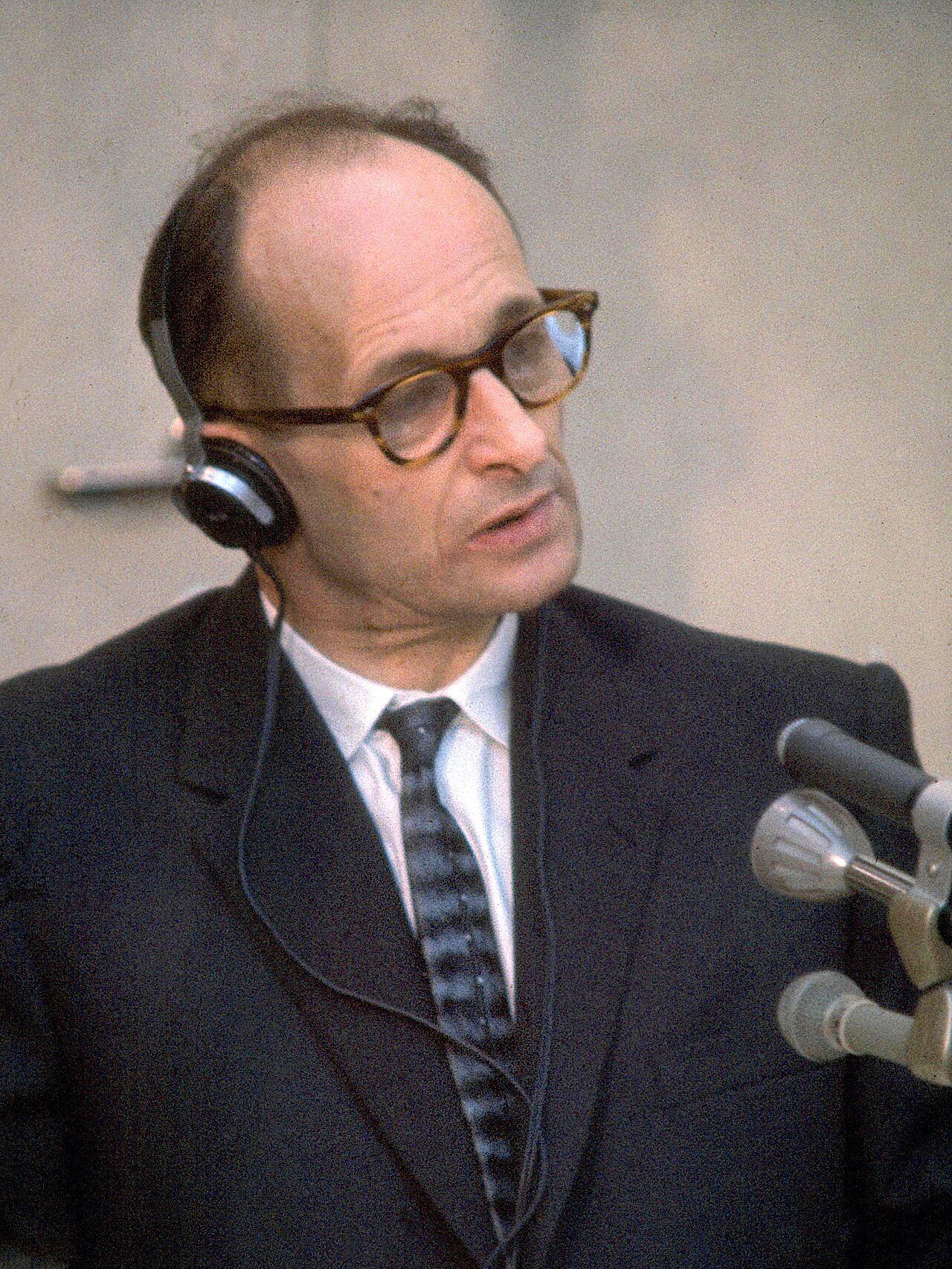
At a Glance
- The fugitive
- Adolf Eichmann, SS-Obersturmbannführer, head of the Gestapo's Jewish affairs office, living in Argentina as 'Ricardo Klement'
- The capture
- 11 May 1960 — Mossad agents seize Eichmann as he walks home from a bus stop on Garibaldi Street, Buenos Aires
- The tip-off
- Lothar Hermann, a blind Jewish refugee and Dachau survivor, and his daughter Sylvia identified Eichmann and alerted prosecutor Fritz Bauer
- The removal
- Flown to Israel on 20 May 1960, sedated and disguised as an airline crew member aboard an El Al aircraft
- The trial
- Jerusalem, April–December 1961: convicted on 15 counts including crimes against humanity, in proceedings televised worldwide
- The sentence
- Hanged on 1 June 1962 — the only civil execution carried out in the State of Israel
Events on this day
- 330Constantinople is formally inaugurated as the new capital of the Roman Empire, the city Constantine built on the site of Byzantium.
- 1812British prime minister Spencer Perceval is shot dead in the lobby of the House of Commons by John Bellingham — the only British premier ever assassinated.
- 1846President James K. Polk asks the U.S. Congress to declare war on Mexico, claiming American blood has been shed on American soil.
- 1910Glacier National Park is established in Montana, preserving a million acres of Rocky Mountain peaks, lakes and glaciers.
- 1943American troops land on Attu in the Aleutian Islands, beginning the only battle of the Second World War fought on incorporated American soil.
- 1949Siam officially resumes the name Thailand, four years after the wartime change back to Siam is reversed.
- 1960Israeli agents capture Nazi war criminal Adolf Eichmann in Buenos Aires, Argentina — the featured story above.
- 1997IBM's Deep Blue defeats world chess champion Garry Kasparov in a six-game match in New York, the first computer victory over a reigning champion under tournament conditions.
- 2010David Cameron becomes British prime minister at 43, ending thirteen years of Labour government, after Gordon Brown resigns.
- 2022Palestinian American journalist Shireen Abu Akleh is killed while reporting on an Israeli military raid in the West Bank city of Jenin.
Born on this day
- 1811Chang and Eng Bunker — Siamese conjoined twins whose touring career made 'Siamese twins' the common term for their condition.
- 1888Irving Berlin — Russian-born American songwriter of 'White Christmas', 'God Bless America' and hundreds of standards.
- 1904Salvador Dalí — Spanish Surrealist painter of melting clocks and dream landscapes, modern art's great showman.
- 1918Richard Feynman — American physicist, Nobel laureate and legendary lecturer who helped develop the atomic bomb and quantum electrodynamics.
- 1927Mort Sahl — American comedian whose topical monologues invented modern stand-up satire.
- 1933Louis Farrakhan — American religious leader who has headed the Nation of Islam since the late 1970s.
- 1963Natasha Richardson — English actress of stage and screen, from a celebrated theatrical family.
Died on this day
- 1778William Pitt the Elder — British statesman who led Britain to victory in the Seven Years' War as its dominant minister.
- 1812Spencer Perceval — prime minister of the United Kingdom, assassinated in the House of Commons at 49.
- 1960John D. Rockefeller Jr. — American philanthropist who built Rockefeller Center and restored colonial Williamsburg.
- 1976Alvar Aalto — Finnish architect and designer, a founding figure of modern Scandinavian design.
- 1981Bob Marley — Jamaican singer who carried reggae to the world, dead of cancer in Miami at 36.
- 2001Douglas Adams — English author of The Hitchhiker's Guide to the Galaxy, dead suddenly at 49.
The featured story: Adolf Eichmann is captured in Buenos Aires, 11 May 1960
On the evening of 11 May 1960, a man who called himself Ricardo Klement got off a bus in a working-class suburb of Buenos Aires and walked toward the house he had built on Garibaldi Street. Waiting for him in the shadows were agents of Mossad, Israel's intelligence service. They seized him, bundled him into a car, and held him in a safe house for nine days while he confirmed what they already believed: Klement was Adolf Eichmann, the SS officer who had organised the deportation of Europe's Jews to the death camps, and one of the most wanted Nazi fugitives in the world.
Eichmann had been the logistical manager of the Holocaust. From his desk in the Reich Security Main Office he scheduled the trains, set the quotas and chaired the paperwork of mass murder, and he had helped plan the extermination programme discussed at the Wannsee Conference in 1942. Captured by American forces at the end of the war, he escaped custody, hid in Germany under an alias, and in 1950 fled along a ratline to Argentina, where the government of Juan Perón sheltered former Nazis. There he worked in a Mercedes-Benz factory and lived openly enough that his son dated a young woman whose father, Lothar Hermann, was a blind Jewish refugee who had himself survived Dachau.
It was Hermann and his daughter Sylvia who set the hunt in motion. Suspicious of the Eichmann name in the household their daughter was visiting, the Hermanns passed word to the German prosecutor Fritz Bauer, who — distrusting his own country's authorities — quietly alerted Israel. Mossad surveillance confirmed the identification, and a team led by Peter Malkin rehearsed the snatch on the street where Eichmann's bus stopped each evening. On 20 May he was flown out of Argentina disguised as an airline crew member, sedated and carrying a forged passport, aboard an El Al plane that had brought an Israeli delegation to Argentina's independence celebrations.
The capture caused a diplomatic storm — Argentina protested to the United Nations at the violation of its sovereignty — but its consequence was the trial that opened in Jerusalem in April 1961. Conducted before television cameras and built around the testimony of more than a hundred survivors, the trial confronted a global audience with the Holocaust in the victims' own voices. Eichmann was convicted on fifteen counts, including crimes against humanity and war crimes, and hanged on 1 June 1962 — the only civil execution ever carried out in Israel. The man who had hidden behind paperwork died insisting he had only obeyed orders, a defence the court, and history, rejected.
Why this date matters
May 11 is a date about accountability arriving late but arriving. A prime minister is shot in Parliament in 1812 and the assassin is hanged within the week; a century and a half later, the bureaucrat of the Holocaust is pulled off a Buenos Aires street and made to answer, name by name and train by train, before the survivors themselves. The day also looks forward: a computer beats the world chess champion on it in 1997, the first clear sign that machines would master games long thought to need human intuition. Justice and machinery — May 11 keeps its accounts in both currencies.
Sources
- Encyclopaedia Britannica — On This Day: May 11
- HISTORY — What Happened on May 11
- Encyclopaedia Britannica — Adolf Eichmann, Argentina, Holocaust & Capture
- Encyclopaedia Britannica — Adolf Eichmann
The facts on this page were checked against these sources on 19 November 2026. The History Trail's permanent pages are researched and written for this site; the live profiles elsewhere on The History Trail are assembled automatically from Wikipedia and Wikidata.
About the Author
Researched and written by the The History Trail Editorial Team — the accountable editorial function behind this site's permanent story pages. The team works from the published sources cited on each page; it does not invent historians, reviewers or credentials, and it corrects errors openly.
Fact Check
Every load-bearing fact on this page traces to one of the sources listed above, and significant claims link to their source in the text. Our checking method is described on the methodology page; errors can be reported via the corrections page.
Sources & Citations
Cite this page as: The History Trail Editorial Team, The History Trail — this article's title, publication and update dates are shown beneath its headline. The full source list appears under Sources above; the site's source standards are on the sources page.