
On This Day
March 17 in History
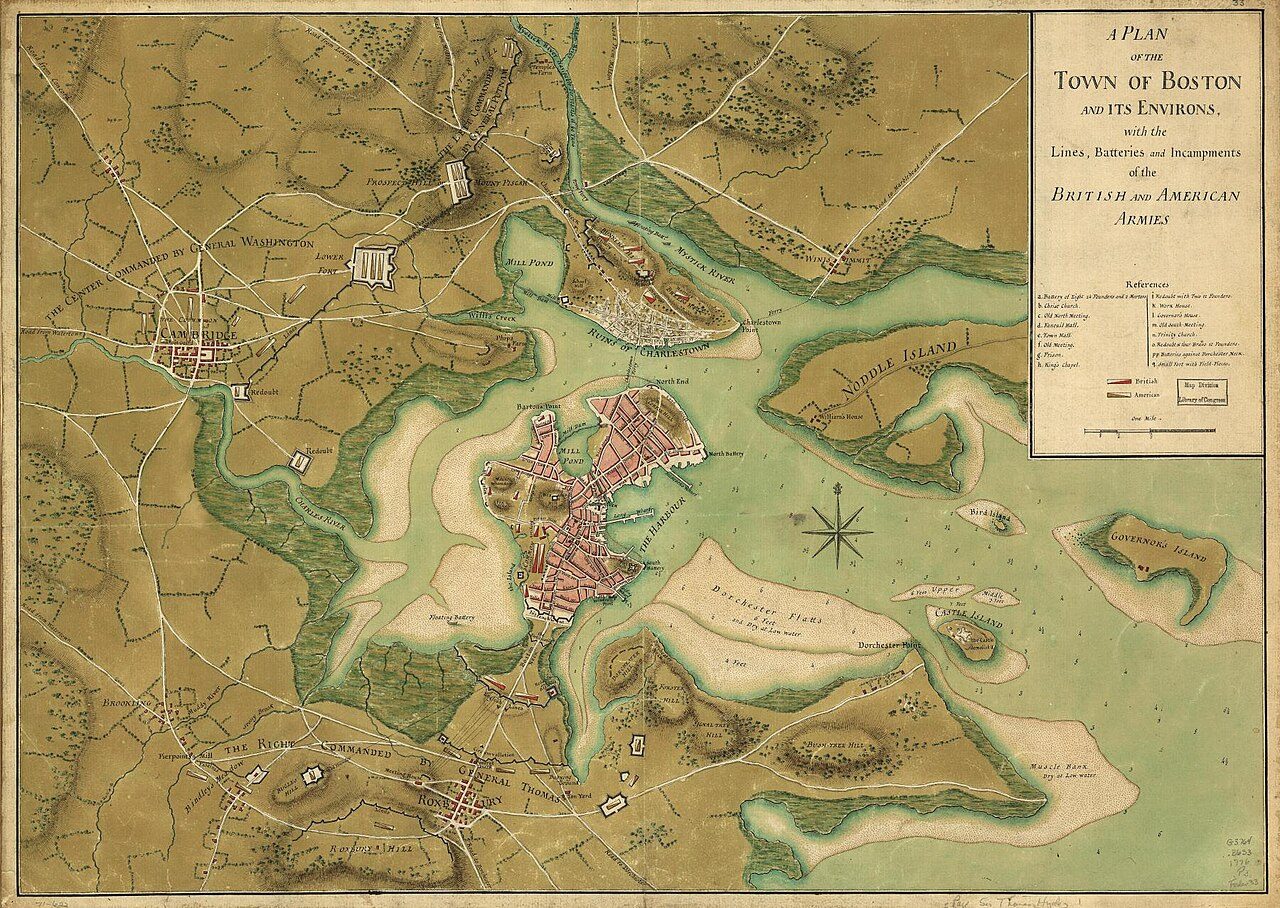
On 17 March 1776, after an eleven-month siege, British forces sailed out of Boston for good — driven from the town by cannon hauled from Fort Ticonderoga and emplaced in a single night on Dorchester Heights. It was the first great success of George Washington's army. March 17 is also St Patrick's Day, kept since the saint's death on this date in 461, and the day South Africa's white voters chose to end apartheid in 1992.
Choose another date: open the On This Day calendar to browse events, births and deaths for any day of the year.
At a Glance
- The siege
- Boston had been besieged since April 1775, following the fighting at Lexington and Concord
- The guns
- Colonel Henry Knox hauled captured artillery from Fort Ticonderoga across winter New England to Washington's army
- The night
- On the night of 4 March 1776 more than 1,200 soldiers, with some 300 oxcarts, fortified Dorchester Heights (National Park Service)
- Howe's reaction
- The British commander is reported to have said the rebels had done more in a night than his army could do in months
- The storm
- A planned British counter-attack was scattered by a storm, leaving evacuation as the only option
- Evacuation day
- 17 March 1776 — the British fleet sailed for Halifax, taking more than a thousand colonial Loyalists with it (National Park Service)
Events on this day
- 1776British forces evacuate Boston after Washington fortifies Dorchester Heights — the featured story above.
- 1805The Italian Republic, Napoleon's client state, is refounded as the Kingdom of Italy, with Napoleon as its king.
- 1861The Kingdom of Italy is formally proclaimed, uniting most of the peninsula under Victor Emmanuel II.
- 1905Franklin D. Roosevelt marries Eleanor Roosevelt in New York, with President Theodore Roosevelt giving away his niece.
- 1941The National Gallery of Art opens in Washington, D.C., dedicated by President Franklin D. Roosevelt before some 6,000 guests.
- 1948Britain, France and the Benelux countries sign the Treaty of Brussels, a mutual-defence pact that lays groundwork for NATO.
- 1950Scientists at Berkeley announce the creation of element 98, named californium after its home state.
- 1959The Dalai Lama flees Tibet for India as Chinese forces crush the Lhasa uprising.
- 1969Golda Meir becomes prime minister of Israel, the country's first woman to hold the office.
- 1973At Travis Air Force Base in California, photographer Slava Veder captures 'Burst of Joy', the era's defining homecoming photograph of a released American POW.
- 1992In a referendum, white South Africans vote by 68.7 percent to end apartheid and negotiate a democratic constitution.
Born on this day
- 1777Patrick Brontë — Irish clergyman, father of the novelist sisters Charlotte, Emily and Anne Brontë.
- 1804Jim Bridger — American mountain man, trapper and scout of the frontier West.
- 1919Nat King Cole — American singer and jazz pianist whose voice defined a generation of popular song.
- 1938Rudolf Nureyev — Soviet-born ballet dancer, born on a Trans-Siberian train, who defected to the West in 1961.
Died on this day
- 180Marcus Aurelius — Roman emperor and Stoic philosopher, author of the Meditations.
- 461St Patrick — missionary and patron saint of Ireland, dead at Saul; his feast day is kept worldwide on this date.
- 1782Daniel Bernoulli — Swiss mathematician whose principle, set out in his Hydrodynamica, explains the behaviour of moving fluids.
- 1957Ramon Magsaysay — president of the Philippines, killed in a plane crash while in office.
The featured story: the British evacuate Boston, 17 March 1776
Boston had been a garrison town under siege for eleven months. Since the fighting at Lexington and Concord in April 1775, American militia had bottled up the British army inside the town, but George Washington, who took command of the Continental Army that summer, lacked the artillery to drive the redcoats out — and General William Howe, commanding the British, lacked the will to storm the American lines. The stalemate broke in the winter, when Colonel Henry Knox hauled a train of captured cannon from Fort Ticonderoga, hundreds of miles over frozen New England, and delivered them to Washington's army.
Washington chose his ground: Dorchester Heights, the hills south of Boston that overlooked both the town and its harbour. On the night of 4 March 1776, under cover of darkness and a covering bombardment, the position was fortified in a single night. The National Park Service describes the scale of the work — more than 1,200 soldiers under General John Thomas and Colonel Richard Gridley, with some 300 oxcarts hauling earth, timber and pre-built defences up the heights. Howe, waking to find a fortress where none had stood at dusk, is said to have marvelled that the rebels had done more in one night than his army could do in months.
Howe prepared a counter-attack, but the weather intervened: a storm scattered the British assault force and made the attempt impossible. With Knox's Ticonderoga guns now commanding the harbour, the British position was untenable. Howe chose evacuation over a second Bunker Hill. On 17 March 1776 the British army embarked for Halifax, Nova Scotia, and the fleet sailed out of Boston — taking with it more than a thousand colonial Loyalists who feared, rightly, to remain in the town their protectors were abandoning.
It was the first great success of Washington's career: an enemy army expelled from an American city without a pitched battle, by engineering, logistics and patience. Boston was never again occupied by the British, and the town — now the city — still marks 17 March as Evacuation Day. The victory also freed Washington to move south to defend New York, where a far harder campaign awaited; but in March 1776, for the first time, the rebellion had something it had never had before: a triumph that belonged to its commander-in-chief.
Why this date matters
March 17 is best known for a saint, but its deeper theme is departure and arrival. Patrick, kidnapped from Roman Britain as a boy of 16, returned to Ireland as a missionary and died there; the British sailed out of Boston in 1776 and a thousand Loyalists sailed with them into exile; the Dalai Lama crossed into India in 1959 to begin an exile that has never ended. Against those leavings stand the day's foundings — a kingdom of Italy proclaimed, a gallery of art opened, a woman taking power in Jerusalem. The date reminds us that history's doors swing both ways, often on the same hinge.
Sources
- Encyclopaedia Britannica — On This Day: March 17
- HISTORY — What Happened on March 17
- National Park Service — Dorchester Heights
- The Famous People — Famous Deaths on March 17
The facts on this page were checked against these sources on 19 November 2026. The History Trail's permanent pages are researched and written for this site; the live profiles elsewhere on The History Trail are assembled automatically from Wikipedia and Wikidata.
About the Author
Researched and written by the The History Trail Editorial Team — the accountable editorial function behind this site's permanent story pages. The team works from the published sources cited on each page; it does not invent historians, reviewers or credentials, and it corrects errors openly.
Fact Check
Every load-bearing fact on this page traces to one of the sources listed above, and significant claims link to their source in the text. Our checking method is described on the methodology page; errors can be reported via the corrections page.
Sources & Citations
Cite this page as: The History Trail Editorial Team, The History Trail — this article's title, publication and update dates are shown beneath its headline. The full source list appears under Sources above; the site's source standards are on the sources page.