
On This Day
March 12 in History
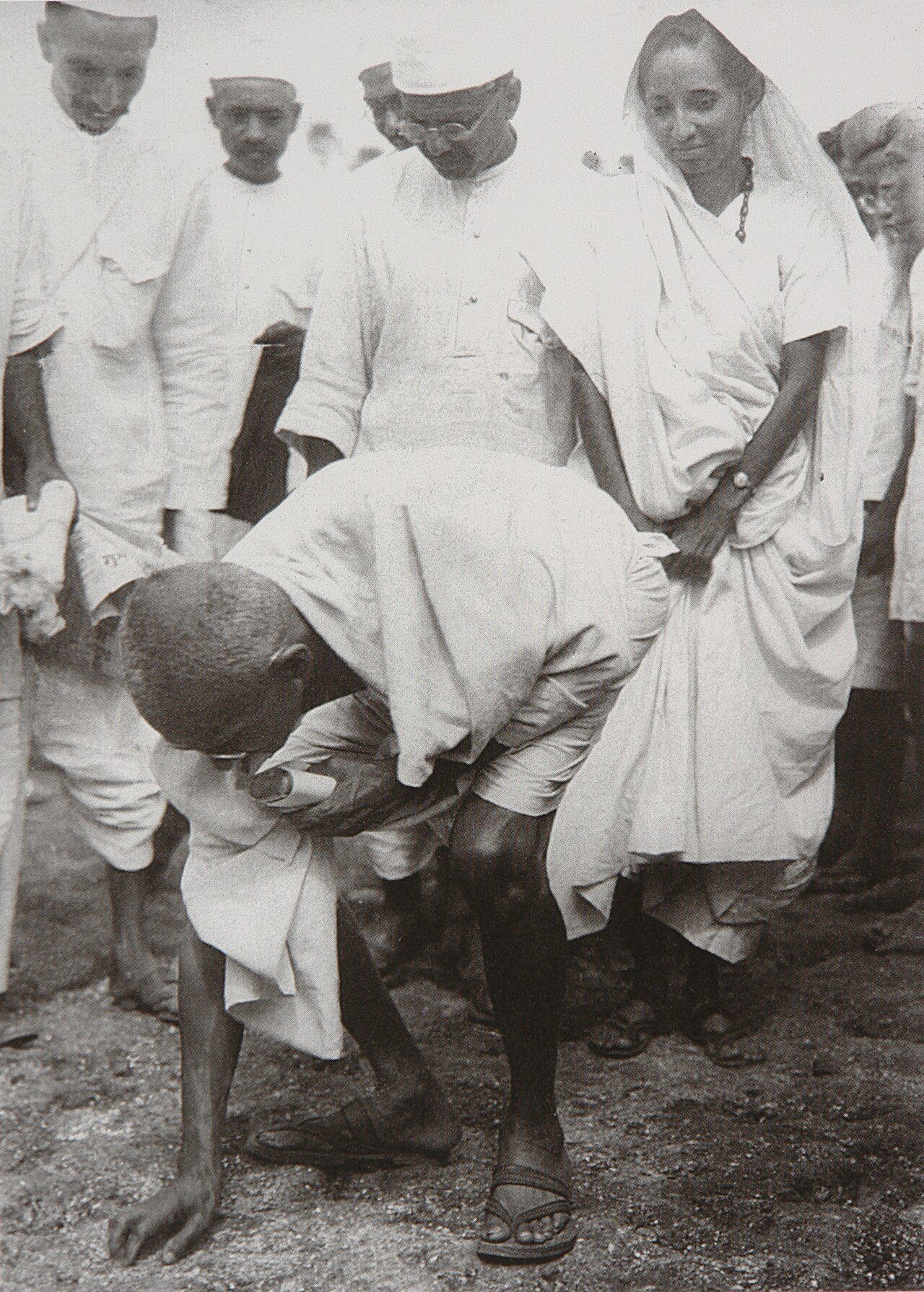
On 12 March 1930 Mohandas Gandhi walked out of his Sabarmati Ashram with 78 followers and started walking to the sea. The Salt March — some 240 miles to make a handful of illegal salt — became the defining act of defiance against British rule in India. March 12 is also the day the Truman Doctrine was proclaimed in 1947 and the first Girl Guide troop in America was formed in 1912.
Choose another date: open the On This Day calendar to browse events, births and deaths for any day of the year.
At a Glance
- Start
- 12 March 1930, from Sabarmati Ashram near Ahmadabad, Gujarat
- The party
- Gandhi set out with 78 followers; crowds swelled as the march passed through the villages of Gujarat
- Distance
- Some 240 miles (385 km) to the coastal town of Dandi on the Arabian Sea
- Arrival
- Reached Dandi on 5 April; on the morning of 6 April Gandhi picked up natural salt from the shore, breaking the salt laws
- The law
- British salt laws made it illegal for Indians to collect or sell salt, forcing them to buy it heavily taxed
- The cost to the Raj
- By the end of 1930 about 60,000 people had been imprisoned in the civil disobedience campaign the march ignited
Events on this day
- 1804Samuel Chase is impeached by the U.S. House of Representatives, becoming the first Supreme Court justice to face impeachment; he is later acquitted by the Senate.
- 1849The Sikh army surrenders at the end of the Second Anglo-Sikh War, and Britain annexes the Punjab.
- 1912Juliette Gordon Low forms the first American Girl Guides troop in Savannah, Georgia — the beginning of the Girl Scouts of the USA.
- 1930Gandhi sets out from Sabarmati Ashram on the Salt March to Dandi, defying Britain's salt laws — the featured story above.
- 1933President Franklin D. Roosevelt delivers his first 'fireside chat', speaking directly to Americans by radio about the banking crisis.
- 1938German troops march into Austria, beginning the Anschluss that absorbs the country into Nazi Germany.
- 1940Finland accepts Soviet peace terms ending the Winter War, ceding western Karelia and a naval base at Hanko.
- 1947President Harry S. Truman proclaims the Truman Doctrine, pledging American support to peoples resisting subjugation — the founding statement of Cold War containment.
- 1993Janet Reno is sworn in as U.S. attorney general, the first woman to hold the office.
- 1999Poland, Hungary and the Czech Republic join NATO, the alliance's first expansion into the former Warsaw Pact.
- 2003The World Health Organization issues a global alert over SARS, the new respiratory disease spreading from Asia.
- 2009Financier Bernard Madoff pleads guilty to running the largest Ponzi scheme in history; he is later sentenced to 150 years in prison.
Born on this day
- 1613André Le Nôtre — French landscape architect who designed the gardens of Versailles for Louis XIV.
- 1824Gustav Kirchhoff — German physicist whose laws of electrical circuits and work on spectroscopy founded whole fields of physics.
- 1862Jane A. Delano — American nurse who founded the American Red Cross nursing service.
- 1863Gabriele D'Annunzio — Italian poet, playwright and flamboyant nationalist leader.
- 1925Leo Esaki — Japanese physicist, inventor of the tunnel diode and Nobel laureate.
- 1947Mitt Romney — American businessman and politician, governor of Massachusetts and United States senator.
- 1948James Taylor — American singer-songwriter and guitarist, a defining voice of 1970s popular music.
Died on this day
- 1999Yehudi Menuhin — American-born violinist, one of the leading virtuosos of the 20th century, dead in Berlin at 82.
- 2001Robert Ludlum — American author of bestselling thrillers, creator of Jason Bourne.
- 2015Michael Graves — American architect, a leading figure of postmodern design.
- 2015Terry Pratchett — English author of the Discworld comic fantasy novels, dead at 66 after living with Alzheimer's disease.
The featured story: Gandhi begins the Salt March, 12 March 1930
Of all the weapons Mohandas Gandhi might have chosen against the British Empire, he chose salt. Under British law, Indians were forbidden to collect or sell salt themselves; they had to buy it, heavily taxed, from the government's monopoly — a tax that fell hardest on the poorest people in India, for whom salt was a necessity of life and labour in a hot climate. In March 1930 Gandhi announced that he would break the law openly: he would walk to the sea and make salt from its water.
On the morning of 12 March 1930 he set out from his Sabarmati Ashram near Ahmadabad with 78 followers, dressed in his usual simple cloth, carrying a staff, and began walking south through the villages of Gujarat toward the coastal town of Dandi, some 240 miles away. The march was choreographed for maximum visibility. Crowds gathered in every village; journalists and newsreel cameras followed; and what had begun as a few dozen marchers became a procession that the whole world watched, day after day, for more than three weeks.
The entourage reached Dandi on 5 April. Early the next morning, 6 April, Gandhi walked down to the shore, bathed in the sea, and picked up a handful of natural salt left by the tide — technically producing salt, and so breaking the law in front of the world's press. Across India, millions followed his example, making and selling illegal salt; the civil disobedience campaign spread to tax refusal and boycotts of foreign cloth. When Gandhi announced a march on the Dharasana saltworks, he was arrested; on 21 May the poet Sarojini Naidu led 2,500 marchers there instead, and their silent endurance of police beatings was reported around the world. By the end of 1930, approximately 60,000 people had been imprisoned.
Gandhi was released in January 1931 and negotiated directly with the Viceroy, Lord Irwin — an extraordinary concession in itself. The Gandhi–Irwin Pact of 5 March 1931 ended the campaign: prisoners were released and Indians were permitted to make salt for their own use. The tax itself survived, and independence was still sixteen years away, but the Salt March had demonstrated something irreversible — that the empire could be defied by an unarmed crowd, in daylight, and made to look both cruel and absurd for stopping it.
Why this date matters
March 12 keeps staging confrontations between the powerless and the powerful — and recording how often the powerless win the argument. Gandhi's walkers faced an empire with nothing but salt; Truman, from the other side of power, redrew the world's alliances with a speech; three former Soviet satellites walked into NATO in 1999. It is also a day of institutions being born to serve ordinary people: the Girl Scouts in 1912, the fireside chat's direct line between president and public in 1933. The date's lesson is that legitimacy, once lost or won in public, is very hard to reverse.
Sources
- Encyclopaedia Britannica — On This Day: March 12
- HISTORY — What Happened on March 12
- Encyclopaedia Britannica — Salt March
- Encyclopaedia Britannica — Yehudi Menuhin
The facts on this page were checked against these sources on 19 November 2026. The History Trail's permanent pages are researched and written for this site; the live profiles elsewhere on The History Trail are assembled automatically from Wikipedia and Wikidata.
About the Author
Researched and written by the The History Trail Editorial Team — the accountable editorial function behind this site's permanent story pages. The team works from the published sources cited on each page; it does not invent historians, reviewers or credentials, and it corrects errors openly.
Fact Check
Every load-bearing fact on this page traces to one of the sources listed above, and significant claims link to their source in the text. Our checking method is described on the methodology page; errors can be reported via the corrections page.
Sources & Citations
Cite this page as: The History Trail Editorial Team, The History Trail — this article's title, publication and update dates are shown beneath its headline. The full source list appears under Sources above; the site's source standards are on the sources page.