
On This Day
March 15 in History
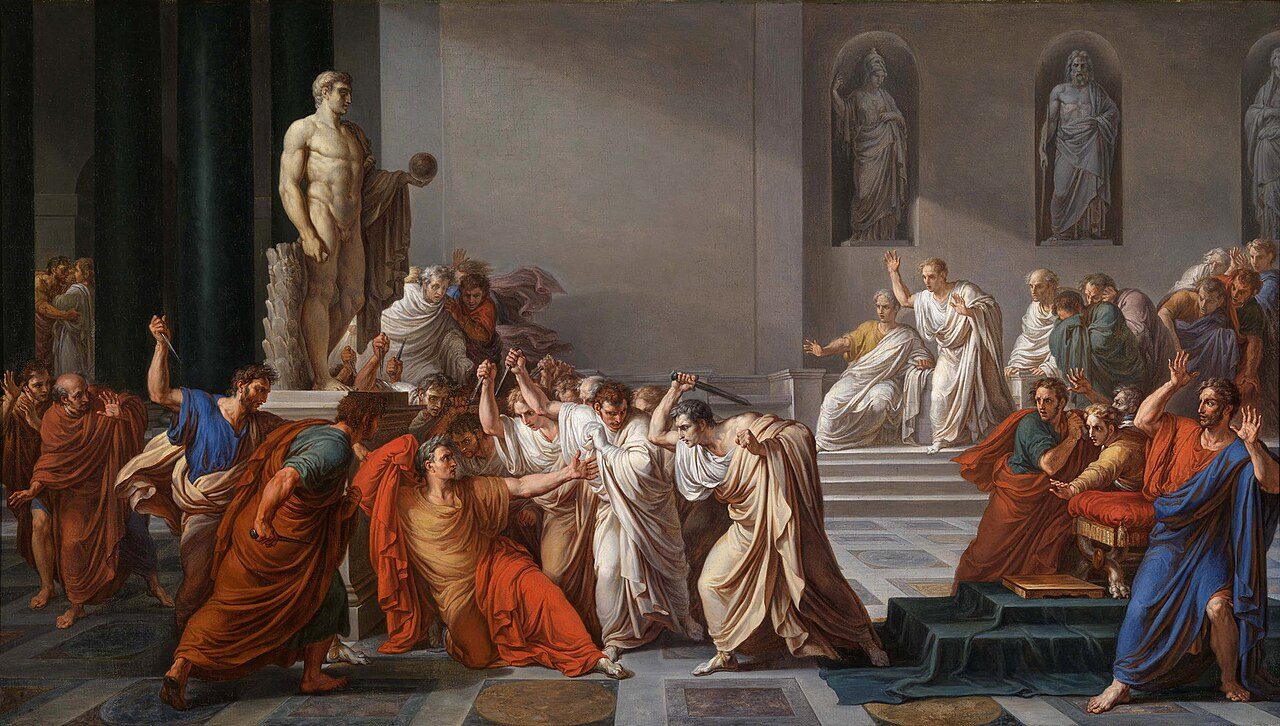
On 15 March 44 BC — the Ides of March — Julius Caesar walked into a meeting of the Roman Senate and was set upon by a conspiracy of senators, who stabbed him 23 times. The murder meant to save the Roman Republic instead destroyed it. March 15 is also the day Columbus returned from the Americas in 1493 and the first cricket Test match began in 1877.
Choose another date: open the On This Day calendar to browse events, births and deaths for any day of the year.
At a Glance
- Date
- 15 March 44 BC — the Ides of March in the Roman calendar
- Place
- The Curia of Pompey, part of the Theatre of Pompey complex in Rome
- The plot
- Led by Gaius Cassius Longinus and Marcus Junius Brutus; Suetonius counts more than sixty conspirators
- The wounds
- Caesar was stabbed 23 times; the physician who examined his body found only one wound fatal (Suetonius)
- Motive
- Fear that Caesar, made dictator for life, intended to make himself king
- Aftermath
- Far from restoring the Republic, the killing triggered civil wars that ended with Caesar's heir Octavian ruling as the emperor Augustus
Events on this day
- 44 BCJulius Caesar is assassinated by senators led by Brutus and Cassius on the Ides of March — the featured story above.
- 1493Christopher Columbus returns to Spain, completing his first voyage to the Americas.
- 1672Charles II of England issues a Declaration of Indulgence suspending the penal laws against Catholics and Protestant dissenters.
- 1783George Washington addresses his officers at Newburgh, New York, and talks them out of a threatened revolt against Congress — saving the young republic's civilian rule.
- 1877The first cricket Test match begins in Melbourne; Australia defeats England by 45 runs.
- 1906Rolls-Royce Limited is founded in Britain by Charles Rolls and Henry Royce.
- 1913Woodrow Wilson holds the first regular presidential press conference in Washington.
- 1940Nazi Germany decrees the requisition of church bells for the war effort; around 175,000 bells are taken down and melted during the war.
- 1965President Lyndon B. Johnson addresses Congress to demand voting rights for Black Americans, adopting the movement's own words: 'We shall overcome.'
- 1985Symbolics.com becomes the first registered internet domain name.
- 2011Antigovernment protests erupt across Syria, the beginning of an uprising that descends into civil war.
- 2019A gunman murders 51 worshippers at two mosques in Christchurch, New Zealand, livestreaming the attack.
Born on this day
- 1813John Snow — English physician who traced cholera to a single water pump, a founder of modern epidemiology.
- 1912Lightnin' Hopkins — American blues guitarist and singer from Texas, one of the form's great improvisers.
- 1933Ruth Bader Ginsburg — American jurist, the second woman to sit on the United States Supreme Court.
- 1975Eva Longoria — American actress, known worldwide for Desperate Housewives.
Died on this day
- 44 BCJulius Caesar — Roman dictator, assassinated by senators on the Ides of March — the featured story above.
- 1898Henry Bessemer — English engineer whose converter process transformed steelmaking and built the modern world.
- 2003Thora Hird — English actress, a fixture of British stage and television for more than half a century.
- 2014Clarissa Dickson Wright — English cook and broadcaster, one half of television's Two Fat Ladies.
The featured story: the assassination of Julius Caesar, 15 March 44 BC
By the spring of 44 BC, Julius Caesar had won everything Rome had to give. Victor in the civil wars, he had been made dictator for life — dictator perpetuo — loaded with honours, his statue placed among the gods, his portrait on the coinage. To a group of senators, it looked like monarchy returning to a republic that had expelled its kings five centuries earlier. More than sixty of them, led by Gaius Cassius Longinus and Marcus Junius Brutus — men Caesar had pardoned and promoted — formed a conspiracy to kill him, calling themselves the Liberators.
They chose the Ides of March, 15 March, when the Senate would meet in the Curia of Pompey, a hall attached to Pompey's great theatre. Suetonius, writing a century and a half later from the imperial archives, tells the scene in detail: as Caesar took his seat, the conspirators crowded round as if to pay their respects. Tillius Cimber seized his toga, pleading for his exiled brother; Caesar waved him off — and Casca struck the first blow, a glancing stab below the throat. Caesar caught his arm and fought, but the daggers came from every side. He was stabbed 23 times, and fell dead at the base of Pompey's own statue.
The Liberators had a plan for the murder and none for the morning after. They had expected Rome to rise in gratitude; instead the city froze in terror, then turned. At Caesar's funeral, Mark Antony displayed the bloody robe and the crowd rioted; Brutus and Cassius fled Italy. Within two years they were dead, defeated at Philippi by Antony and Caesar's great-nephew and heir, Octavian, and Rome was plunged into a fresh round of civil wars bloodier than the ones Caesar's victory had ended.
The assassination meant to save the Republic killed it. The wars that followed ended with Octavian supreme — renamed Augustus, the first emperor — and the republican constitution surviving only as a façade. What survived intact was the date itself: Shakespeare's Julius Caesar, with its soothsayer's warning to 'beware the Ides of March', fixed 15 March in the language forever as the archetype of the betrayal that destroys the thing it claims to defend.
Why this date matters
March 15 carries an unmatched double charge. It is the most famous assassination date in history — the day that taught the world that killing a tyrant and saving a republic are different things — and, in the modern calendar, a day of democratic pressure from below: Washington defending civilian rule in 1783, Johnson demanding the vote in 1965, Syrians rising in 2011. It also holds intimate firsts that changed daily life quietly: the presidential press conference, the internet domain name. No other date so neatly frames the permanent contest between the knife, the speech and the ballot. It also asks, in every age, the question Caesar's killers answered wrongly: not whether power should change hands, but how — and what follows when the method chosen is murder.
Sources
- Encyclopaedia Britannica — On This Day: March 15
- HISTORY — What Happened on March 15
- Livius — Suetonius on the Death of Caesar
- National Geographic — Inside the Conspiracy to Kill Julius Caesar
The facts on this page were checked against these sources on 19 November 2026. The History Trail's permanent pages are researched and written for this site; the live profiles elsewhere on The History Trail are assembled automatically from Wikipedia and Wikidata.
About the Author
Researched and written by the The History Trail Editorial Team — the accountable editorial function behind this site's permanent story pages. The team works from the published sources cited on each page; it does not invent historians, reviewers or credentials, and it corrects errors openly.
Fact Check
Every load-bearing fact on this page traces to one of the sources listed above, and significant claims link to their source in the text. Our checking method is described on the methodology page; errors can be reported via the corrections page.
Sources & Citations
Cite this page as: The History Trail Editorial Team, The History Trail — this article's title, publication and update dates are shown beneath its headline. The full source list appears under Sources above; the site's source standards are on the sources page.