
On This Day
July 8 in History
On 8 July 1497 Vasco da Gama sailed from Lisbon with four ships and some 170 men, opening the sea route from Europe to India around the Cape of Good Hope — the voyage that bound Europe and Asia into one trading world. July 8 is also the day Perry arrived in Japan in 1853, the Roswell 'flying disc' was reported in 1947, and the last space shuttle flew in 2011.
Choose another date: open the On This Day calendar to browse events, births and deaths for any day of the year.
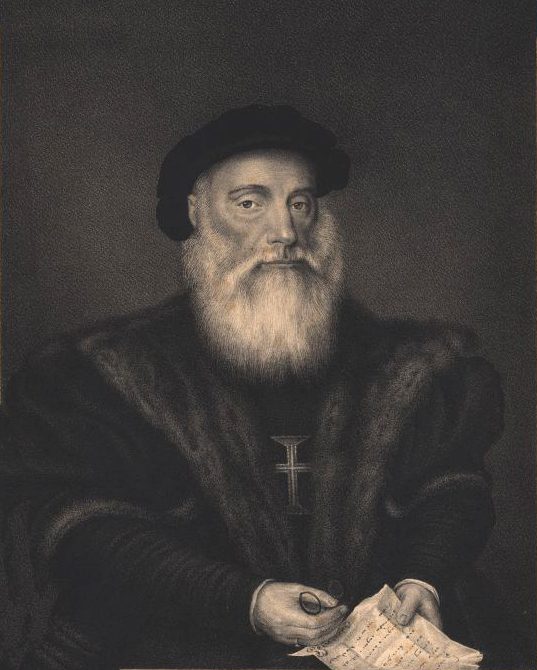
At a Glance
- Sailed
- 8 July 1497, from Lisbon, Portugal
- The fleet
- Four vessels: the São Gabriel and São Rafael (about 120 tons each), the caravel Berrio (50 tons) and a 200-ton storeship
- The crew
- About 170 men
- The landfall
- Calicut, on India's Malabar Coast, reached on 20 May 1498
- The achievement
- The first voyage from western Europe to the East by sea, around the Cape of Good Hope
- Da Gama's later voyages
- A second expedition in 1502–03 and a third in 1524, when he died at Cochin as viceroy
Events on this day
- 1497Vasco da Gama sails from Lisbon with four ships on the first voyage from Europe to India by sea — the featured story above.
- 1709Peter the Great of Russia crushes Charles XII of Sweden at the Battle of Poltava, ending Sweden's era as a great power and confirming Russia's rise.
- 1776The Declaration of Independence receives its first public reading, in Philadelphia, four days after its adoption; tradition links the day with the ringing of the Liberty Bell.
- 1777Vermont adopts a constitution that abolishes adult slavery, the first such provision in what becomes the United States.
- 1853Commodore Matthew Perry sails into Edo Bay, Japan, with American warships, beginning the forced opening of Japan to foreign trade.
- 1889The first issue of The Wall Street Journal is published in New York.
- 1947Newspapers report the recovery of a crashed 'flying disc' near Roswell, New Mexico, launching the most famous UFO story of the century; the debris was later identified as a military balloon.
- 2011The space shuttle Atlantis lifts off on STS-135, the final mission of NASA's thirty-year Space Shuttle programme.
Born on this day
- 1621Jean de La Fontaine — French poet whose Fables, retelling Aesop for the court of Louis XIV, became classics of French literature.
- 1838Ferdinand von Zeppelin — German general and inventor who founded the airship company that bore his name.
- 1839John D. Rockefeller — American industrialist who built Standard Oil and became the archetype of the modern tycoon and philanthropist.
- 1908Nelson Rockefeller — grandson of John D., governor of New York and vice president of the United States under Gerald Ford.
- 1926Elisabeth Kübler-Ross — Swiss-American psychiatrist whose On Death and Dying changed how medicine treats the dying.
Died on this day
- 1822Percy Bysshe Shelley — English Romantic poet, drowned at 29 when his boat Don Juan sank in a storm off the Italian coast.
- 1994Kim Il-sung — founder and supreme leader of North Korea, dead after 46 years in power; succeeded by his son Kim Jong-il.
- 2012Ernest Borgnine — American actor, Oscar winner for Marty, dead in Los Angeles at 95.
The featured story: Vasco da Gama sails for India, 8 July 1497
On 8 July 1497 a small fleet of four ships sailed from Lisbon under the command of Vasco da Gama, a Portuguese nobleman of about thirty-seven, bound on the voyage Portugal had been preparing for most of a century: the sea route to India around the southern tip of Africa. As Britannica recounts, the fleet comprised two purpose-built three-masted ships of about 120 tons, the São Gabriel and the São Rafael, a 50-ton caravel, the Berrio, and a 200-ton storeship, with some 170 men in all. Among their cargo were padrões — stone pillars topped with a cross, to be erected as markers of Portuguese presence on newly reached coasts.
The voyage was the culmination of decades of Portuguese exploration down the African coast, and of Bartolomeu Dias's rounding of the Cape of Good Hope in 1488. Da Gama's fleet swung wide into the Atlantic to catch the winds, made the African coast near the Cape, rounded it in November, and worked up the east African coast, taking on pilots at Mozambique and Malindi for the crossing of the Indian Ocean. On 20 May 1498, after more than ten months at sea, the fleet anchored off Calicut, on India's Malabar Coast — the first Europeans to reach India by sea from the Atlantic.
The arrival was a commercial disappointment and a strategic earthquake. Da Gama's trade goods were scorned at Calicut, relations with its ruler soured, and the fleet's return crossing, against the monsoon, took three months and cost many lives to scurvy; of the roughly 170 men who had sailed, only about a third are reckoned to have come home, and the storeship had been broken up on the way. Yet the route itself was the prize: spices could now reach Europe by sea, bypassing the Venetian and Mamluk middlemen of the Mediterranean trade.
Da Gama returned to Lisbon in 1499 to honours and reward, sailed again in 1502 with a far more heavily armed fleet, and in 1524 went out a third time as viceroy, dying at Cochin on Christmas Eve of that year. The sea route he opened on 8 July 1497 bound Europe and Asia into a single trading system for the first time, and began the Portuguese seaborne empire — the first of the European maritime empires that would reshape the world.
Why this date matters
July 8 is the calendar's great departure day. Da Gama's four ships left Lisbon on it and stitched two halves of the world together; Perry's black ships arrived in Japan on it and ended two centuries of seclusion; the last space shuttle left Earth on it. Between the sailings come the first public reading of the Declaration and a constitution that abolished slavery. The date's habit is connection — coasts, markets and worlds being joined, sometimes by invitation and sometimes not — and its consequences have a way of still running centuries later.
Sources
- Encyclopaedia Britannica — On This Day: July 8
- HISTORY — This Day in History: July 8
- Encyclopaedia Britannica — Vasco da Gama
- HistoryExtra — 8 July: On this day in history
- Dartmouth College, Rockefeller Center — Remembering Nelson A. Rockefeller '30, born July 8, 1908
The facts on this page were checked against these sources on 19 November 2026. The History Trail's permanent pages are researched and written for this site; the live profiles elsewhere on The History Trail are assembled automatically from Wikipedia and Wikidata.
About the Author
Researched and written by the The History Trail Editorial Team — the accountable editorial function behind this site's permanent story pages. The team works from the published sources cited on each page; it does not invent historians, reviewers or credentials, and it corrects errors openly.
Fact Check
Every load-bearing fact on this page traces to one of the sources listed above, and significant claims link to their source in the text. Our checking method is described on the methodology page; errors can be reported via the corrections page.
Sources & Citations
Cite this page as: The History Trail Editorial Team, The History Trail — this article's title, publication and update dates are shown beneath its headline. The full source list appears under Sources above; the site's source standards are on the sources page.