
On This Day
January 29 in History
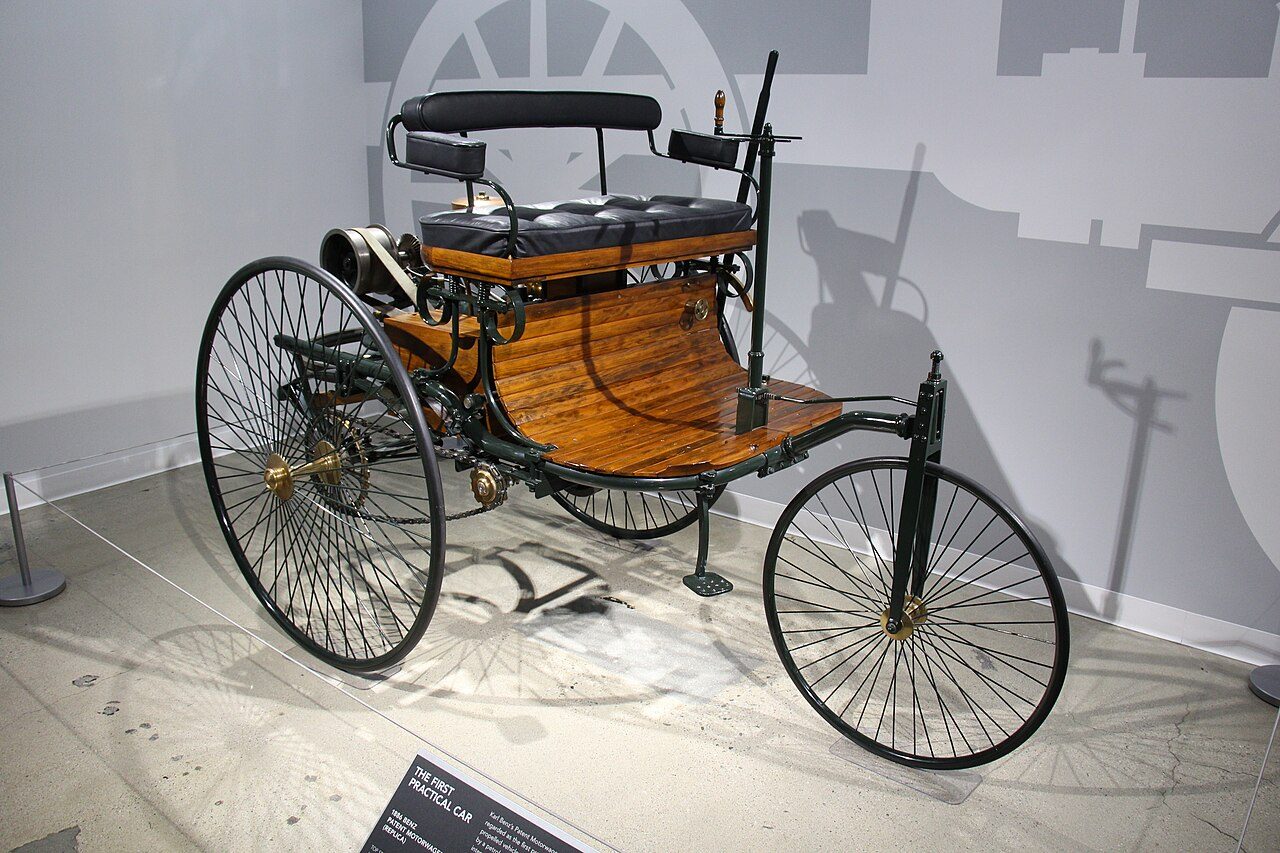
On 29 January 1886 Karl Benz applied for patent 37435 on his 'vehicle powered by a gas engine' — the Benz Patent-Motorwagen, the first practical automobile, designed from the ground up as a machine rather than a motorised carriage. January 29 is also the day Kansas became a state, Poe's 'Raven' appeared, Queen Victoria created the Victoria Cross, and baseball elected its first Hall of Famers.
Choose another date: open the On This Day calendar to browse events, births and deaths for any day of the year.
At a Glance
- The patent
- German patent DRP 37435, applied for on 29 January 1886 and granted on 2 November 1886, for a 'vehicle powered by a gas engine'
- The vehicle
- The Benz Patent-Motorwagen, built in Mannheim in 1885 — three wheels, one cylinder, designed as a complete machine rather than a motorised carriage
- The engine
- Single-cylinder four-stroke, 958 cc, about 0.75 horsepower; top speed roughly 16 km/h (10 mph)
- First public drive
- July 1886, on the Ringstrasse in Mannheim, reported in local newspapers
- The proof
- Bertha Benz's drive of some 106 km from Mannheim to Pforzheim in August 1888 — the first long-distance automobile journey
- The legacy
- Benz & Cie. became the world's largest car factory of its era and merged with Daimler in 1926 to form Mercedes-Benz
Events on this day
- 1845Edgar Allan Poe's poem 'The Raven' is published for the first time, in New York's Evening Mirror, making him famous overnight.
- 1856Queen Victoria institutes the Victoria Cross, Britain's highest award for gallantry in the face of the enemy, born of the Crimean War.
- 1861Kansas is admitted to the Union as the 34th state — a free state, after the violent struggle of 'Bleeding Kansas' over slavery.
- 1863In the Bear River Massacre, U.S. soldiers attack a Shoshone village in present-day Idaho, killing several hundred people in one of the deadliest attacks on Native Americans in the West.
- 1886Karl Benz applies for the patent on his Motorwagen, the first practical automobile — the featured story above.
- 1891Liliuokalani becomes queen of Hawaii on the death of her brother Kalakaua; she will be Hawaii's last monarch.
- 1936The first five men elected to the Baseball Hall of Fame are announced: Ty Cobb, Babe Ruth, Honus Wagner, Christy Mathewson and Walter Johnson.
- 1991The Battle of Khafji begins in the Gulf War, the first major ground engagement of the campaign to liberate Kuwait.
- 2002In his State of the Union address, President George W. Bush describes Iraq, Iran and North Korea as an 'axis of evil'.
Born on this day
- 1737Thomas Paine — English-born writer whose pamphlet Common Sense fired the American Revolution.
- 1843William McKinley — 25th president of the United States, assassinated in office in 1901.
- 1860Anton Chekhov — Russian playwright and master of the short story, author of The Cherry Orchard.
- 1880W. C. Fields — American comedian of the exasperated drawl and the top hat.
- 1927Edward Abbey — American writer and desert provocateur, author of Desert Solitaire.
- 1954Oprah Winfrey — American broadcaster who built a media empire from a Chicago talk show.
Died on this day
- 1820George III — king of Great Britain, who lost the American colonies and reigned for sixty years, dead at Windsor at 81.
- 1888Edward Lear — English artist and writer of nonsense verse, including 'The Owl and the Pussycat', dead in Italy at 75.
- 1956H. L. Mencken — American journalist and satirist, the 'Sage of Baltimore', dead at 75.
- 1963Robert Frost — American poet of New England, four-time Pulitzer winner, dead in Boston at 88.
The featured story: Karl Benz patents the first automobile, 29 January 1886
On 29 January 1886, in Mannheim, Germany, the engineer Karl Benz filed the document that the Mercedes-Benz Group still calls 'the birth certificate of the automobile': patent number 37435, for a 'vehicle powered by a gas engine'. The vehicle it described — the Benz Patent-Motorwagen — had been built the year before and was unlike anything else on the road, for the simple reason that it was not a carriage with an engine added. Benz had designed the whole thing as one machine: a lightweight three-wheeled chassis built around a single-cylinder, four-stroke engine of his own design, with electric ignition, a water-cooled cylinder and a differential driving the rear wheels by belt and chain.
The Motorwagen was, by any modern measure, frail. Its 958 cc engine produced about three-quarters of a horsepower and pushed the open three-wheeler to roughly 16 km/h (10 mph). Benz had chosen three wheels partly because he was dissatisfied with the steering available for four. Steering was by a tiller, the body was a bench seat over exposed machinery, and early test runs around Mannheim ended, on one famous occasion, against a wall. But it worked — repeatedly, controllably, and in public: in July 1886 newspapers reported the Motorwagen's first outing on Mannheim's Ringstrasse, with Benz driving and his son Eugen running alongside with a bottle of fuel.
The patent was granted on 2 November 1886, and Benz began selling the Patent-Motorwagen, making it the first automobile offered commercially. Sales were slow until the machine got its great advertisement — provided, without asking her husband, by Bertha Benz. In August 1888 she took the improved Model III and her two teenage sons and drove from Mannheim to her mother's home in Pforzheim, some 106 kilometres, the first long-distance journey by automobile in history. Along the way she cleared a blocked fuel line with a hatpin, insulated a worn ignition wire with a garter, and had a cobbler nail leather onto the wooden brakes — inventing brake lining in the process. The drive proved the car was transport, not a toy.
From that patent the industry descends in a straight line. Benz & Cie. became the world's largest automobile factory of its day; in 1926 it merged with Daimler to form the company that builds Mercedes-Benz cars. Gottlieb Daimler, working independently a few miles away in Cannstatt, patented his own motorised carriage the same year, and the argument over who 'invented the car' has run ever since — but the legal priority, and the first purpose-built, commercially sold automobile, belong to the three-wheeler of patent 37435, filed on 29 January 1886. Every car on every road today is its descendant.
Why this date matters
January 29 is a hinge between the horse-drawn world and the motorised one. The same date that saw Kansas join a Union about to fight over slavery, and a massacre close the frontier's violent account, also saw a Mannheim engineer file the paperwork for the machine that would reorganise every city, suburb and battlefield of the next century. The day's culture runs just as deep: Poe's Raven, Chekhov's birth, Frost's death, and the first five names in baseball's Hall of Fame. Few dates let you watch one age ending and another being patented in the same twenty-four hours.
Sources
- Encyclopaedia Britannica — On This Day: January 29
- HISTORY — What Happened on January 29
- Mercedes-Benz Group — Benz Patent Motor Car: The First Automobile (1885–1886)
The facts on this page were checked against these sources on 19 November 2026. The History Trail's permanent pages are researched and written for this site; the live profiles elsewhere on The History Trail are assembled automatically from Wikipedia and Wikidata.
About the Author
Researched and written by the The History Trail Editorial Team — the accountable editorial function behind this site's permanent story pages. The team works from the published sources cited on each page; it does not invent historians, reviewers or credentials, and it corrects errors openly.
Fact Check
Every load-bearing fact on this page traces to one of the sources listed above, and significant claims link to their source in the text. Our checking method is described on the methodology page; errors can be reported via the corrections page.
Sources & Citations
Cite this page as: The History Trail Editorial Team, The History Trail — this article's title, publication and update dates are shown beneath its headline. The full source list appears under Sources above; the site's source standards are on the sources page.