
On This Day
January 28 in History
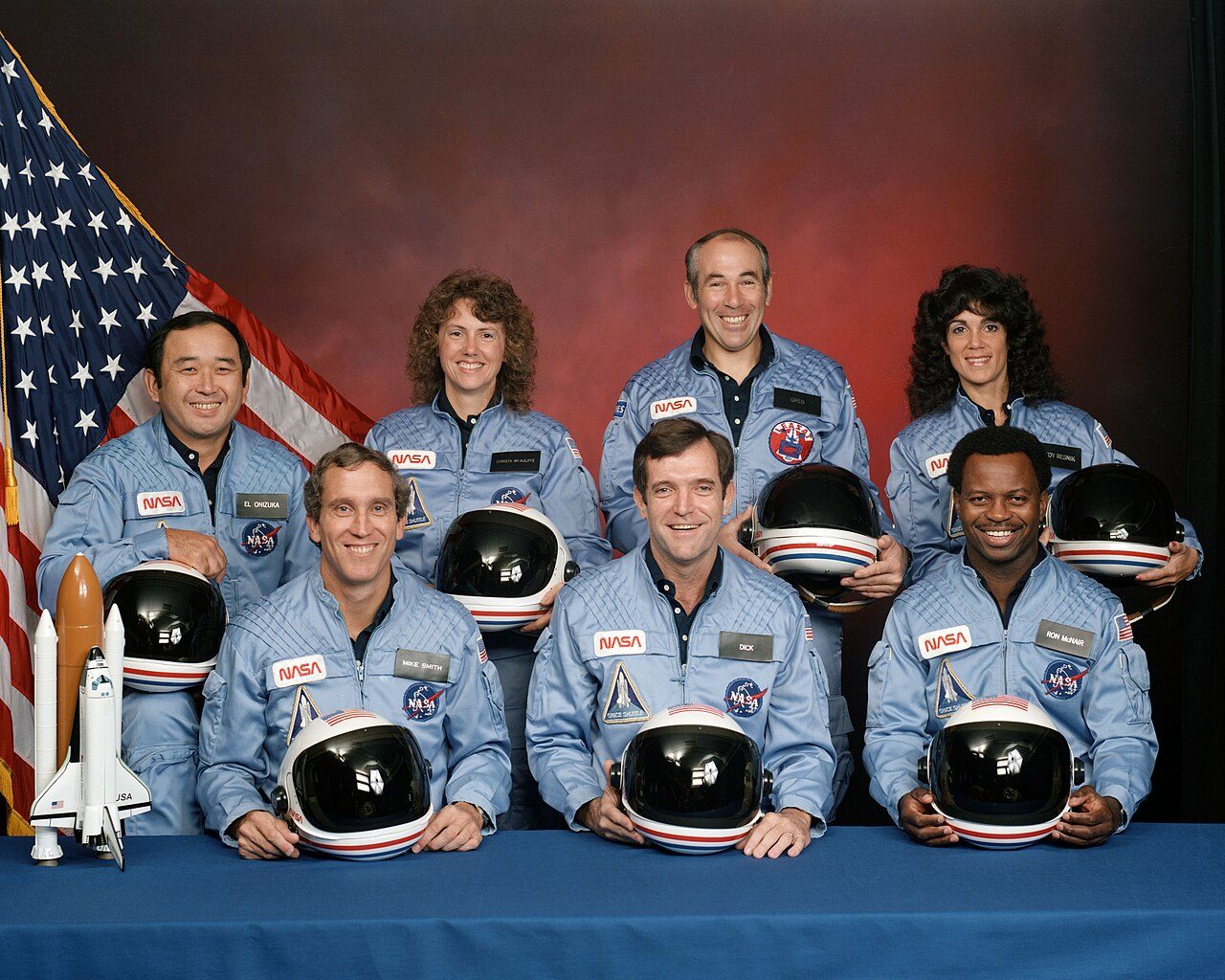
On 28 January 1986 the space shuttle Challenger broke apart 73 seconds after launch from Cape Canaveral, killing all seven crew members, including Christa McAuliffe, the first teacher in space — a disaster traced to a cold-stiffened rubber seal and to warnings that were overruled. January 28 is also the day Charlemagne and Henry VIII died, Pride and Prejudice was published, and the Lego brick was patented.
Choose another date: open the On This Day calendar to browse events, births and deaths for any day of the year.
At a Glance
- The mission
- STS-51-L, Challenger's tenth flight and the shuttle programme's 25th, launched 11:39 a.m. EST, 28 January 1986
- The crew
- Seven: Dick Scobee, Michael Smith, Judith Resnik, Ronald McNair, Ellison Onizuka, Gregory Jarvis and teacher Christa McAuliffe — all killed
- The failure
- A rubber O-ring seal in the right solid rocket booster, stiffened by record cold, failed at liftoff; at 73 seconds the shuttle broke apart
- The warning
- Thiokol engineers had argued against launching in the cold the night before; their objection was overruled
- The inquiry
- The Rogers Commission blamed both the seal design and NASA's decision-making culture; Richard Feynman's iced-water demonstration made the cause plain
- The aftermath
- Shuttle flights suspended for 32 months; boosters redesigned; replacement orbiter Endeavour built
Events on this day
- 814Charlemagne, first Holy Roman emperor, dies at Aachen; his son Louis the Pious succeeds him as ruler of the Frankish Empire.
- 1077At Canossa in Italy, the excommunicated emperor Henry IV, standing as a penitent, is absolved by Pope Gregory VII — the most famous humbling of a medieval monarch.
- 1547Edward VI, aged nine, becomes king of England on the death of his father, Henry VIII.
- 1813Jane Austen's Pride and Prejudice is published in London, issued anonymously as the work of 'the Author of Sense and Sensibility'.
- 1871The Armistice of Versailles ends the Siege of Paris and the fighting of the Franco-Prussian War, ten days after the German Empire is proclaimed in the same palace.
- 1878The first commercial telephone exchange in the United States opens at New Haven, Connecticut, serving 21 subscribers.
- 1902The Carnegie Institution of Washington is founded with Andrew Carnegie's gift of $10 million to advance scientific research.
- 1915The United States Coast Guard is established, merging the Revenue Cutter Service and the Life-Saving Service into a single armed service.
- 1958The Lego company patents the design of its interlocking brick; bricks made to that 1958 patent still fit the ones sold today.
- 1986The space shuttle Challenger breaks apart 73 seconds after launch, killing all seven crew members — the featured story above.
Born on this day
- 1457Henry VII — founder of England's Tudor dynasty, victor at Bosworth Field.
- 1873Colette — French novelist Sidonie-Gabrielle Colette, author of Gigi and the Claudine books.
- 1887Arthur Rubinstein — Polish-born pianist, among the most celebrated interpreters of Chopin.
- 1912Jackson Pollock — American painter, the leading figure of Abstract Expressionism and its 'drip' technique.
- 1936Alan Alda — American actor who carried the television series M*A*S*H through eleven seasons.
Died on this day
- 814Charlemagne — emperor of the Franks, dead at Aachen at about 71, having reshaped Europe after Rome.
- 1547Henry VIII — king of England, dead at Whitehall at 55, leaving the throne to his nine-year-old son Edward.
- 1596Francis Drake — English sea captain and circumnavigator, dead of dysentery off Panama at about 55.
- 1939W. B. Yeats — Irish poet and Nobel laureate, dead in France at 73.
- 1986Christa McAuliffe — American schoolteacher chosen as the first teacher in space, killed with the six other members of Challenger's crew at 37.
- 2002Astrid Lindgren — Swedish creator of Pippi Longstocking, dead at 94.
The featured story: the Challenger disaster, 28 January 1986
At 11:39 on a freezing Florida morning, 28 January 1986, the space shuttle Challenger lifted off from Cape Canaveral on its tenth mission, STS-51-L. Seventy-three seconds later, watched live by millions — among them schoolchildren across America, because the crew included Christa McAuliffe, a New Hampshire schoolteacher chosen to be the first teacher in space — the shuttle broke apart in a white plume over the Atlantic. All seven crew members were killed: commander Dick Scobee, pilot Michael Smith, mission specialists Judith Resnik, Ronald McNair and Ellison Onizuka, and payload specialists Gregory Jarvis and McAuliffe.
The launch had been delayed for days by weather and technical problems, and the morning itself was the coldest in shuttle history, with ice on the launch pad. Engineers at Morton Thiokol, the company that built the shuttle's solid rocket boosters, had argued the night before against launching in such cold: the rubber O-ring seals in the booster joints, they warned, lost their resilience at low temperatures and might not seal. Under pressure, the company's managers reversed their recommendation, and NASA proceeded. In the first seconds of flight, the O-ring in the right booster's aft joint failed, exactly as feared. Hot gas burned through the joint, and at 73 seconds the escaping flame breached the external fuel tank; the shuttle, travelling at twice the speed of sound, was torn apart by aerodynamic forces.
President Ronald Reagan postponed that evening's State of the Union address — the first time that had ever happened — and instead spoke to the nation about the crew, ending with the words of the poem 'High Flight': they had 'slipped the surly bonds of Earth' and 'touched the face of God'. He appointed a commission under former secretary of state William Rogers. Its members, who included Neil Armstrong, Chuck Yeager, Sally Ride and the physicist Richard Feynman, found not only the failed seal but a failed system: NASA managers had known of the O-ring design's weaknesses for years, warnings had been normalised as acceptable risk, and the decision to launch had been made by people who never heard the engineers' full objection. Feynman demonstrated the rubber's loss of elasticity by dropping a piece of O-ring into a glass of iced water on live television.
The shuttle fleet was grounded for 32 months while the boosters were redesigned and NASA's safety culture rebuilt; flights resumed in September 1988, and a replacement orbiter, Endeavour, was built. Challenger remains the defining case study in engineering ethics — taught wherever professionals are reminded that a warning overridden is still a warning — and 28 January is kept by NASA, with the anniversaries of Apollo 1 and Columbia, as its Day of Remembrance for the astronauts it has lost.
Why this date matters
January 28 bookends the making of Europe and the testing of modernity. Charlemagne's death in 814 begins the long division of his empire; nine-year-old Edward's accession in 1547 continues England's religious upheaval; and in 1871, in the same palace of Versailles, an armistice and a new German Empire together set the terms of the next century's wars. Against that, the date also holds the quiet machinery of the modern world arriving: a telephone exchange, a coast guard, a plastic brick that still fits its grandchildren. And in 1986 it holds modernity's sharpest lesson — that the most advanced machine of its age can be undone by a rubber ring, a cold morning, and a warning nobody acted on.
Sources
- Encyclopaedia Britannica — On This Day: January 28
- HISTORY — What Happened on January 28
- HISTORY — Challenger Explosion: Date, Crew & Shuttle Program
- HISTORY — Challenger Lost After Liftoff (This Day in History, January 28, 1986)
The facts on this page were checked against these sources on 19 November 2026. The History Trail's permanent pages are researched and written for this site; the live profiles elsewhere on The History Trail are assembled automatically from Wikipedia and Wikidata.
About the Author
Researched and written by the The History Trail Editorial Team — the accountable editorial function behind this site's permanent story pages. The team works from the published sources cited on each page; it does not invent historians, reviewers or credentials, and it corrects errors openly.
Fact Check
Every load-bearing fact on this page traces to one of the sources listed above, and significant claims link to their source in the text. Our checking method is described on the methodology page; errors can be reported via the corrections page.
Sources & Citations
Cite this page as: The History Trail Editorial Team, The History Trail — this article's title, publication and update dates are shown beneath its headline. The full source list appears under Sources above; the site's source standards are on the sources page.