
On This Day
January 24 in History
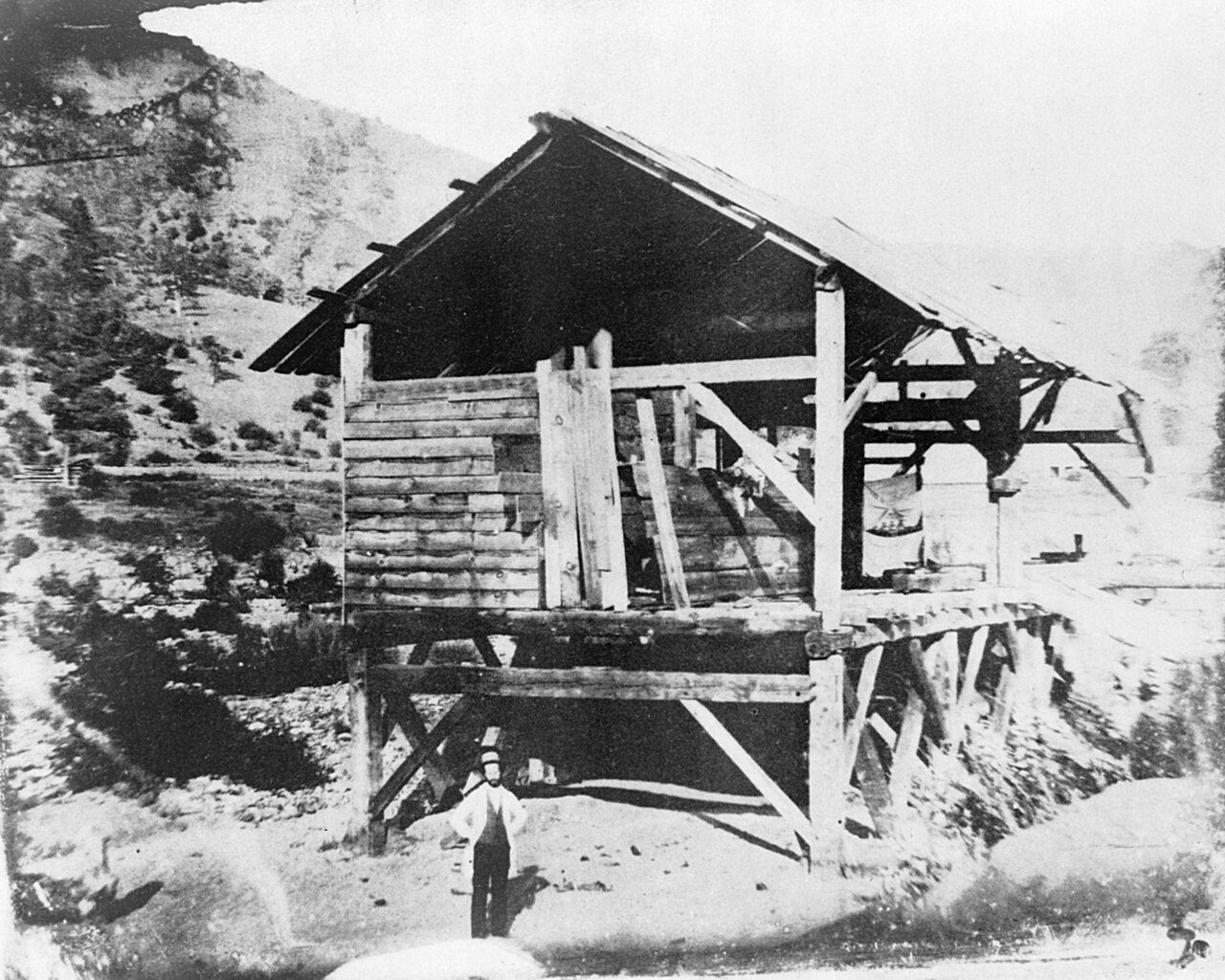
On 24 January 1848 James Marshall found flakes of gold in the tailrace of Sutter's Mill at Coloma, California — a discovery its owners tried to keep secret, and which instead drew some 300,000 people west in the California Gold Rush and made California a state within two years. January 24 is also the day Winston Churchill died, canned beer first went on sale, and NASA's Opportunity rover reached Mars.
Choose another date: open the On This Day calendar to browse events, births and deaths for any day of the year.
At a Glance
- The finder
- James W. Marshall, a carpenter building a sawmill for John Sutter at Coloma, California
- The date
- 24 January 1848, in the tailrace of the mill on the South Fork of the American River
- The secret
- Sutter tried to keep the find quiet to protect his mill and lands; the news escaped within weeks
- The rush
- Roughly 300,000 people — the 'forty-niners' and those who followed — migrated to California
- Statehood
- California entered the Union as the 31st state on 9 September 1850, skipping a long territorial stage
- The cost
- Neither Marshall nor Sutter profited; California's Indigenous peoples suffered catastrophic losses of life and land
Events on this day
- 1781Patriot commanders Henry Lee and Francis Marion raid British-held Georgetown, South Carolina, in a combined operation of the American Revolutionary War.
- 1848James Marshall discovers gold in the tailrace of Sutter's Mill at Coloma, California — the featured story above.
- 1908The Boy Scouts movement begins in England with the publication of the first instalment of Robert Baden-Powell's Scouting for Boys.
- 1935Canned beer goes on sale for the first time, as the Krueger Brewing Company delivers 2,000 cans to drinkers in Richmond, Virginia.
- 1943At Stalingrad, German general Friedrich Paulus asks Hitler for permission to surrender his encircled Sixth Army; Hitler refuses.
- 1972Farmers on Guam discover Sergeant Shoichi Yokoi, a Japanese soldier who has hidden in the jungle for nearly 28 years, unaware the Second World War has ended.
- 1984Steve Jobs unveils the Apple Macintosh, the first successful computer driven by a mouse and a graphical screen, at a shareholders' meeting in California.
- 1986The Voyager 2 spacecraft makes its closest approach to Uranus, still the only visit to the planet by a probe from Earth.
- 2003The U.S. Department of Homeland Security formally begins operations, with Tom Ridge as its first secretary.
- 2004NASA's rover Opportunity lands on Mars, three weeks after its twin Spirit; planned for 90 days of work, it will operate for nearly fifteen years.
- 2006Disney announces it will buy the animation studio Pixar for $7.4 billion, making Steve Jobs Disney's largest shareholder.
Born on this day
- 1712Frederick the Great — king of Prussia, who made his small kingdom a European great power.
- 1862Edith Wharton — American novelist of The Age of Innocence, the first woman to win the Pulitzer Prize for fiction.
- 1941Neil Diamond — American singer-songwriter whose anthems filled stadiums for half a century.
- 1949John Belushi — American comedian and actor, a founding star of Saturday Night Live and The Blues Brothers.
- 1968Mary Lou Retton — American gymnast who won all-around gold at the 1984 Los Angeles Olympics.
Died on this day
- 41Caligula — Roman emperor Gaius Caesar, assassinated by his own guard after a four-year reign of extravagance and terror.
- 1965Winston Churchill — British prime minister who led his country through the Second World War, dead in London at 90.
- 1989Ted Bundy — American serial killer, executed in Florida's electric chair after confessing to dozens of murders.
- 1993Thurgood Marshall — first Black justice of the U.S. Supreme Court and the lawyer who argued Brown v. Board of Education, dead at 84.
The featured story: gold is found at Sutter's Mill, 24 January 1848
On the morning of 24 January 1848, James Wilson Marshall walked down to inspect the tailrace of the sawmill he was building on the South Fork of the American River at Coloma, California. The water had been shut off overnight to deepen the channel, and in the gravel at the bottom something glittered. Marshall picked up a few soft, yellow flakes, bit one, hammered one between stones, and carried them in his hat to show the workmen. 'Boys,' he is remembered as saying, 'I have found a gold mine.' Tests at the mill — including boiling a flake in lye soap without tarnishing it — confirmed what the flakes suggested: it was gold.
The mill belonged to John Sutter, the Swiss-born founder of the settlement of New Helvetia, around which Sacramento would grow. Sutter saw ruin in the discovery: he wanted his mill finished, his lands worked and his workers sober, and he swore everyone to secrecy. It could not hold. Workers talked, Mormon labourers from the mill crew found more gold downstream, and in San Francisco the merchant Sam Brannan — who had quietly stocked his store with picks, pans and shovels — famously paraded through the streets holding a bottle of gold dust, shouting the news. By the summer of 1848 the rush was on, and California's non-native population was emptying into the hills.
What followed was the largest mass migration of its century. President James K. Polk confirmed the discovery to Congress in December 1848, and in 1849 the 'forty-niners' came — by sea around Cape Horn, across Panama, and overland on the trails — from the eastern United States, Mexico, Chile, China, Australia and Europe. In all, roughly 300,000 people reached California. San Francisco grew from a village of hundreds into a city of tens of thousands; California, American for barely a week when the gold was found (the Treaty of Guadalupe Hidalgo, ending the Mexican-American War, was signed nine days after Marshall's discovery), had people enough to skip territorial status and enter the Union as a state on 9 September 1850.
The discovery made California and broke the two men at its centre. Sutter's lands were overrun, his livestock stolen and his empire destroyed; he died in 1880 still petitioning Washington for compensation. Marshall, whose name is on the state park at Coloma, never profited from the gold and died poor in 1885. For California's native peoples the rush was catastrophe: disease, violence and dispossession cut the Indigenous population catastrophically within a generation. The little flake Marshall carried to Sutter — a specimen believed to be from that first find is kept by the Smithsonian's National Museum of American History — had rearranged a continent.
Why this date matters
January 24 is a day when small things turn out to be loaded. A few flakes of metal in a mill-race in 1848 moved 300,000 people across a continent and redrew the map of the United States. A tin can of beer in 1935, a handbook for boys in 1908, a beige computer with a mouse in 1984 — each looked modest and proved enormous. Even the day's endings carry that charge: an emperor murdered in Rome, a sergeant found still fighting a finished war, and Churchill, the century's loudest voice, falling silent at ninety. Few dates better teach the historian's first lesson: consequences are not sized like their causes.
Sources
- Encyclopaedia Britannica — On This Day: January 24
- HISTORY — What Happened on January 24
- Smithsonian Magazine — The Discovery of Gold on This Date in 1848 at Sutter's Creek Kicked Off the California Gold Rush
The facts on this page were checked against these sources on 19 November 2026. The History Trail's permanent pages are researched and written for this site; the live profiles elsewhere on The History Trail are assembled automatically from Wikipedia and Wikidata.
About the Author
Researched and written by the The History Trail Editorial Team — the accountable editorial function behind this site's permanent story pages. The team works from the published sources cited on each page; it does not invent historians, reviewers or credentials, and it corrects errors openly.
Fact Check
Every load-bearing fact on this page traces to one of the sources listed above, and significant claims link to their source in the text. Our checking method is described on the methodology page; errors can be reported via the corrections page.
Sources & Citations
Cite this page as: The History Trail Editorial Team, The History Trail — this article's title, publication and update dates are shown beneath its headline. The full source list appears under Sources above; the site's source standards are on the sources page.