
On This Day
January 23 in History
On 23 January 1973 President Richard Nixon announced that an agreement had been reached 'to end the war and bring peace with honour in Vietnam' — initialled in Paris that day and signed four days later, it withdrew America from its longest war, though not Vietnam from war itself. January 23 is also the day of the deadliest earthquake in recorded history, in Shaanxi in 1556, and of Elizabeth Blackwell's medical degree, the first for an American woman.
Choose another date: open the On This Day calendar to browse events, births and deaths for any day of the year.
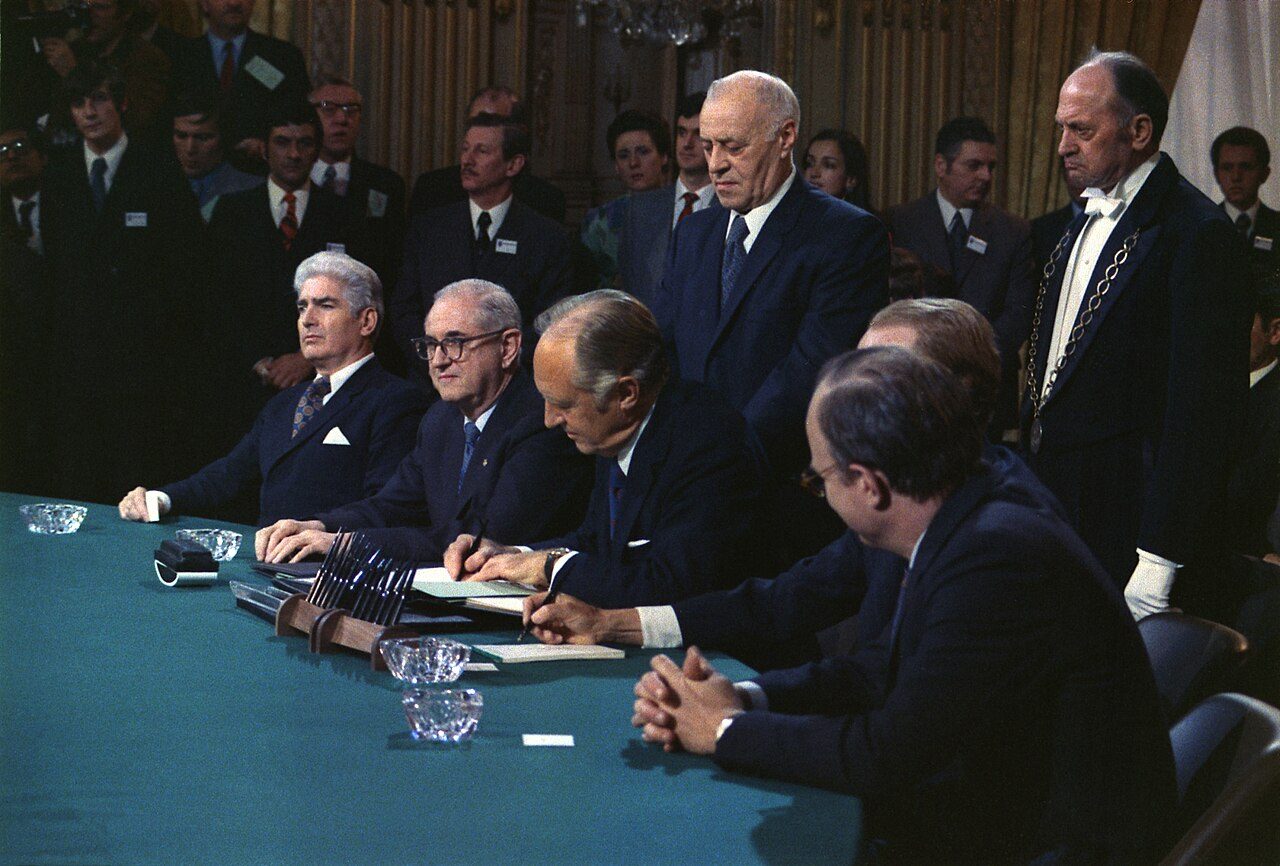
At a Glance
- Initialled
- 23 January 1973 in Paris, by Henry Kissinger and Le Duc Tho
- Announced
- President Nixon's televised address on the evening of 23 January 1973: 'peace with honour' in Vietnam
- Formally signed
- 27 January 1973 in Paris by the United States, South Vietnam, North Vietnam and the Provisional Revolutionary Government
- Main terms
- Ceasefire in place; all U.S. forces withdrawn within 60 days; American prisoners of war released
- The catch
- North Vietnamese troops were allowed to remain in South Vietnam; the two Vietnamese sides were left to settle their future
- What followed
- Fighting continued; Saigon fell to North Vietnamese forces on 30 April 1975
Events on this day
- 1556An earthquake devastates China's Shaanxi province; it is considered the deadliest earthquake in recorded history, with an estimated 830,000 people killed.
- 1849Elizabeth Blackwell receives her medical degree at Geneva, New York, becoming the first woman in the United States to do so.
- 1870U.S. soldiers attack a peaceful Blackfeet camp on the Marias River in Montana, killing some 200 people, most of them women, children and the elderly, in the Marias Massacre.
- 1907Charles Curtis of Kansas becomes the first Native American elected to the United States Senate; he later serves as vice president under Herbert Hoover.
- 1964The Twenty-fourth Amendment is ratified, banning the poll tax in federal elections — a device long used to keep poor and Black Americans from voting.
- 1968North Korean patrol boats capture the U.S. Navy intelligence ship Pueblo off the Korean coast, killing one sailor and holding 82 crew members prisoner for 11 months.
- 1973President Nixon announces that an agreement has been reached to end the Vietnam War — the featured story above.
- 1977The television miniseries Roots, following one family from West Africa through slavery to freedom, premieres in the United States and becomes a national event.
- 1986The Rock and Roll Hall of Fame inducts its first class, including Chuck Berry, James Brown, Ray Charles and Elvis Presley.
- 1997Madeleine Albright is sworn in as the first woman to serve as U.S. secretary of state, then the highest office ever held by an American woman.
Born on this day
- 1832Édouard Manet — French painter whose modern, unflinching pictures paved the way for Impressionism.
- 1855John Browning — American designer of firearms, among the most influential gun inventors in history.
- 1910Django Reinhardt — Belgian-born Romani jazz guitarist who created a new style with two working fingers on his fretting hand.
- 1928Jeanne Moreau — French actress and singer, a face of the French New Wave.
- 1933Chita Rivera — American actress and dancer, a Broadway star from West Side Story to Kiss of the Spider Woman.
- 1939Ed Roberts — American disability-rights activist, a founder of the independent living movement.
Died on this day
- 1976Paul Robeson — American singer, actor and activist, whose stand against racism cost him his career at home, dead at 79.
- 1989Salvador Dalí — Spanish surrealist painter of melting clocks, dead at Figueres at 84.
- 2005Johnny Carson — American host of The Tonight Show for thirty years, dead at 79.
- 2011Jack LaLanne — American fitness pioneer who brought exercise to television, dead at 96.
- 2021Larry King — American broadcaster whose suspenders and microphone framed a quarter-century of interviews, dead at 87.
The featured story: Nixon announces the end of America's war in Vietnam, 23 January 1973
On the evening of 23 January 1973, President Richard Nixon went on American television and radio with the announcement millions had waited years to hear. 'We have concluded an agreement to end the war and bring peace with honour in Vietnam and in Southeast Asia,' he said. That morning in Paris, his national security adviser Henry Kissinger and North Vietnam's Le Duc Tho had initialled the text of the agreement; the formal signing by the four parties — the United States, South Vietnam, North Vietnam and the Viet Cong's Provisional Revolutionary Government — followed on 27 January, and the ceasefire took effect the same day.
The road to that broadcast had run through five years of public talks in Paris that went nowhere and four years of secret meetings between Kissinger and Le Duc Tho. A draft settlement had been reached in October 1972 — prompting Kissinger's famous declaration that 'peace is at hand' — but South Vietnam's president, Nguyen Van Thieu, refused it, objecting that North Vietnamese troops were allowed to stay in the South. Washington then launched the heaviest bombing of the war, the December 'Christmas bombing' of Hanoi and Haiphong, and in January the negotiators returned to Paris and settled on terms much like October's. Thieu, promised American support if Hanoi broke the deal, reluctantly agreed.
The agreement provided for a ceasefire in place, the withdrawal of all remaining American forces within sixty days, the release of American prisoners of war, and elections to decide South Vietnam's political future. Some 23,700 U.S. troops were still in Vietnam; the last of them left on 29 March 1973, and the prisoners came home to a relieved country. But the settlement's central weakness was written into it: roughly 150,000 North Vietnamese soldiers remained inside South Vietnam, and the two Vietnamese sides were left to settle their war between themselves, supervised by an international commission with no power to enforce anything.
So the announcement of 23 January 1973 ended America's war, not Vietnam's. Fighting between North and South continued almost without pause, American aid to Saigon shrank, and Nixon — the president who had promised to stand by Thieu — resigned over Watergate in August 1974. In the spring of 1975 North Vietnam launched a final offensive, and on 30 April 1975 Saigon fell. Kissinger and Le Duc Tho had been jointly awarded the Nobel Peace Prize for the agreement; Le Duc Tho declined it, saying peace had not yet come to Vietnam. On the evidence of the two years that followed, he had a point — which is what makes Nixon's confident broadcast the most bittersweet announcement of the decade.
Why this date matters
January 23 is a day of thresholds crossed and prices paid. In 1556 the earth itself moved in Shaanxi, in the deadliest natural disaster ever recorded. In 1849 Elizabeth Blackwell walked through a door no American woman had passed before, and in 1964 the poll tax — a quieter barrier — was struck from the Constitution. The day also holds the two faces of America's long Asian war: a spy ship seized off Korea in 1968, and in 1973 a president announcing that the fighting, for Americans at least, was over. Beginnings and endings share this date, and neither kind has ever come cheap.
Sources
- Encyclopaedia Britannica — On This Day: January 23
- HISTORY — What Happened on January 23
- Office of the Historian, U.S. Department of State — Foreign Relations of the United States, 1969–1976, Editorial Note on the Paris Peace Accords
- Office of the Historian, U.S. Department of State — Foreign Relations of the United States, 1969–1976, Editorial Note (Soviet Union volume)
The facts on this page were checked against these sources on 19 November 2026. The History Trail's permanent pages are researched and written for this site; the live profiles elsewhere on The History Trail are assembled automatically from Wikipedia and Wikidata.
About the Author
Researched and written by the The History Trail Editorial Team — the accountable editorial function behind this site's permanent story pages. The team works from the published sources cited on each page; it does not invent historians, reviewers or credentials, and it corrects errors openly.
Fact Check
Every load-bearing fact on this page traces to one of the sources listed above, and significant claims link to their source in the text. Our checking method is described on the methodology page; errors can be reported via the corrections page.
Sources & Citations
Cite this page as: The History Trail Editorial Team, The History Trail — this article's title, publication and update dates are shown beneath its headline. The full source list appears under Sources above; the site's source standards are on the sources page.