
On This Day
January 16 in History
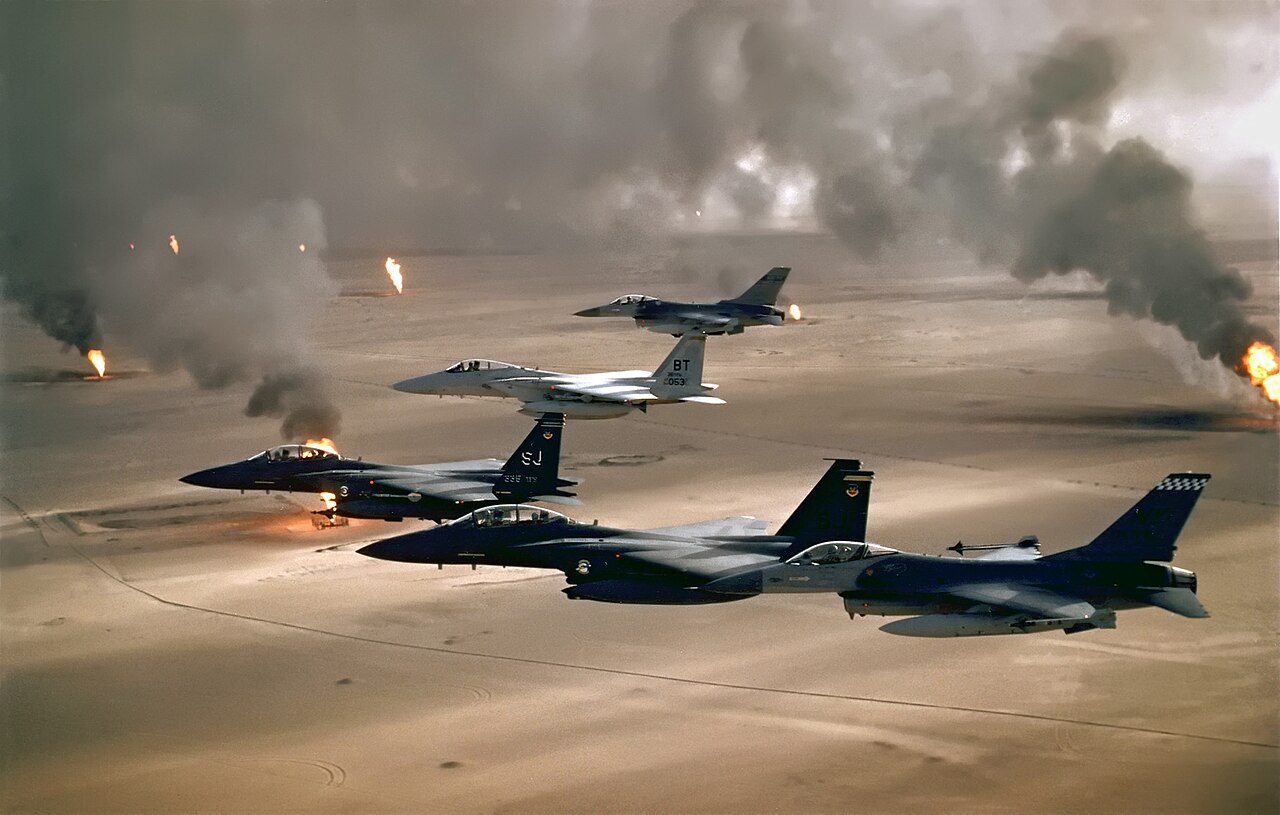
On 16 January 1991, as the UN deadline for Iraq to leave Kuwait expired, a U.S.-led coalition of more than thirty nations opened Operation Desert Storm — a 42-day air campaign that began the Gulf War, watched live on television around the world. January 16 is also the day Ivan IV was crowned the first Tsar of Russia, the Shah fled Iran, and NASA announced its first class of women astronauts.
Choose another date: open the On This Day calendar to browse events, births and deaths for any day of the year.
At a Glance
- The trigger
- Iraq invaded and annexed Kuwait on 2 August 1990 and ignored a UN deadline of 15 January 1991 to withdraw
- The opening
- The air campaign began on 16 January 1991 U.S. time — the early hours of 17 January in Baghdad
- The coalition
- More than thirty nations, commanded by U.S. General Norman Schwarzkopf
- The air war
- 42 days of strikes against Iraqi forces and infrastructure
- The ground war
- Began 24 February 1991 and lasted about 100 hours
- The outcome
- Kuwait liberated; a cease-fire took effect on 28 February 1991
Events on this day
- 1547Ivan IV is crowned in Moscow as the first Tsar of Russia — the ruler history remembers as Ivan the Terrible.
- 1605The first part of Cervantes' Don Quixote is published in Madrid, inventing the modern novel as it goes.
- 1861The Crittenden Compromise, a last attempt to avert the American Civil War by protecting slavery in law, is defeated in the Senate.
- 1883The Pendleton Act becomes law, beginning merit-based civil service reform in the United States after Garfield's assassination.
- 1938Benny Goodman's orchestra plays Carnegie Hall, the landmark concert that carried swing jazz into America's concert halls.
- 1945Adolf Hitler moves into the bunker beneath the Reich Chancellery in Berlin, where he will spend the last 105 days of his life.
- 1970Muammar al-Qaddafi becomes premier of Libya, consolidating the rule he seized in a coup the year before.
- 1978NASA announces its first class of astronauts to include women — six of them, among them Sally Ride and Judy Resnick.
- 1979The Shah of Iran flees his country as revolution gathers force; Ayatollah Khomeini will return within weeks.
- 1991Operation Desert Storm begins: the coalition air campaign opens the Gulf War — the featured story above.
Born on this day
- 1902Eric Liddell — Scottish Olympic champion runner and missionary, immortalised in Chariots of Fire.
- 1908Ethel Merman — American stage star, the brassy voice of Broadway's golden age.
- 1932Dian Fossey — American primatologist who lived among Rwanda's mountain gorillas and was murdered defending them.
- 1933Susan Sontag — American essayist and critic, author of On Photography and Illness as Metaphor.
- 1948John Carpenter — American film director of Halloween and The Thing.
- 1980Lin-Manuel Miranda — American composer and actor, creator of Hamilton.
Died on this day
- 1794Edward Gibbon — English historian of The History of the Decline and Fall of the Roman Empire.
- 1942Carole Lombard — American queen of screwball comedy, killed at 33 in a plane crash while selling war bonds.
- 1957Arturo Toscanini — Italian conductor, among the most commanding musicians of the recording age.
- 2017Eugene Cernan — American astronaut, commander of Apollo 17 and the last person to walk on the Moon.
- 2021Phil Spector — American record producer who built the 'Wall of Sound', dead in prison at 81.
The featured story: the Gulf War begins, 16 January 1991
In the early hours of 2 August 1990, Iraqi tanks crossed into Kuwait, and Saddam Hussein announced that his small, oil-rich neighbour was Iraq's nineteenth province. The world answered with a coalition: over the following five months, as the U.S. Department of Defense records, American and allied forces poured into Saudi Arabia under Operation Desert Shield, while the UN Security Council set a deadline — Iraq must be out of Kuwait by 15 January 1991, or face force. Saddam let the deadline pass. On 16 January, Washington time, the war began.
Operation Desert Storm opened with the most intensively planned air campaign since the Second World War. In the first hours, stealth aircraft and cruise missiles struck Baghdad's air defences, command centres and communications, and over 42 days coalition aircraft flew more than 100,000 sorties against Iraqi forces in Kuwait and Iraq itself. It was also the first war the world watched live: television carried the flashes over Baghdad in real time, and briefings with maps and gun-camera footage became a daily ritual. By late February, Iraq's army in Kuwait had been bombed for six weeks before a single coalition soldier crossed the line.
The ground war, when it came on 24 February, lasted about one hundred hours. Coalition forces under General Norman Schwarzkopf swung through the desert west of Kuwait in a vast left hook, liberating Kuwait City and cutting off much of the Iraqi army; a cease-fire took effect on 28 February. Kuwait's sovereignty was restored, at a coalition cost remarkably low for a war of that scale — though Iraqi military and civilian deaths were far higher and remain debated, and retreating Iraqi forces left Kuwait's oil wells burning, an environmental catastrophe that took months to cap.
Desert Storm redrew the map of modern war without redrawing the map of Iraq. It demonstrated a new kind of warfare — precision-guided weapons, stealth, satellite navigation — and restored American military confidence a generation after Vietnam. But Saddam Hussein remained in power, the sanctions and no-fly zones that followed kept the U.S. entangled in Iraq for a further decade, and the road from the 1991 cease-fire to the 2003 invasion runs straight through the settlement that ended this war. The argument over whether Desert Storm finished its job has never really closed.
Why this date matters
January 16 is a hinge day for empires and the men who run them. Ivan IV took a new and terrible title in 1547; the Shah lost his throne in 1979; Saddam Hussein tested the world's patience once too often in 1991. Against the falls stand the day's quieter firsts — a novel that invented a genre in 1605, jazz in Carnegie Hall in 1938, six women named astronauts in 1978. Power changes hands on this date, one way or another, and the rest of history has to adjust.
Sources
- Encyclopaedia Britannica — On This Day: January 16
- HISTORY — What Happened on January 16
- U.S. Department of Defense — Nation Observes Anniversary of Operation Desert Storm
- Wikipedia — January 16 (births and deaths lists)
The facts on this page were checked against these sources on 19 November 2026. The History Trail's permanent pages are researched and written for this site; the live profiles elsewhere on The History Trail are assembled automatically from Wikipedia and Wikidata.
About the Author
Researched and written by the The History Trail Editorial Team — the accountable editorial function behind this site's permanent story pages. The team works from the published sources cited on each page; it does not invent historians, reviewers or credentials, and it corrects errors openly.
Fact Check
Every load-bearing fact on this page traces to one of the sources listed above, and significant claims link to their source in the text. Our checking method is described on the methodology page; errors can be reported via the corrections page.
Sources & Citations
Cite this page as: The History Trail Editorial Team, The History Trail — this article's title, publication and update dates are shown beneath its headline. The full source list appears under Sources above; the site's source standards are on the sources page.