
On This Day
January 14 in History
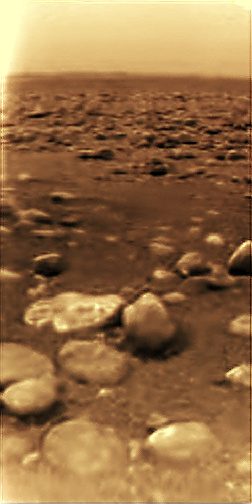
On 14 January 2005 the European Space Agency's Huygens probe parachuted through the orange haze of Titan, Saturn's largest moon, and touched down on a plain of water-ice pebbles — the first landing in the outer solar system and still the most distant ever made. January 14 is also the day the Miami Dolphins completed the NFL's only perfect season, Tosca premiered in Rome and Albert Schweitzer was born.
Choose another date: open the On This Day calendar to browse events, births and deaths for any day of the year.
At a Glance
- Landing
- 14 January 2005; Huygens entered Titan's atmosphere at 09:05 UT and touched down at 11:38 UT
- The spacecraft
- ESA's Huygens probe, carried to Saturn by NASA's Cassini orbiter
- The journey
- Launched together in 1997; Huygens separated from Cassini on 25 December 2004, three weeks before landing
- The descent
- About two and a half hours under parachutes through Titan's thick nitrogen atmosphere
- What it found
- A landscape of ice pebbles and channels cut by liquid methane — an Earth-like world running on hydrocarbons
- Why it matters
- The first landing on a moon of another planet, and still the most remote touchdown ever achieved
Events on this day
- 1639Connecticut adopts the Fundamental Orders, a framework of self-government often called the first written constitution in the American colonies.
- 1900Puccini's opera Tosca premieres in Rome, a tale of love and political murder that has held the stage ever since.
- 1942President Franklin D. Roosevelt issues Proclamation 2537, ordering 'alien enemies' in the United States to register with the government.
- 1954Actress Marilyn Monroe marries baseball legend Joe DiMaggio in San Francisco; the marriage lasts nine months.
- 1963George Wallace is inaugurated governor of Alabama, declaring 'segregation now, segregation tomorrow, segregation forever'.
- 1967Thousands gather in San Francisco's Golden Gate Park for the Human Be-In, the counterculture's coming-out party.
- 1969An explosion and fire aboard the carrier USS Enterprise kill 27 sailors off Hawaii.
- 1970Diana Ross performs with the Supremes for the final time in Las Vegas, closing the reign of Motown's defining group.
- 1973The Miami Dolphins beat Washington 14–7 in Super Bowl VII to finish 17–0 — the NFL's only perfect season.
- 1980The price of gold passes $800 an ounce for the first time, amid inflation and international crisis.
- 2005ESA's Huygens probe lands on Titan, the most distant landing ever made — the featured story above.
- 2011Tunisia's president Zine al-Abidine Ben Ali flees the country as the Jasmine Revolution ends his 23-year rule.
Born on this day
- 1741Benedict Arnold — American general who won fame at Saratoga, then infamy as the Revolution's most notorious traitor.
- 1875Albert Schweitzer — Alsatian physician, theologian and organist who built a hospital in Gabon and won the Nobel Peace Prize.
- 1925Yukio Mishima — Japanese novelist of The Sailor Who Fell from Grace with the Sea, famed for his art and his theatrical death.
- 1941Faye Dunaway — American actress of Bonnie and Clyde, Chinatown and Network.
- 1969Jason Bateman — American actor of Arrested Development and Ozark.
Died on this day
- 1742Edmond Halley — English astronomer who predicted the return of the comet that bears his name.
- 1898Lewis Carroll — English mathematician and author of Alice's Adventures in Wonderland, dead at 65.
- 1957Humphrey Bogart — American actor of Casablanca and The Maltese Falcon, dead at 57.
- 1978Kurt Gödel — Austrian-American logician whose incompleteness theorems set the limits of mathematics itself.
- 2016Alan Rickman — English actor of Die Hard and the Harry Potter films, dead at 69.
The featured story: Huygens lands on Titan, 14 January 2005
Titan had been a mystery wrapped in orange smog for four centuries. Saturn's largest moon — bigger than the planet Mercury — hides its surface under a nitrogen atmosphere thicker than Earth's, and when the Voyager probes flew past in 1980 and 1981 they saw only haze. The Cassini-Huygens mission was built to break that veil: NASA's Cassini orbiter would study the Saturn system for years, while the European Space Agency's small Huygens probe, riding piggyback, would do something no spacecraft had done — descend into the atmosphere of a moon in the outer solar system and land on it.
Cassini released Huygens on Christmas Day 2004, and the probe coasted silently for twenty days. On 14 January 2005 it hit Titan's atmosphere at 09:05 UT, its heat shield glowing, then deployed parachutes and began a descent of about two and a half hours, measuring winds, chemistry and pressure as it fell. At 11:38 UT it touched down — NASA describes it as the first landing in the outer solar system, and it remains the most distant landing ever made, some 1.2 billion kilometres from Earth. Signals from the surface, relayed by Cassini overhead, kept coming for more than an hour after touchdown.
What Huygens found was eerily familiar and utterly alien at once. Its camera showed rounded pebbles of water ice — hard as rock at Titan's minus 179 degrees — strewn on a dark plain, and descent images revealed branching channels that looked like river valleys. On Titan it is liquid methane, not water, that rains, flows and evaporates; the pebbles had plainly been tumbled by some flowing liquid. The probe's instruments sniffed an atmosphere rich in organic chemistry, the kind of prebiotic brew that makes Titan one of the most intriguing places to ask how life begins.
Huygens fell silent when its batteries faded and Cassini passed below the horizon, but the mission it opened ran until 2017, when Cassini was deliberately burned up in Saturn's atmosphere. No lander has yet returned to Titan — NASA's Dragonfly rotorcraft, planned for the 2030s, will be the next to try. The little European probe, built to survive a landing it might not achieve on a world no one had ever seen, is still sitting there in the methane cold.
Why this date matters
January 14 is a day for reaching beyond the known map. A probe fell through alien haze to a shore of ice in 2005; Puccini put a new opera before a nervous Rome in 1900; Connecticut's settlers wrote themselves a constitution in 1639. Even its sporting entry is about perfection never repeated — the Dolphins' 17–0 of 1973. Against that stand the day's darker registrations and segregation speeches, reminders that the same date can hold both humanity's longest reach and its narrowest instincts.
Sources
- Encyclopaedia Britannica — On This Day: January 14
- HISTORY — What Happened on January 14
- NASA — Cassini-Huygens Mission
- European Space Agency — The Huygens Landing: One Year On
The facts on this page were checked against these sources on 19 November 2026. The History Trail's permanent pages are researched and written for this site; the live profiles elsewhere on The History Trail are assembled automatically from Wikipedia and Wikidata.
About the Author
Researched and written by the The History Trail Editorial Team — the accountable editorial function behind this site's permanent story pages. The team works from the published sources cited on each page; it does not invent historians, reviewers or credentials, and it corrects errors openly.
Fact Check
Every load-bearing fact on this page traces to one of the sources listed above, and significant claims link to their source in the text. Our checking method is described on the methodology page; errors can be reported via the corrections page.
Sources & Citations
Cite this page as: The History Trail Editorial Team, The History Trail — this article's title, publication and update dates are shown beneath its headline. The full source list appears under Sources above; the site's source standards are on the sources page.