
On This Day
December 9 in History
On 9 December 1979, in Geneva, the members of the Global Commission for the Certification of Smallpox Eradication signed the document that ended a scourge of millennia: smallpox, which had killed an estimated 300 million people in the twentieth century alone, no longer existed in nature. It was the first — and still the only — human disease deliberately eradicated. December 9 is also the day John Milton and Grace Hopper were born, and the day A Charlie Brown Christmas first charmed America.
Choose another date: open the On This Day calendar to browse events, births and deaths for any day of the year.
At a Glance
- The signing
- 9 December 1979, Geneva — the Global Commission for the Certification of Smallpox Eradication signs its final report
- The disease
- Smallpox (variola major and minor) killed roughly 30 percent of those it infected and scarred or blinded many survivors
- The last natural case
- Ali Maow Maalin, a hospital cook in Merka, Somalia, diagnosed in October 1977 — he survived
- The last death
- Janet Parker, a medical photographer in Birmingham, England, infected by a laboratory escape in 1978
- The campaign
- The WHO's intensified programme from 1967, built on surveillance and ring vaccination rather than mass vaccination alone, cost an estimated $300 million
- The confirmation
- The World Health Assembly formally accepts the eradication on 8 May 1980; samples of the virus remain only in two high-security laboratories, in the United States and Russia
Events on this day
- 1824At the Battle of Ayacucho in the Peruvian highlands, Antonio José de Sucre's patriot army destroys the last great royalist force in South America, sealing Spanish America's independence.
- 1941China, at war with Japan since 1937, formally declares war on Japan — and on Germany and Italy — two days after Pearl Harbor.
- 1961Tanganyika becomes independent from Britain under Julius Nyerere, the first of the East African mainland states to reach nationhood; it later unites with Zanzibar as Tanzania.
- 1965A Charlie Brown Christmas, the first Peanuts television special, premieres on CBS — made in six months on a small budget, doubted by the network, and watched by nearly half of America's television audience.
- 1969Charles Manson and four followers are indicted in Los Angeles for the Tate-LaBianca murders committed the previous August.
- 1979The Global Commission certifies the eradication of smallpox — the featured story above.
- 1990Lech Wałęsa, the Gdańsk shipyard electrician who led Solidarity, wins Poland's presidential election — the first popular vote for a Polish head of state.
- 1992The first U.S. Marines come ashore in Mogadishu before dawn, opening Operation Restore Hope to secure food deliveries in famine-stricken Somalia — and are met on the beach by waiting television crews.
Born on this day
- 1608John Milton — English poet of Paradise Lost, who dictated his epic blind and in political disgrace after the Restoration.
- 1902Margaret Hamilton — American actress whose Wicked Witch of the West in The Wizard of Oz defined screen villainy for generations of children.
- 1906Grace Hopper — American computer scientist and U.S. Navy rear admiral who built the first compiler and championed machine-independent programming languages.
- 1916Kirk Douglas — American actor of Spartacus and Paths of Glory, a star of Hollywood's golden age who lived to 103.
- 1922Redd Foxx — American comedian whose nightclub act paved the way for a generation, and who starred in Sanford and Son.
- 1953John Malkovich — American actor of dangerous charm in Dangerous Liaisons, In the Line of Fire and Being John Malkovich.
Died on this day
- 1641Anthony van Dyck — Flemish painter whose portraits set the image of Charles I's court and of English aristocracy for a century.
- 1908William Harvey Carney — American soldier of the 54th Massachusetts, among the first African Americans to receive the Medal of Honor, for saving the colours at Fort Wagner in 1863.
- 1979Fulton J. Sheen — American Catholic archbishop whose television programme Life Is Worth Living won an Emmy against Milton Berle and made him a household name.
- 2009Gene Barry — American actor of Bat Masterson and Burke's Law, and the lead of the 1953 film The War of the Worlds.
The featured story: smallpox is certified eradicated, 9 December 1979
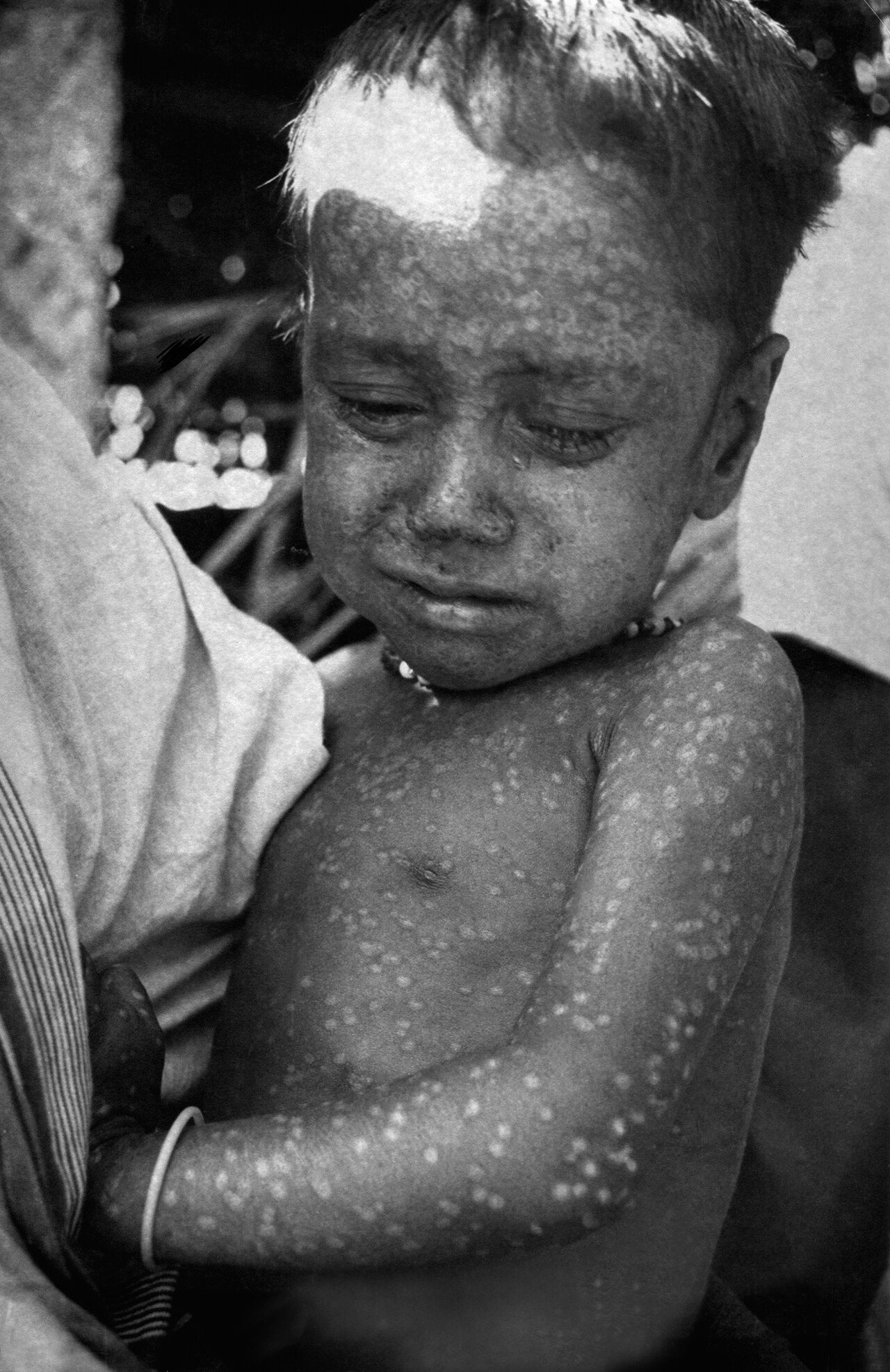
Smallpox is older than civilisation's records of it. Its marks have been found on the mummy of Pharaoh Ramses V, dead more than 3,000 years ago; it killed emperors of Rome and China, a queen of England and at least one American president's son; it emptied whole peoples in the Americas after 1492; and in the twentieth century alone it is estimated to have killed 300 million people — more than both world wars and every plague of the century combined. The disease killed about a third of those it caught, and left many survivors blind or carved with pitted scars. On 9 December 1979, a commission of scientists from around the world, meeting in Geneva, signed a parchment declaring that this enemy no longer existed anywhere on earth.
The weapon was old: vaccination, demonstrated by Edward Jenner in 1796 with matter from a cowpox sore. The strategy was new. When the World Health Organization launched its intensified eradication programme in 1967, smallpox was still killing some two million people a year across more than thirty countries, and the original plan — vaccinate 80 percent of everyone, everywhere — was failing in the face of war, flood, famine and sheer human geography. Under leaders including D. A. Henderson and, in the field, thousands of national health workers, the programme pivoted to surveillance and containment: hunt every outbreak, isolate every case, and vaccinate a ring of contacts around it. Freeze-dried vaccine that survived tropical heat, the cheap bifurcated needle, and cash rewards for reporting cases — like the 250 taka paid to the eight-year-old Bangladeshi girl who reported Rahima Banu, the last variola major case, in 1975 — did the rest.
The endgame ran through the Horn of Africa. The last naturally occurring case of all was Ali Maow Maalin, a 23-year-old hospital cook in Merka, Somalia, diagnosed in October 1977; he recovered, and later worked as a polio vaccinator, saying Somalia had been the last country with smallpox and he did not want it to be the last with polio. One tragedy remained: in 1978 the virus escaped from a Birmingham laboratory and killed medical photographer Janet Parker, the disease's final victim. After two more years of searching — thousands of suspected rashes investigated, none confirmed — the Global Commission was satisfied. Its members signed the certification in Geneva on 9 December 1979, and the World Health Assembly accepted it the following May.
Nothing like it had ever happened. Smallpox remains the only human disease eradicated by deliberate effort — the proof, cited in every eradication debate since, that a disease with no animal reservoir can be hunted to extinction if the world acts together. The virus itself survives in just two declared repositories, at the CDC in Atlanta and the VECTOR institute in Russia, whose destruction has been debated, and postponed, for four decades. The parchment signed on this day in 1979 is the campaign's monument: a death certificate for a disease, signed by the species it used to kill.
Why this date matters
December 9 is the calendar's monument to collective competence. Its featured event is not a battle or a coronation but a signature on a certificate — the moment humanity formally recorded that it had out-organised a virus older than its pyramids. Around it cluster the date's other signatures: a battle that ends an empire in Peru, an election that makes a shipyard worker a president, a cartoon special a network nearly cancelled. The day suggests that the largest changes are often the least theatrical: a form, signed in Geneva, in triplicate.
Sources
- Encyclopaedia Britannica — On This Day: December 9
- HISTORY — What Happened on December 9
- HISTORY — Smallpox is officially declared eradicated (December 9, 1979)
- CDC — Public Health Image Library: Rahima Banu, 1975
The facts on this page were checked against these sources on 19 November 2026. The History Trail's permanent pages are researched and written for this site; the live profiles elsewhere on The History Trail are assembled automatically from Wikipedia and Wikidata.
About the Author
Researched and written by the The History Trail Editorial Team — the accountable editorial function behind this site's permanent story pages. The team works from the published sources cited on each page; it does not invent historians, reviewers or credentials, and it corrects errors openly.
Fact Check
Every load-bearing fact on this page traces to one of the sources listed above, and significant claims link to their source in the text. Our checking method is described on the methodology page; errors can be reported via the corrections page.
Sources & Citations
Cite this page as: The History Trail Editorial Team, The History Trail — this article's title, publication and update dates are shown beneath its headline. The full source list appears under Sources above; the site's source standards are on the sources page.