
On This Day
August 21 in History
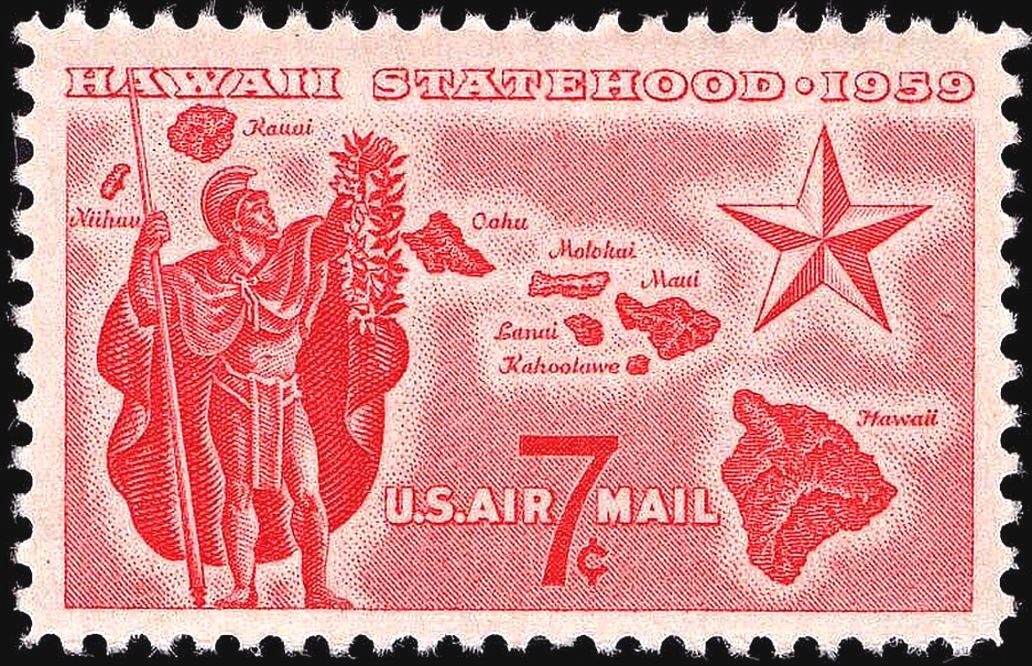
On 21 August 1959 President Eisenhower signed Proclamation 3309 and Hawaii became the 50th state of the United States — the last star on the flag, added eight months after Alaska's. August 21 is also the day Nat Turner's rebellion began, the Mona Lisa was stolen from the Louvre, and a total solar eclipse crossed America from coast to coast.
Choose another date: open the On This Day calendar to browse events, births and deaths for any day of the year.
At a Glance
- The law
- The Hawaii Admission Act, signed by President Eisenhower on 18 March 1959
- The vote
- Hawaii's voters approved statehood in a referendum on 27 June 1959
- The proclamation
- Proclamation 3309, signed at 4 p.m. Washington time on 21 August 1959, admitting Hawaii 'on an equal footing with the other States'
- The wait
- Statehood bills had been introduced, and had failed, for more than half a century, in part because of discrimination against the islands' non-white population
- The flag
- Eisenhower also ordered the new 50-star flag, which became official on 4 July 1960
- The first senators
- Hiram Fong, the first US senator of Asian descent, and Oren Long, seated on 24 August 1959
Events on this day
- 1831Nat Turner, an enslaved preacher, launches a rebellion in Southampton County, Virginia; it is suppressed within two days and Turner is later hanged.
- 1858Abraham Lincoln and Stephen Douglas open their famous series of debates in their contest for a US Senate seat from Illinois.
- 1863Confederate raiders under William Quantrill sack Lawrence, Kansas, murdering around 150 men and boys in one of the Civil War's worst atrocities.
- 1897Ransom E. Olds founds the Olds Motor Vehicle Company in Lansing, Michigan, the maker of the Oldsmobile.
- 1911The Mona Lisa is stolen from the Louvre in Paris by Vincenzo Peruggia, an Italian workman; the painting is recovered in Florence two years later.
- 1942Walt Disney's animated film Bambi is released in the United States.
- 1944The Dumbarton Oaks conference opens in Washington, DC, where the Allied powers draft the plans that become the United Nations.
- 1959President Eisenhower signs Proclamation 3309, and Hawaii becomes the 50th state of the United States — the featured story above.
- 1986A burst of carbon dioxide from Lake Nyos in Cameroon suffocates villagers in their sleep; Britannica puts the toll at more than 1,700 people, while other accounts say nearly 2,000.
- 1987The film Dirty Dancing, starring Patrick Swayze and Jennifer Grey, is released in the United States.
- 1991Latvia declares its full independence from the Soviet Union restored.
- 1991The attempted coup against Mikhail Gorbachev collapses in Moscow after three days, fatally weakening the Soviet Union.
- 2017A total solar eclipse crosses the United States from coast to coast, the first to do so since 1918.
Born on this day
- 1904Count Basie — American jazz pianist and bandleader, a giant of the swing era.
- 1920Christopher Robin Milne — son of A. A. Milne, and the boy at the centre of the Winnie-the-Pooh stories.
- 1936Wilt Chamberlain — American basketball star who once scored 100 points in a single game.
- 1973Sergey Brin — Russian-born American computer scientist, the co-founder of Google.
- 1986Usain Bolt — Jamaican sprinter, the fastest man in recorded history.
- 1988Robert Lewandowski — Polish footballer, among the most prolific goalscorers of his era.
Died on this day
- 1940Leon Trotsky — Russian revolutionary and founder of the Red Army, dead in Mexico City a day after an NKVD agent struck him with an ice axe.
- 1995Subrahmanyan Chandrasekhar — Indian-American astrophysicist and Nobel laureate who worked out how stars end their lives.
- 2005Robert Moog — American engineer, the inventor of the Moog synthesiser.
- 2006Bismillah Khan — Indian musician who brought the shehnai to the concert stage.
The featured story: Hawaii becomes the fiftieth state, 21 August 1959
Hawaii had been American on paper since the nineteenth century — annexed in 1898 and organised as a territory in 1900 — but for more than half a century its people were governed from Washington without being full members of the Union. Statehood bills were introduced in Congress again and again, and failed again and again: the islands were far away, their economy was dominated by a few sugar and pineapple companies, and, as HISTORY's account makes plain, many in Congress balked at admitting a state whose population was largely of Asian and Native Hawaiian descent. The Second World War, in which Hawaii's soldiers served with distinction, weakened the old objections but did not remove them.
The breakthrough came as a pair. Alaska, the other great territory, was admitted as the 49th state on 3 January 1959, and the pairing of the two — one northern and Republican-leaning, one Pacific and Democratic-leaning — broke the logjam for both. On 18 March 1959 President Dwight D. Eisenhower signed the Hawaii Admission Act, which dissolved the territory and provided for statehood once Hawaii's voters approved the act's terms and elected their officers. The voters did so, overwhelmingly, in a referendum on 27 June 1959, and elected senators and representatives in July.
What remained was a signature. At four o'clock in the afternoon, Washington time, on 21 August 1959, Eisenhower signed Proclamation 3309, declaring that the requirements of the act had been met and that 'admission of the State of Hawaii into the Union on an equal footing with the other States of the Union is now accomplished'. Hawaii was the 50th state. Among its first senators, seated on 24 August, was Hiram Fong, the first American senator of Asian descent — a direct answer to the argument that had kept the islands waiting for two generations.
The proclamation changed the flag as well as the map. Eisenhower also issued the order fixing the new design: fifty stars in nine staggered rows. That flag became official on the Fourth of July 1960, and it has flown unchanged ever since — the longest-serving version of the American flag. No state has joined the Union since Hawaii, which remains, more than six decades on, the most recent: the 50th star, added on 21 August 1959, is still the last.
Why this date matters
August 21 is a day of foundings and thefts. A state joins the Union in 1959 and a superpower begins to leave the stage in 1991, when Latvia walks free and the Moscow coup collapses on the same day; the United Nations is sketched at Dumbarton Oaks in 1944; and the world's most famous painting is carried out of the Louvre under a workman's smock in 1911. Underneath runs a darker thread — Nat Turner's rebellion, the Lawrence massacre, the silent gas of Lake Nyos — days when violence arrived unannounced. The date's emblem is its eclipse in 2017: everything briefly rearranged, then the familiar pattern restored.
Sources
- Encyclopaedia Britannica — On This Day: August 21
- HISTORY — This Day in History: August 21
- United States Senate — Hawaii Statehood Timeline
- Eisenhower Presidential Library — Hawaii Statehood
- National Archives — Proclamation 3309: Admission of the State of Hawaii into the Union
The facts on this page were checked against these sources on 19 November 2026. The History Trail's permanent pages are researched and written for this site; the live profiles elsewhere on The History Trail are assembled automatically from Wikipedia and Wikidata.
About the Author
Researched and written by the The History Trail Editorial Team — the accountable editorial function behind this site's permanent story pages. The team works from the published sources cited on each page; it does not invent historians, reviewers or credentials, and it corrects errors openly.
Fact Check
Every load-bearing fact on this page traces to one of the sources listed above, and significant claims link to their source in the text. Our checking method is described on the methodology page; errors can be reported via the corrections page.
Sources & Citations
Cite this page as: The History Trail Editorial Team, The History Trail — this article's title, publication and update dates are shown beneath its headline. The full source list appears under Sources above; the site's source standards are on the sources page.