
On This Day
April 15 in History
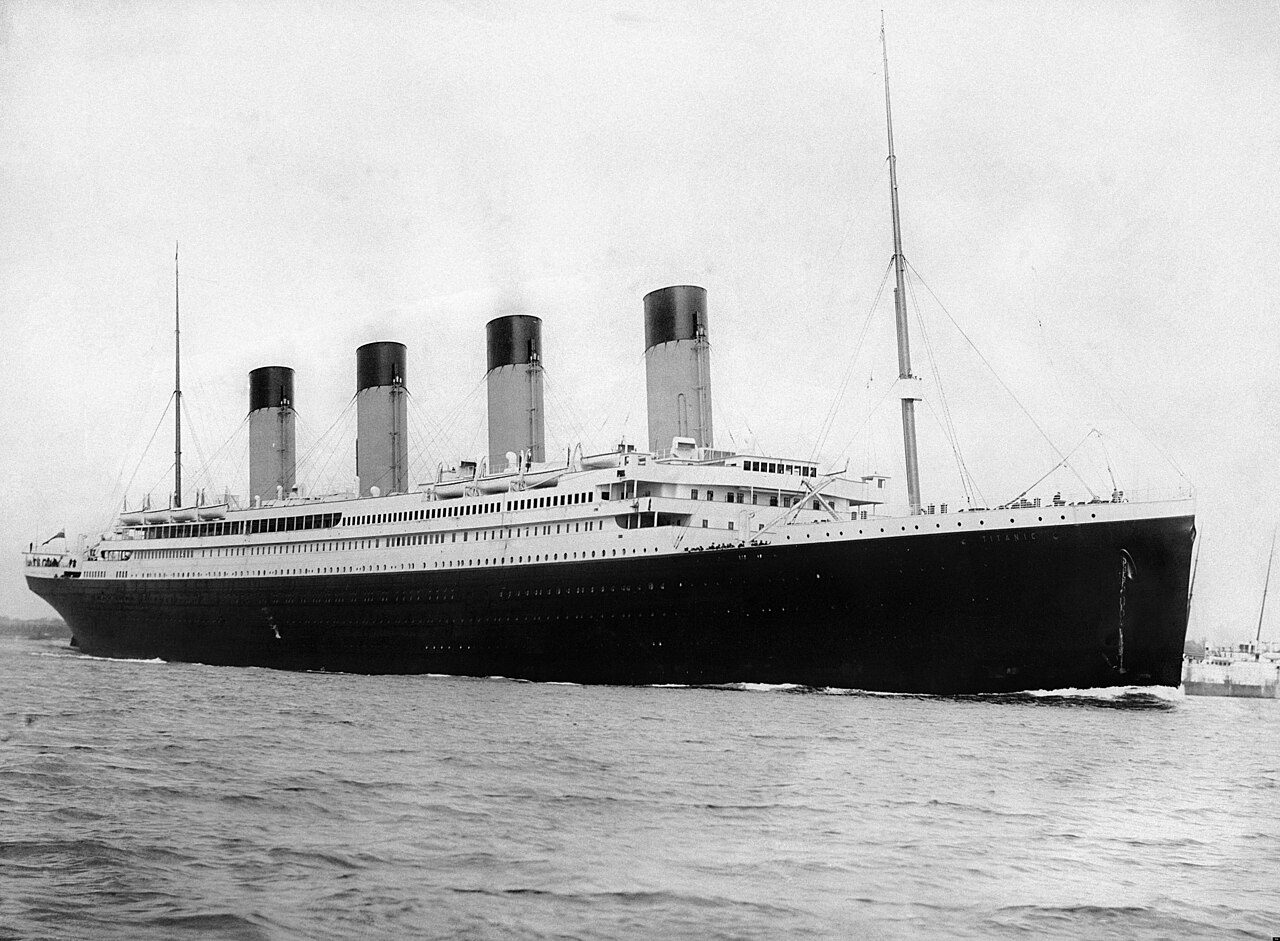
In the early hours of 15 April 1912, two hours and forty minutes after striking an iceberg, the British liner Titanic — the largest ship afloat, on her maiden voyage — sank in the North Atlantic. Of the roughly 2,200 people aboard, some 1,500 died. April 15 is also the morning Abraham Lincoln died, the day Jackie Robinson broke baseball's colour line, and Leonardo da Vinci's birthday.
Choose another date: open the On This Day calendar to browse events, births and deaths for any day of the year.
At a Glance
- The ship
- RMS Titanic of the White Star Line, 46,328 tons, sailing Southampton to New York on her maiden voyage
- The collision
- 11:40 p.m. on 14 April 1912 — the iceberg opened the hull across five watertight compartments; she was designed to float with four flooded
- The sinking
- 2:20 a.m. on 15 April, two hours and forty minutes later, after the bow filled and the ship broke in two
- The people
- About 2,200 aboard; some 1,500 died and about 710 survived, most of them rescued by the Carpathia
- The lifeboats
- Capacity for about 1,178 people — more than the law required, far less than the ship carried; many left partly filled
- The consequences
- The first SOLAS safety convention, ice patrols, lifeboats for all and round-the-clock radio watches became law
Events on this day
- 1755Samuel Johnson's Dictionary of the English Language is published in London, the standard work of its kind for a century.
- 1861President Lincoln calls for 75,000 volunteers to suppress the rebellion, three days after the fall of Fort Sumter.
- 1865Abraham Lincoln dies of his wound in Washington; Andrew Johnson is sworn in as president hours later.
- 1912The Titanic sinks in the North Atlantic — the featured story above.
- 1920Two men are shot dead in a payroll robbery at South Braintree, Massachusetts — the crime for which Sacco and Vanzetti will be executed.
- 1947Jackie Robinson plays his first game for the Brooklyn Dodgers, breaking major league baseball's colour barrier.
- 1955Ray Kroc opens his first franchised McDonald's restaurant, in Des Plaines, Illinois, and begins building the chain.
- 1989A crush at Hillsborough Stadium in Sheffield kills 97 Liverpool football fans; police failures are later blamed.
- 2013Two bombs explode near the finish line of the Boston Marathon, killing 3 people and wounding more than 260.
- 2019Fire engulfs Notre-Dame Cathedral in Paris, destroying its spire and roof before firefighters save the stone structure.
Born on this day
- 1452Leonardo da Vinci — Italian painter, sculptor, engineer and anatomist, the defining genius of the Renaissance.
- 1707Leonhard Euler — Swiss mathematician, the most prolific of his century, who shaped modern analysis and notation.
- 1843Henry James — American novelist of The Portrait of a Lady and The Turn of the Screw.
- 1938Claudia Cardinale — Italian actress, star of The Leopard and Once Upon a Time in the West.
- 1959Emma Thompson — English actress and screenwriter, Oscar winner for Howards End and for adapting Sense and Sensibility.
- 1990Emma Watson — English actress who grew up on screen as Hermione Granger in the Harry Potter films.
Died on this day
- 1865Abraham Lincoln — sixteenth president of the United States, dead at 56 of Booth's bullet, nine hours after the shooting at Ford's Theatre.
- 1949Wallace Beery — American actor, Oscar winner and one of the biggest box-office draws of the 1930s.
- 1980Jean-Paul Sartre — French philosopher of existentialism, who declined the Nobel Prize in Literature, dead in Paris at 74.
- 2001Joey Ramone — American singer of the Ramones, the band that launched punk rock, dead at 49.
The featured story: the Titanic sinks, 15 April 1912
She was, in the careful language of her owners, practically unsinkable — and in the language of the press, simply unsinkable. Titanic left Southampton on 10 April 1912 as the largest moving object human beings had built: 883 feet long, with a swimming pool, a gymnasium, and watertight doors that could be closed from the bridge. Her maiden voyage drew the age in miniature — millionaires in first class, emigrants in third, and Captain Edward Smith, the White Star Line's most trusted commodore, making what was to have been his final crossing before retirement.
The North Atlantic that April was full of ice, and warnings reached Titanic by wireless all through 14 April; at least one, from the Mesaba, reporting heavy pack ice directly in her path, never reached the bridge. She steamed on at about 22 knots. At 11:40 p.m. the lookout, Frederick Fleet, rang the bell three times — iceberg, right ahead. First Officer Murdoch turned the ship and reversed the engines; the starboard side brushed the ice for some seven seconds. To most passengers it felt like nothing. Below, the sea was pouring in across five compartments — one more than she could survive.
What followed was orderly, slow and fatally short of boats. Titanic carried lifeboats for about half the people aboard — legal under regulations written for smaller ships — and the early boats were lowered partly filled, their crews doubting the davits would hold and expecting to pick up swimmers. The rockets went up; the Californian, stopped in the ice perhaps twenty miles away, saw them and did not come; the Carpathia, 58 miles off, raced through the icefield at record speed. At 2:20 a.m., her lights still blazing, the stern rose, the ship broke, and Titanic went down. In water at minus two degrees, most of those in the sea were dead within half an hour. Carpathia gathered about 710 survivors from the boats at dawn.
The inquiries in Washington and London exposed the whole system that had failed: speed through a known icefield, lifeboat law decades out of date, a wireless treated as a passenger luxury rather than a safety service. The reforms came quickly and have never left — an international ice patrol, lifeboats for everyone aboard, twenty-four-hour radio watches, and the first SOLAS convention on safety of life at sea. The wreck itself was not found until 1985, nearly two and a half miles down. But the disaster's hold on the imagination was instant and permanent: the unsinkable ship remains the standing parable of confidence outrunning evidence.
Why this date matters
April 15 is a day of reckonings. Lincoln died on it, closing the Civil War with a martyrdom; the Titanic went down on it, closing the Edwardian age's faith in its own machines; Jackie Robinson walked onto a Brooklyn diamond on it in 1947 and opened a door that had been shut for sixty years; and Leonardo, its birthday child, embodies the day's other pole — curiosity without limit. Even its modern echoes are sombre: Hillsborough, the Boston Marathon bombing, the fire at Notre-Dame. Few dates ask so plainly what progress costs, and what it is for.
Sources
- Encyclopaedia Britannica — On This Day: April 15
- HISTORY — What Happened on April 15
- Encyclopaedia Britannica — Titanic
- Smithsonian Magazine — Titanic
The facts on this page were checked against these sources on 19 November 2026. The History Trail's permanent pages are researched and written for this site; the live profiles elsewhere on The History Trail are assembled automatically from Wikipedia and Wikidata.
About the Author
Researched and written by the The History Trail Editorial Team — the accountable editorial function behind this site's permanent story pages. The team works from the published sources cited on each page; it does not invent historians, reviewers or credentials, and it corrects errors openly.
Fact Check
Every load-bearing fact on this page traces to one of the sources listed above, and significant claims link to their source in the text. Our checking method is described on the methodology page; errors can be reported via the corrections page.
Sources & Citations
Cite this page as: The History Trail Editorial Team, The History Trail — this article's title, publication and update dates are shown beneath its headline. The full source list appears under Sources above; the site's source standards are on the sources page.