
Animals
Red Kangaroo
The red kangaroo is the world's largest marsupial: a two-metre grazer of Australia's arid interior whose newborn is the size of a jellybean, whose hop gets cheaper the faster it goes, and whose name entered English from a Guugu Yimithirr word shared in 1770.
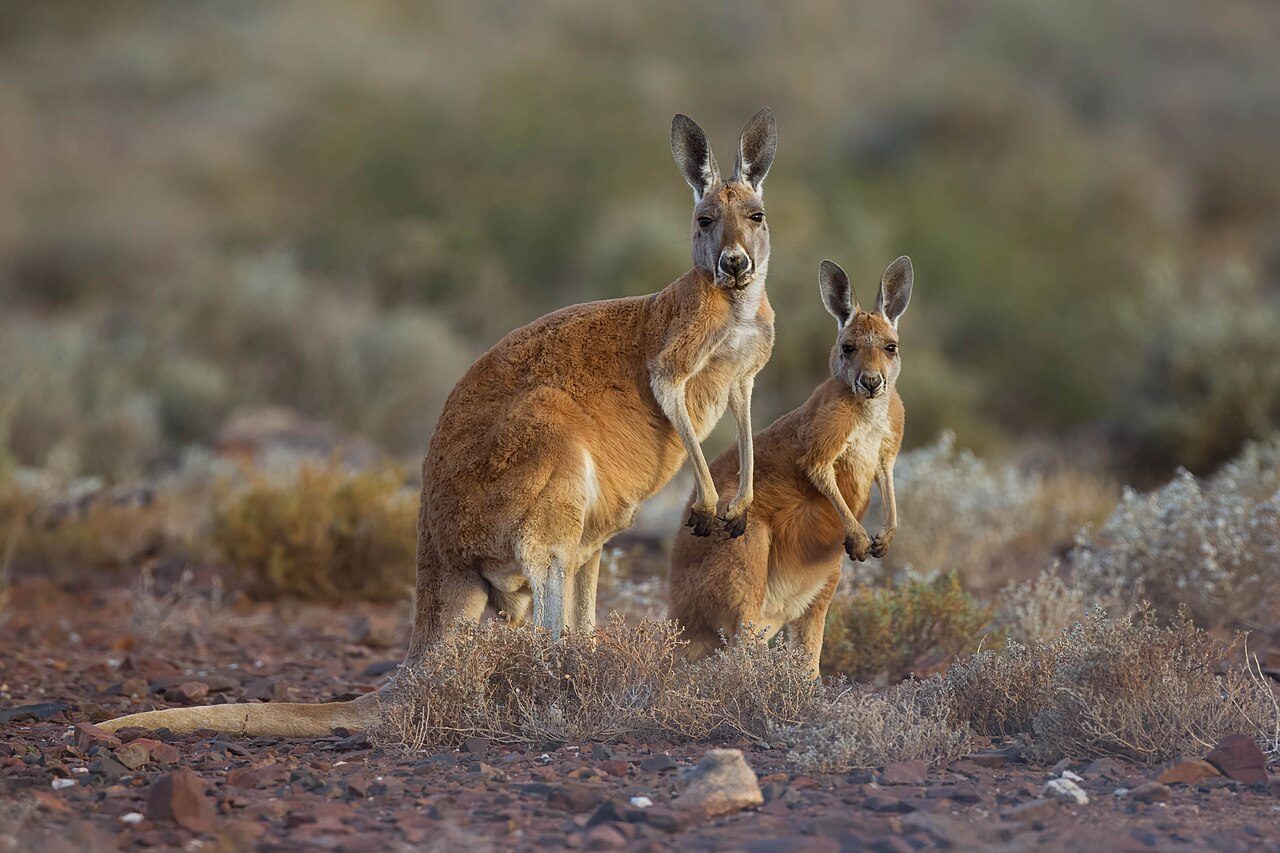
At a Glance
- Scientific name
- Osphranter rufus (formerly Macropus rufus)
- Distinction
- The largest living marsupial in the world, and Australia's largest native land mammal
- Size
- Body up to 1.4 metres with a tail up to 1 metre; males up to 92 kg, females up to 39 kg
- Range
- The semi-arid and arid regions of mainland Australia
- Diet
- Grasses, forbs and shrub leaves; can meet its water needs from its food when water is scarce
- Young
- Born after about 33 days at the size of a jellybean; leaves the pouch at about 235 days, suckles to 12 months
- Signature ability
- Embryonic diapause — a female can pause a pregnancy until her pouch is free
- Family
- Macropodidae — 'big foot' — with the wallabies, potoroos and tree kangaroos
Introduction
The red kangaroo is the largest living marsupial on Earth and the largest land mammal native to Australia. A big male stands taller than most people — up to about two metres, with a body as long as 1.4 metres and a tail adding another metre — and weighs as much as 92 kilograms, twice the weight of the blue-grey females. Everything about the animal is engineered for one of the harshest inhabited landscapes on the planet: the dry, open interior of a continent where food and water appear and vanish with the rain.
It travels by a method no other large animal uses. Kangaroos are the only big mammals that get about by hopping, and the red kangaroo's hop is a masterpiece of energy recycling: long tendons in the hind legs stretch on landing and spring back on take-off, so that within its working speeds the animal spends no more energy going fast than going slowly. Add a muscular tail used as a prop and a counterweight, a stomach built to ferment tough grass, and an ability to live on the water contained in its food, and you have an animal exquisitely fitted to the outback.
Background
Red kangaroos live across the semi-arid and arid regions of mainland Australia, most at home in open savanna woodland, grassland and shrubland. They are grazers first — grasses are the staple — but they also browse forbs and the leaves of shrubs, and their numbers rise and fall with the country itself: when drought shrinks the food supply, populations suffer; when rain greens the interior, they breed in the good season, though females can produce young all year round.
Their reproduction is the marsupial plan carried to an extreme. After a gestation of only about 33 days, a female gives birth to a single young the size of a jellybean, which climbs unaided into her pouch and develops there, leaving the pouch for good at around 235 days and suckling until it is about a year old. Stranger still, a female can hold a fertilised embryo in suspended animation — embryonic diapause — until the joey in her pouch has left, so that in good conditions she may support a youngster at foot, a joey in the pouch and a paused embryo all at once.
Timeline
- Early Pleistocene
The red kangaroo's fossil record reaches back to the Pleistocene — this is a lineage that shared Australia with marsupials far larger than itself.
- 1770
The crew of Cook's Endeavour, camped near modern Cooktown, meet the animal; the Guugu Yimithirr people share their word for it: gangurru.
- 1773
The official account of the Endeavour voyage is published with an engraving after George Stubbs' painting — the first printed illustration of a kangaroo, and an instant symbol of the continent.
- 1822
French zoologist Anselme Gaëtan Desmarest formally describes the red kangaroo as a species.
- 1880s
The kangaroo is branding products from bicycles to Billy Tea across the young Australian nation.
- 1908
The kangaroo takes its place on Australia's coat of arms — curiosity become official emblem.
- 2015
A taxonomic revision restores Osphranter as the red kangaroo's genus, replacing the long-used Macropus.
- 2019
The Australian government estimates 42.8 million kangaroos of the large species across the commercial harvest areas, down from 53.2 million in 2013 — numbers that swing with drought and rain.
Significance
The red kangaroo's scientific significance starts with its superlative: it is the biggest surviving example of the marsupial experiment, the alternative mammalian design that evolved in isolation in Australia while placental mammals took the rest of the world. Its hopping locomotion, its chambered, fermenting stomach and its pouch-based reproduction are all solutions no placental grazer ever found, and biomechanists still study how its tendons return energy with every bound — research with implications from prosthetics to robotics.
Culturally, the kangaroo did something no other animal has done: it became a continent's coat of arms, currency, airline and sporting mascot while remaining a wild, unmanaged presence across half that continent. The National Museum of Australia traces the arc — from the Guugu Yimithirr word shared in 1770, through Stubbs' painting and nineteenth-century product labels, to the coat of arms in 1908. The red kangaroo is the largest and most purely outback form of that national symbol.
Legacy
The red kangaroo remains abundant by the standards of large mammals — tens of millions of kangaroos of the large species range the interior — but its numbers are hostage to climate in a direct way few animals match: drought cuts its food, and its population falls with the grass. It is hunted commercially under regulation, watched by science as a model of desert adaptation, and recognised everywhere as the living signature of Australia.
Its deeper legacy is the proof it carries. For European science in 1770, the kangaroo was a creature that seemed to break the rules — an animal that carried its young in a pocket and moved by leaping. Two and a half centuries on, the red kangaroo still stands as the largest working demonstration that evolution found more than one way to build a great grazing mammal.
Sources
- The Australian Museum — Red Kangaroo
- National Museum of Australia — Kangaroo
- Encyclopaedia Britannica — Red kangaroo
- Wikipedia — Red kangaroo (corroboration)
The facts on this page were checked against these sources on 19 November 2026. The History Trail's permanent pages are researched and written for this site; the live profiles elsewhere on The History Trail are assembled automatically from Wikipedia and Wikidata.
About the Author
Researched and written by the The History Trail Editorial Team — the accountable editorial function behind this site's permanent story pages. The team works from the published sources cited on each page; it does not invent historians, reviewers or credentials, and it corrects errors openly.
Fact Check
Every load-bearing fact on this page traces to one of the sources listed above, and significant claims link to their source in the text. Our checking method is described on the methodology page; errors can be reported via the corrections page.
Sources & Citations
Cite this page as: The History Trail Editorial Team, The History Trail — this article's title, publication and update dates are shown beneath its headline. The full source list appears under Sources above; the site's source standards are on the sources page.