
Years
1905 in History
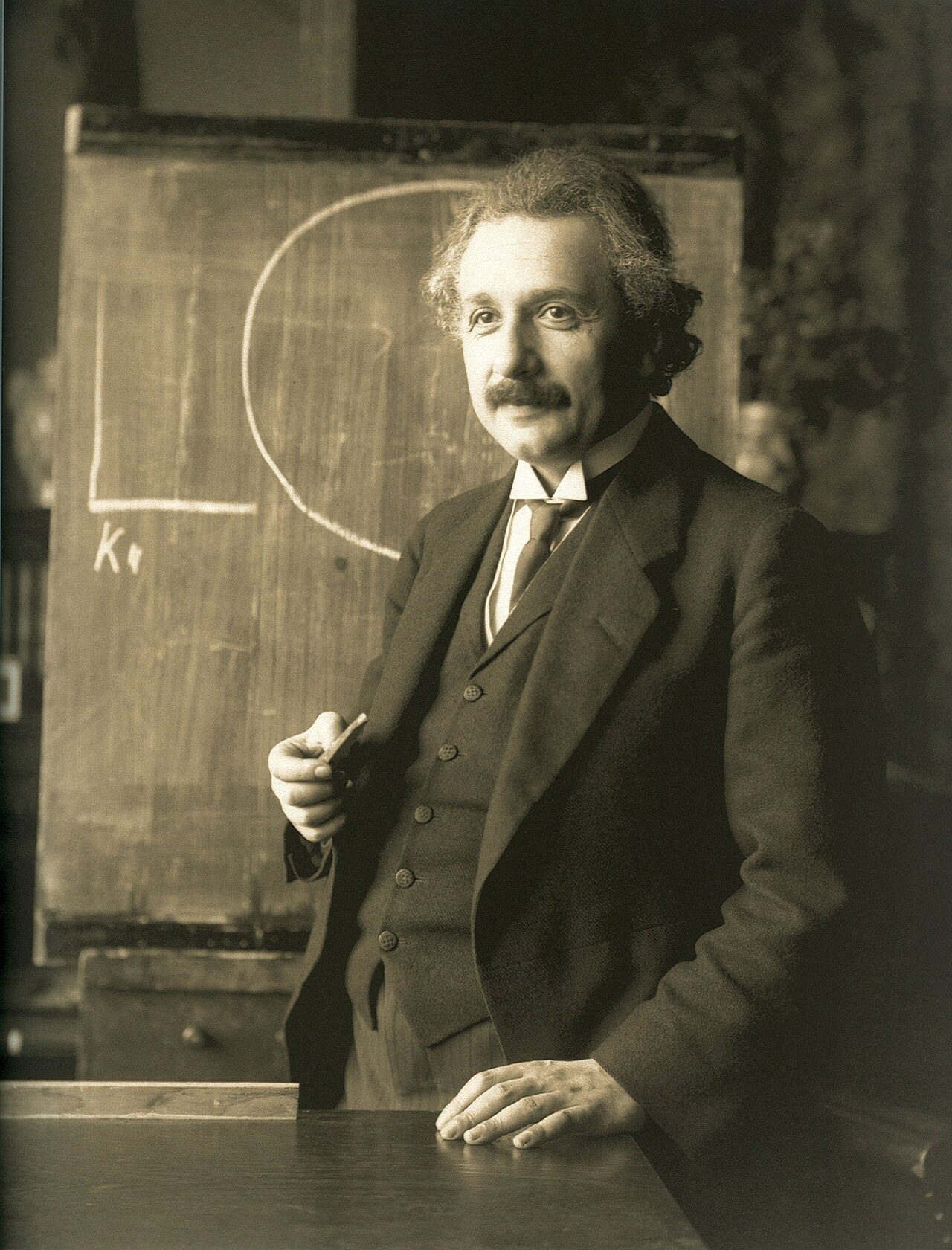
1905 is remembered for two revolutions. In Bern, a 26-year-old patent clerk named Albert Einstein published the papers of his miracle year — on the photoelectric effect, Brownian motion and special relativity, with E = mc² drawn out in a follow-up. In Russia, Bloody Sunday, the Potemkin mutiny and defeat by Japan produced the Revolution of 1905, the dress rehearsal for 1917.
At a Glance
- Defining event
- Einstein's miracle year: papers on the photoelectric effect, Brownian motion and special relativity, plus E = mc², while he works at the Bern patent office
- The paper
- 'On the Electrodynamics of Moving Bodies', setting out special relativity, is received by Annalen der Physik on 30 June 1905
- Revolution begins
- Bloody Sunday, 22 January: troops fire on a peaceful workers' procession in St. Petersburg, killing and wounding hundreds
- Defeat of the year
- At Tsushima, 28 May, Japan destroys the Russian Baltic Fleet, a turning point of the Russo-Japanese War
- Peace
- The Treaty of Portsmouth, mediated by Theodore Roosevelt, ends the Russo-Japanese War on 5 September
- Gem of the year
- The Cullinan diamond, the largest gem-quality rough diamond ever found, is unearthed in South Africa at 3,106 carats
The defining story: a clerk rewrites physics
In 1905 a 26-year-old clerk at the Swiss patent office in Bern published four papers that between them recast light, atoms, space and time. Albert Einstein's miracle year, as his record on this site calls it, produced papers on the photoelectric effect — treating light as something that can behave both as a wave and as a stream of particles — on Brownian motion, and on special relativity, along with the short follow-up that drew out mass–energy equivalence in the equation E = mc². He completed his doctorate at the University of Zürich in the same year, between patent applications.
The relativity paper arrived at the journal Annalen der Physik on 30 June, under the unassuming title 'On the Electrodynamics of Moving Bodies'. Its claims, as The History Trail's relativity record summarises them, were that the laws of physics are the same for all observers in uniform motion and that the speed of light is constant — so simultaneity, lengths and clock rates are relative, not absolute. Space and time, separate fixtures of physics since Newton, were recast as a single fabric. The 1921 Nobel Prize, when it came, would be awarded for the photoelectric effect paper, not for relativity — the committee honouring the miracle year's most provable paper rather than its most famous.
While Einstein rewrote the universe on paper, Russia's empire began to come apart in fact. On 22 January — Bloody Sunday — troops in St. Petersburg fired on a peaceful workers' procession petitioning the tsar, killing and wounding hundreds and shaking faith in Nicholas II. In May the empire's humiliation was completed at sea: at the Battle of Tsushima, Japan destroyed the Russian Baltic Fleet, the turning point of the Russo-Japanese War. In June, sailors of the battleship Potemkin mutinied in the Black Sea, an episode that became a symbol of revolution. Defeat abroad and revolt at home forced the tsar toward the concessions of the Revolution of 1905 — a promised parliament, the Duma, which he then repeatedly limited.
The war itself was ended by American mediation: the Treaty of Portsmouth, mediated by President Theodore Roosevelt, closed the Russo-Japanese War on 5 September. The year of upheaval also founded movements meant to outlast it: on 11 July members of the Niagara Movement, an early Black civil-rights organisation led by W. E. B. Du Bois, met for the first time on the Canadian side of Niagara Falls; and on 28 November Arthur Griffith founded Sinn Féin in Dublin, the party that would lead Ireland's independence movement.
Timeline of 1905
- 22 January
Bloody Sunday in St. Petersburg: troops fire on a peaceful workers' procession petitioning the tsar, killing and wounding hundreds.
- 26 January
The Cullinan diamond, the largest gem-quality rough diamond ever found, at 3,106 carats, is unearthed at the Premier Mine in South Africa.
- 17 March
Franklin D. Roosevelt marries Eleanor Roosevelt in New York, with President Theodore Roosevelt giving away his niece.
- 24 March
Jules Verne, novelist of Twenty Thousand Leagues Under the Seas, dies at Amiens at 77.
- 28 May
The Battle of Tsushima ends with Japan's destruction of the Russian Baltic Fleet.
- 27 June
Sailors of the Russian battleship Potemkin mutiny in the Black Sea.
- 30 June
Einstein's paper 'On the Electrodynamics of Moving Bodies', setting out special relativity, is received by Annalen der Physik.
- 11 July
Members of the Niagara Movement, led by W. E. B. Du Bois, meet for the first time on the Canadian side of Niagara Falls.
- 5 September
The Treaty of Portsmouth, mediated by Theodore Roosevelt, ends the Russo-Japanese War.
- 18 September
Greta Garbo, the Swedish-American film star, is born.
- 28 November
Arthur Griffith founds Sinn Féin in Dublin.
- 24 December
Howard Hughes, aviator, film producer and industrialist, is born.
Why 1905 still matters
The miracle year is the standing refutation of the idea that revolutions need institutions. Four papers from a patent office supplied a foundation for quantum theory, proved atoms by their jitter, and rebuilt space and time — and the follow-up equation, E = mc², foreshadowed the atomic age by showing how much energy is locked inside matter, as Einstein's record here notes. General relativity, a decade later, extended the work; the eclipse observations of 1919 confirmed it. Everything in modern physics runs through the Bern papers of 1905.
Russia's 1905 ran the opposite course: a revolution absorbed and postponed. As the Russian Revolution record on this site puts it, defeat by Japan triggered the Revolution of 1905, which forced Nicholas II to promise reforms and create the Duma — promises he then repeatedly limited. The grievances were catalogued, the methods rehearsed — strikes, mutinies, petitions answered with bullets — and the regime learned just enough to survive twelve more years. When the end came in 1917, it followed the script drafted in 1905.
Tsushima, meanwhile, announced a new distribution of power: a European great power's fleet destroyed by an Asian navy, in a war ended by an American president's mediation at Portsmouth. The twentieth century's map — Japan ascendant, Russia humiliated, the United States arbitrating — was sketched in a single year, by a clerk, a fleet action and a massacre outside a palace.
1905 on The History Trail
Einstein's miracle year leads this year on The History Trail, with Bloody Sunday, Tsushima and the Potemkin mutiny.
- June 30 in History — Einstein's special relativity paper is received by Annalen der Physik.
- January 22 in History — Bloody Sunday shakes faith in the tsar in St. Petersburg.
- May 28 in History — Japan destroys the Russian Baltic Fleet at Tsushima.
- June 27 in History — The sailors of the battleship Potemkin mutiny in the Black Sea.
- September 5 in History — The Treaty of Portsmouth ends the Russo-Japanese War.
- Albert Einstein — The patent clerk whose four papers of 1905 recast light, atoms, space and time.
- Theory of relativity — Special relativity in 1905, general relativity in 1915, and the eclipse that confirmed it.
- Russian Revolution — The upheaval whose script was drafted in the Revolution of 1905.
Sources
- Encyclopaedia Britannica — On This Day: June 30
- Encyclopaedia Britannica — On This Day: January 22
- Encyclopaedia Britannica — On This Day: May 28
- https://www.britannica.com/on-this-day/June-27
- Encyclopaedia Britannica — On This Day: September 5
- Encyclopaedia Britannica — On This Day: January 26
- Encyclopaedia Britannica — On This Day: July 11
- Encyclopaedia Britannica — On This Day: November 28
The facts on this page were checked against these sources on 19 November 2026. The History Trail's permanent pages are researched and written for this site; the live profiles elsewhere on The History Trail are assembled automatically from Wikipedia and Wikidata.
About the Author
Researched and written by the The History Trail Editorial Team — the accountable editorial function behind this site's permanent story pages. The team works from the published sources cited on each page; it does not invent historians, reviewers or credentials, and it corrects errors openly.
Fact Check
Every load-bearing fact on this page traces to one of the sources listed above, and significant claims link to their source in the text. Our checking method is described on the methodology page; errors can be reported via the corrections page.
Sources & Citations
Cite this page as: The History Trail Editorial Team, The History Trail — this article's title, publication and update dates are shown beneath its headline. The full source list appears under Sources above; the site's source standards are on the sources page.