
Timelines
History of the calendar
The calendar is humanity's longest-running attempt to force two cycles that do not divide into each other - the Moon's roughly 29.5-day month and the Sun's roughly 365.25-day year - into one workable count of days. This timeline follows the attempts that built the modern system: Egypt's 365-day year, Babylon's lunisolar cycle, Caesar's reform, the AD era devised in 525, and the Gregorian settlement of 1582, alongside the calendars that never gave way to it.
At a Glance
- The problem
- A lunar year of 12 months is about 354 days - some 11 days short of the solar year, so lunar and solar reckoning drift apart unless corrected
- First practical calendar
- The Egyptian civil calendar: 12 months of 30 days plus 5 extra days, 365 in all, with no leap year - so it wandered slowly through the seasons
- The lunisolar fix
- Babylon's 19-year cycle: a thirteenth month added seven times in 19 years to keep lunar months in step with the solar year
- The Julian reform
- From 1 January 45 BC: a solar year of 365 days with one leap day every four years, designed with the astronomer Sosigenes
- The AD era
- Devised in AD 525 by the monk Dionysius Exiguus for his Easter tables; there is no year zero - 1 BC is followed by AD 1
- The Gregorian reform
- 1582: a correction of the Julian calendar, told in full on this site's Gregorian calendar page; adopted in Britain only in 1752
- The modern layer
- ISO 8601 (first published 1988) standardises how dates are written, including ISO week dates - the calendar become invisible infrastructure
Introduction
Every calendar is a compromise dressed as a fact. The day is given by the Earth's rotation and the year by its orbit, but the month belongs to the Moon, and none of the three divides evenly into any other. So every civilisation that needed to plant, tax, feast or pray on schedule had to choose which cycle to honour and which to fudge - and the history of the calendar is the history of those choices, their errors, and the rare moments when a society admitted the error and reformed the count.
One line of those choices leads to the calendar on your phone. Several other lines never joined it, and still run beside it today.
Egypt, Babylon and Rome: Three Answers
Egypt's answer was the boldest simplification. The Egyptian civil calendar fixed every month at 30 days and added five extra days at the year's end: 365 days, every year, no exceptions, as Britannica describes it. It was the first practical calendar - but with no leap day, its New Year drifted against the seasons by about a day every four years, completing a full wandering circuit in roughly a millennium and a half. Egypt's priests knew: a reform decreed under Ptolemy III in 238 BC, the Canopus Decree, proposed a sixth extra day every fourth year, and was simply not kept.
Babylon's answer was to keep the Moon and correct it. Babylonian months alternated 29 and 30 days, and to stop the lunar year slipping through the seasons a thirteenth month was intercalated - by about 499 BC on a fixed rule, seven times in every 19 years, a cycle the Hebrew calendar later inherited. Rome's early answer was political: a lunar year of about 355 days, traditionally credited first to Romulus, said to have begun the year in March with ten months, and then to Numa, who added January and February. Those attributions are legend, not record - but the system was real, and by Caesar's time its keepers had let it drift some eight weeks from the seasons.
The Julian Reform: Caesar Takes Egypt's Answer
Julius Caesar's reform was Egypt's calendar, corrected. Advised by Sosigenes of Alexandria, Caesar abandoned the lunar reckoning altogether, as Britannica sets out: the year would be solar, 365 days, with one extra day every fourth year - the Egyptian 365 with the Canopus leap day finally applied. To clear the accumulated drift, 46 BC was stretched to 445 days, the year of confusion, and the new calendar began on 1 January 45 BC. Even then it stumbled: the leap day was at first inserted every three years instead of four, and Augustus had to suspend leap years to absorb the error. In Egypt, Augustus fixed the old civil calendar to the Julian count - the Alexandrine year - and that form survives as the Coptic calendar, still keeping Egypt's twelve 30-day months and five or six extra days.
Timeline
- Third millennium BC
Egypt's civil calendar: 12 months of 30 days plus 5 extra days - a fixed 365-day year with no leap day, wandering through the seasons.
- Legendary era
Roman tradition credits Romulus with a 10-month year beginning in March, and Numa with adding January and February - attributions Romans believed, not documented fact.
- c. 499 BC
Babylonians fix the 19-year cycle: a thirteenth month seven times in 19 years keeps lunar months in step with the seasons.
- 238 BC
Ptolemy III's Canopus Decree orders a leap day every four years for Egypt. It is not kept - but Caesar will revive the idea.
- 46-45 BC
Caesar, advised by Sosigenes, stretches 46 BC to 445 days, then launches the Julian calendar on 1 January 45 BC: 365 days, plus a leap day every four years.
- c. 30-26 BC
Augustus fixes Egypt's civil year to the Julian count - the Alexandrine calendar, ancestor of the Coptic calendar.
- AD 525
Dionysius Exiguus, preparing Easter tables in Rome, numbers years from the Incarnation - the Anno Domini era. There is no year zero.
- AD 622
The Hijra becomes the epoch of the Islamic calendar, a purely lunar count of 12 months and about 354 days.
- Middle Ages
Christian Europe shares the Julian calendar but not a New Year: the year begins at Christmas, at the Annunciation on 25 March, or at Easter, depending on place.
- 1582
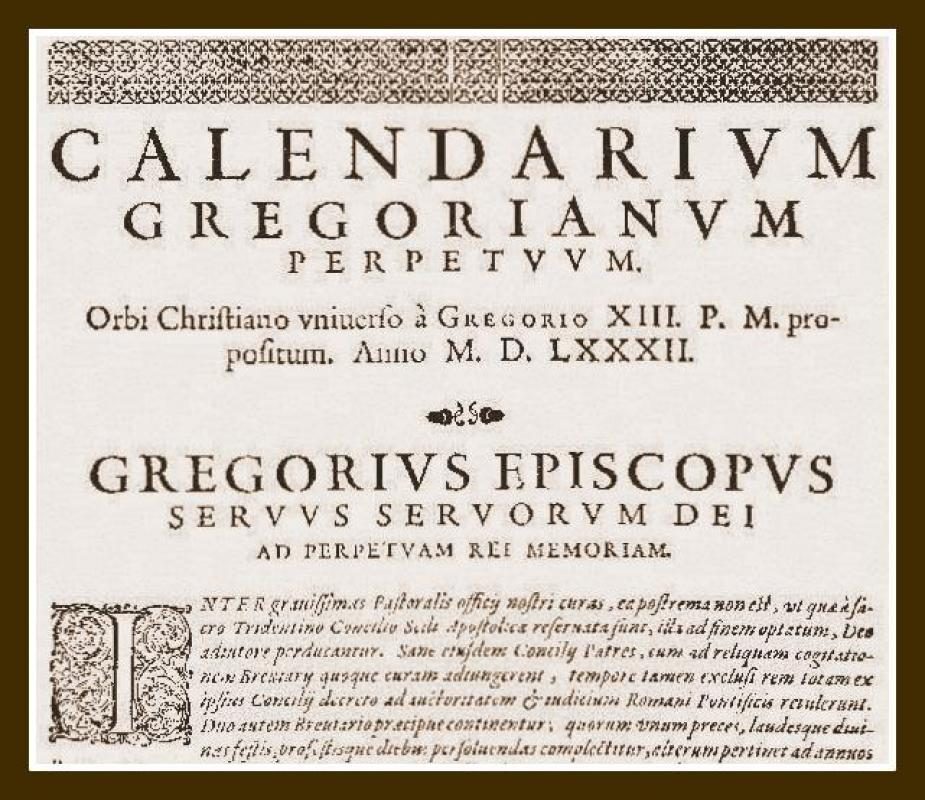
Pope Gregory XIII promulgates the Gregorian reform, correcting the Julian drift. Catholic states adopt it at once; others take centuries.
- 1752
Britain adopts the Gregorian calendar: 2 September is followed by 14 September, and the legal year begins on 1 January, not 25 March.
- 1793-1805
France replaces the Gregorian calendar with the Republican calendar - 12 months of 30 days, ten-day weeks, years counted from the Republic. Napoleon abolishes it from 1 January 1806.
- 1918
Russia adopts the Gregorian calendar for civil use, among the last major European states to do so.
- 1988
ISO 8601 is first published, standardising date notation, including week dates.
The Calendars That Never Yielded
The Julian-Gregorian line won the world's civil business, but never its worship, and three great systems still run on their own logic. The Hebrew calendar is Babylon's heir: lunisolar, adding a leap month seven times in 19 years so Passover stays in spring. The Chinese calendar is likewise lunisolar, setting months by the Moon and anchoring the year to solar terms, which is why Chinese New Year moves between late January and February. The Islamic calendar made the opposite choice: it kept the Moon and let the year go, refusing intercalation, so its 354-day years carry Ramadan through every season in a cycle of about 33 years. Each is a living answer to the same problem, optimised for a different loyalty.
Significance
The calendar is the oldest piece of standardised infrastructure humanity shares. Roads, laws and languages stop at borders; the count of days mostly does not. The reforms that mattered were administrative as much as astronomical: Caesar's fixed leap rule ended the priestly discretion that had let Rome's calendar be stretched for political convenience, and Dionysius's era, spread by Bede's history-writing, gave distant peoples a single numbering of years in which events could be compared. A calendar is a treaty between the sky and the state, and its history is the record of states slowly conceding to the sky.
Myths and disputes
Did the monks lose eleven days? The famous story belongs to Britain, not to monks, and not to 1582. When Britain adopted the Gregorian calendar in 1752, eleven days - not ten, because the gap had grown - were omitted from September, and legend says crowds rioted demanding their eleven days back. Historians have found no such riots: the slogan survives from a placard in Hogarth's 1755 election satire and from opposition electioneering, not from any documented disturbance, and the Calendar Act had protected rents, wages and contracts by real elapsed time. What was genuinely lost was not days but agreement: for 170 years after 1582, neighbouring countries could disagree about the date by ten or eleven days, and correspondents resorted to double-dating their letters.
The October 1582 skipped days belong to the Gregorian reform's own story, told on this site's Gregorian calendar page; its uneven adoption is where the 'lost days' tales breed. And Dionysius's era is misaligned with its own subject: the evidence places the birth he counted from a few years before AD 1, which is why scholars date it to about 5 BC - a monk's honest miscalculation, preserved in every date since.
Legacy
The modern settlement is layered. Underneath sits the Gregorian calendar, used for civil purposes almost worldwide; beside it run the religious and cultural calendars, un-reformed; and on top sits a clerical layer, ISO 8601, which since 1988 has standardised not the calendar itself but how its dates are written - year first, with week dates counted in numbered weeks. France's revolutionaries tried in 1793 to rebuild the whole edifice on decimal principles; their calendar lasted barely twelve years, because a calendar is something people live inside. Egypt's wandering year, Babylon's cycle, Caesar's leap day and Dionysius's era all survive in the date at the top of this page - infrastructure so complete it has become invisible.
Sources
- Encyclopaedia Britannica - Calendar
- Encyclopaedia Britannica - Calendar: The Western calendar and calendar reforms
- Royal Museums Greenwich (National Maritime Museum) - Calendars from around the world
- Claremont Colleges, Coptic Encyclopedia - Calendar, Coptic
- Armagh Robinson Library - Exhibition: History of Calendars
- Royal Museums Greenwich - An Election Entertainment (Hogarth) and the eleven days
The facts on this page were checked against these sources on 19 November 2026. The History Trail's permanent pages are researched and written for this site; the live profiles elsewhere on The History Trail are assembled automatically from Wikipedia and Wikidata.
About the Author
Researched and written by the The History Trail Editorial Team — the accountable editorial function behind this site's permanent story pages. The team works from the published sources cited on each page; it does not invent historians, reviewers or credentials, and it corrects errors openly.
Fact Check
Every load-bearing fact on this page traces to one of the sources listed above, and significant claims link to their source in the text. Our checking method is described on the methodology page; errors can be reported via the corrections page.
Sources & Citations
Cite this page as: The History Trail Editorial Team, The History Trail — this article's title, publication and update dates are shown beneath its headline. The full source list appears under Sources above; the site's source standards are on the sources page.