
Things
Venus
Venus matches Earth in size and sits next door, yet it is the hottest planet in the solar system, crushed under ninety times our air pressure, spinning backwards so slowly that its day outlasts its year. Spacecraft took thirty years of visits to see the volcanic world under its clouds.
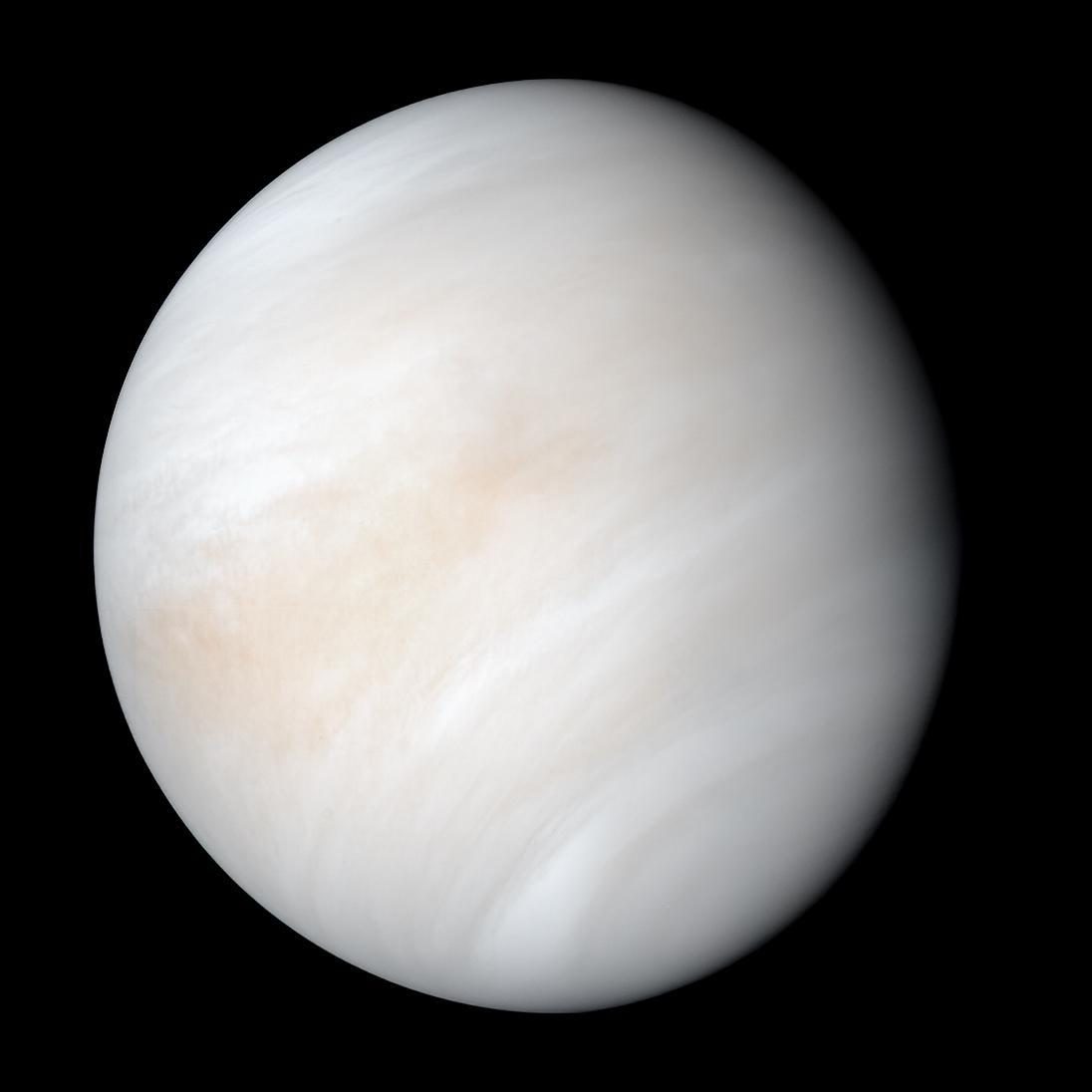
At a Glance
- Position
- Second planet from the Sun; Earth's closest planetary neighbour
- Surface temperature
- About 467 degrees Celsius, the hottest planet in the solar system
- Surface pressure
- About 93 times Earth's sea-level pressure
- Atmosphere
- Mostly carbon dioxide, with clouds of sulphuric acid
- Rotation
- Retrograde; one turn takes 243 Earth days, longer than its 225-day year
- First visit
- Mariner 2 flyby, 14 December 1962
- First landing
- Venera 7 (USSR), 15 December 1970
- Best map
- Magellan radar mapping, 1990-1994, about 98 percent of the surface
Introduction
Venus is the second planet from the Sun, Earth's closest planetary neighbour, and close enough in size and structure to be called Earth's twin. The resemblance ends at the clouds. Beneath a permanent deck of corrosive, light-coloured cloud, Venus keeps the hottest surface of any planet in the solar system, about 467 degrees Celsius, hot enough to melt lead, under an atmospheric pressure some 93 times that at sea level on Earth. It is the third brightest object in our sky after the Sun and Moon, and one of the most hostile places known.
The engine of that hostility is its atmosphere, a deep blanket of carbon dioxide that traps heat in what NASA calls a runaway greenhouse effect. Mercury, closer to the Sun, lets its heat escape to space each night; Venus cannot. The result is a surface that stays at nearly the same fierce temperature at the poles and the equator, by day and by night, while sulphuric-acid clouds race overhead on winds far faster than the planet itself turns.
Background
Venus also turns the wrong way, and barely turns at all. It spins slowly in the opposite direction to most planets, a retrograde rotation so leisurely that one full turn takes 243 Earth days, longer than its own year of about 225 Earth days. From sunrise to sunrise takes about 117 Earth days, and the Sun, perversely, rises in the west. Why Venus ended up upside down and nearly stopped, whether through ancient collisions or the slow drag of its own thick air, remains an open question in planetary science.
Because the clouds never part, the surface was a blank until radar arrived. Spacecraft changed that in stages: NASA's Mariner 2 flew past in 1962, the first successful visit to any planet; Soviet Venera landers reached the surface from 1970, surviving long enough to send back data and photographs; and NASA's Magellan orbiter, launched in 1989, mapped almost the entire planet through the cloud with radar. The world it revealed is volcanic: vast lava plains, deformed mountains and a surface young enough, in geological terms, to suggest Venus resurfaces itself.
Timeline
- 14 December 1962
NASA's Mariner 2 flies past Venus, the first successful spacecraft visit to another planet, and confirms the surface is extremely hot.
- 15 December 1970
The Soviet Venera 7 lands on Venus, the first spacecraft to touch down on another planet and transmit data from the surface.
- 1975
Venera 9 returns the first photographs from the surface of another planet, showing a rocky landscape under orange light.
- 20 May 1978
Pioneer Venus 1 launches; it becomes the first United States spacecraft to orbit Venus and maps the planet by radar.
- 4 May 1989
NASA launches the Magellan orbiter from the cargo bay of the space shuttle Atlantis.
- 1990-1994
Magellan maps about 98 percent of Venus by radar through the clouds, revealing a volcanic surface of plains, highlands and mountains.
- 9 November 2005
The European Space Agency launches Venus Express, the first European spacecraft to orbit Venus.
- 15 March 2023
Re-examination of Magellan radar images shows a volcanic vent changing shape in 1991, direct evidence of recent volcanic activity on Venus.
Significance
Venus is the solar system's standing warning about atmospheres. Two planets formed at similar sizes from similar material, and one kept oceans while the other lost its water, thickened its sky and cooked. Working out when and how Venus diverged, whether it once had oceans and for how long, bears directly on how scientists judge rocky planets around other stars, where the line between an Earth-like world and a Venus-like one decides where life could plausibly persist.
The planet also anchors the physics of the greenhouse effect in observation rather than theory. Its carbon dioxide atmosphere, crushing pressure and sulphuric-acid clouds are measured facts, returned by dozens of missions, and they demonstrate how far a runaway process can go when a planet cannot shed heat. Venus is not a prediction; it is an outcome, preserved next door for study.
Legacy
Venus was the first planet ever visited by a spacecraft and for decades the most visited, yet it then spent a generation comparatively neglected while Mars took the attention. That is reversing: NASA is planning the DAVINCI and VERITAS missions, and Europe its EnVision orbiter, all aimed at the questions Magellan left open, from the history of Venusian water to whether its volcanoes are still feeding the atmosphere today.
The twin that turned out to be a warning has become a destination again. Each new measurement sharpens the comparison with Earth, and with the thousands of rocky exoplanets now being catalogued, many of which will be Venus-like rather than Earth-like. Understanding the planet next door has become part of understanding where, in general, habitable worlds end.
Sources
- NASA Science — Venus: Facts
- NASA Science — Venus: Exploration
- NASA Jet Propulsion Laboratory — NASA's Magellan Data Reveals Volcanic Activity on Venus (2023)
- Wikipedia — Venus
The facts on this page were checked against these sources on 19 November 2026. The History Trail's permanent pages are researched and written for this site; the live profiles elsewhere on The History Trail are assembled automatically from Wikipedia and Wikidata.
About the Author
Researched and written by the The History Trail Editorial Team — the accountable editorial function behind this site's permanent story pages. The team works from the published sources cited on each page; it does not invent historians, reviewers or credentials, and it corrects errors openly.
Fact Check
Every load-bearing fact on this page traces to one of the sources listed above, and significant claims link to their source in the text. Our checking method is described on the methodology page; errors can be reported via the corrections page.
Sources & Citations
Cite this page as: The History Trail Editorial Team, The History Trail — this article's title, publication and update dates are shown beneath its headline. The full source list appears under Sources above; the site's source standards are on the sources page.