
Things
Sushi
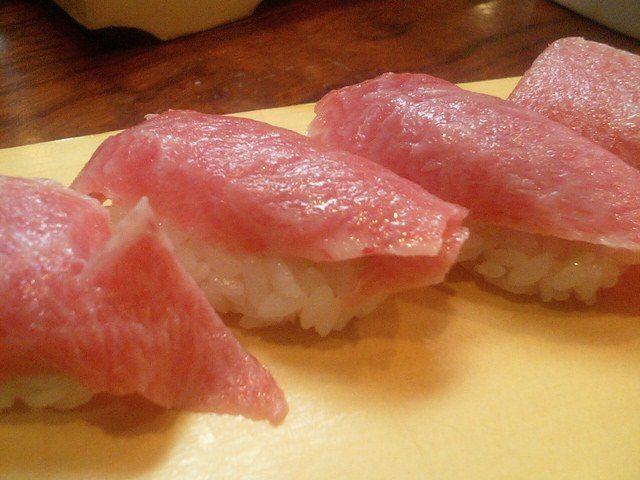
Sushi is a Japanese dish of vinegared rice topped or rolled with seafood, egg or vegetables - but it began in Southeast Asia as narezushi, a way of preserving fish by fermenting it in salted rice, with the rice thrown away. In Edo, now Tokyo, vinegar replaced fermentation, and in the 1820s Hanaya Yohei was credited with nigiri, the hand-pressed sushi the world now knows.
At a Glance
- What it is
- A Japanese dish of vinegared rice with seafood, egg or vegetables; the word sushi names the rice, not raw fish
- The earliest form
- Narezushi: fish fermented for months in salted rice, developed in Southeast Asia; the rice was originally discarded
- First Japanese record
- The Yoro Code of 718 contains the earliest written reference to sushi in Japan
- The turning point
- In the Muromachi period the rice began to be eaten with the fish; in the Edo period vinegar replaced fermentation
- Nigiri
- Hand-pressed sushi created in Edo (now Tokyo) in the 1820s; Hanaya Yohei is credited with inventing or perfecting it in 1824
- Going global
- The California roll was created in North America in the 1960s-70s - its exact maker is disputed - and supermarket sushi followed
- Heritage
- In 2013 UNESCO inscribed washoku, Japan's traditional dietary cultures, as Intangible Cultural Heritage of Humanity
Introduction
Modern sushi - a bite of vinegared rice shaped by hand and topped with raw or cooked seafood - looks timeless, but it is one of the youngest forms of a very old food. Sushi began not as a delicacy but as a way to keep fish from rotting: freshwater fish packed in salt and cooked rice and left to ferment, a method developed in Southeast Asia and carried, by way of China, to Japan. For most of sushi's history the rice was a preservative to be thrown away. The transformation into the dish the world now knows happened in one city - Edo, today's Tokyo - in the early 19th century, when Hanaya Yohei is credited with serving nigiri, hand-pressed sushi, as fast food for a busy city.
Narezushi: Sushi as Preservation
The earliest form, now called narezushi, originated in Southeast Asia, most likely around the Mekong River basin, as a method of preserving freshwater fish. Cleaned fish were salted and packed into cooked rice; lactic-acid fermentation soured the rice and protected the fish for months, and when the fish was eaten the rice was discarded. The technique is first documented in Chinese records - a Chinese dictionary of around the fourth century describes salted fish placed in rice and fermented - and it reached Japan with rice culture itself. Japan's earliest written reference to sushi appears in the Yoro Code of 718.
In Japan the method slowly shortened. During the Muromachi period (1336-1573) a half-fermented style called namanare became popular, in which fermentation took a month or two rather than many months, and the rice - now pleasantly sour rather than ruined - began to be eaten with the fish instead of thrown away. That single change is the hinge of sushi's whole history: from here on, sushi is a dish of fish and rice together, and the rice becomes its defining element. A fully fermented narezushi survives today as a regional speciality, funa-zushi, made with crucian carp from Lake Biwa in Shiga Prefecture.
Edo: Vinegar, Stalls and Nigiri
The Edo period (1603-1867) removed the wait. Instead of fermenting rice to sour it, makers added vinegar directly, producing haya-zushi, fast sushi, in which rice and fish could be assembled and eaten the same day. Edo - the shogun's capital, one of the largest cities on earth, with a huge class of townspeople eating away from home - was the perfect market. Street stalls sold sushi alongside tempura and noodles as fast food.
In the 1820s the form that conquered the world appeared: nigirizushi, an oblong mound of vinegared rice pressed in the hand and draped with a slice of fish, much of it caught in Edo Bay - hence its other name, Edomae sushi, in front of Edo. Tradition credits the chef Hanaya Yohei (1799-1858), who is said to have invented or perfected the technique in 1824 at his shop in the Ryogoku district. His nigiri was larger than today's, made to order and eaten at once, with the fingers, standing at a stall. The credit should be read as credited, not proved - it rests on later writings, and other names are attached to early nigiri - but Yohei's shop was real and famous. After the Great Kanto Earthquake of 1923 displaced Edo's sushi chefs across Japan, nigiri spread nationwide.
Timeline
- Early centuries CE
Narezushi - fish preserved by fermentation in salted rice - develops in Southeast Asia and is documented in Chinese records.
- 718
The Yoro Code contains Japan's earliest written reference to sushi.
- Muromachi period (1336-1573)
Namanare, a shorter-fermented sushi, becomes popular in Japan, and the rice begins to be eaten with the fish.
- Edo period (1603-1867)
Haya-zushi, fast sushi, replaces fermentation with vinegar added directly to the rice.
- 1824
Hanaya Yohei is traditionally credited with inventing or perfecting nigirizushi at his shop in Ryogoku, Edo.
- 1820s-1830s
Hand-pressed nigiri becomes popular across Edo, sold from street stalls as fast food for townspeople.
- 1923
The Great Kanto Earthquake displaces Edo's sushi chefs, who carry nigiri across Japan.
- Mid-1960s
Sushi chefs in Los Angeles's Little Tokyo create the California roll, swapping fatty tuna for avocado and hiding the nori inside.
- 1996
Pre-packaged sushi reaches American supermarkets nationally, with the California roll a favourite, per the Smithsonian.
- December 2013
UNESCO inscribes washoku, the traditional dietary cultures of the Japanese, as Intangible Cultural Heritage of Humanity.
Sushi Goes Global
Sushi's second transformation was American. Sushi's breakthrough came in Los Angeles's Little Tokyo in the 1960s, where, the Smithsonian's National Museum of American History records, the neighbourhood's restaurants drew Japanese businessmen and their American colleagues. Adapting the food to new diners, Little Tokyo chefs in the mid-1960s created the California roll: avocado standing in for expensive fatty tuna, crab alongside, and the unfamiliar black nori hidden inside the roll, with rice on the outside. By the 1980s sushi signified sophistication in American cities; by the 1990s, pre-packaged sushi in supermarkets had made it an everyday food. From America the pattern repeated worldwide - each country first adapting sushi, then, often, circling back to the Edo original.
Significance
Sushi's significance is the distance travelled by a preservation technique. A method for keeping freshwater fish edible without refrigeration became, step by step - eat the rice, sour it with vinegar instead of time, press it by hand, serve it in seconds - a cuisine built on freshness, seasonality and the skill of the individual chef. Few foods carry their evolution so visibly: funa-zushi still ferments for months in Shiga while, a train ride away, Tokyo counters serve nigiri made in under a minute, and both are genuinely sushi.
It is also Japan's most successful cultural export. In 2013 UNESCO inscribed washoku - the traditional dietary cultures of the Japanese, the whole social practice around food, not any single dish - on its Representative List of the Intangible Cultural Heritage of Humanity. Sushi, washoku's most recognised ambassador, had by then already taught the world to eat raw fish and vinegared rice, and to trust the chef - omakase, I leave it to you - rather than the menu.
Myths and disputes
Was sushi invented in Japan? Not from nothing. The fermentation method behind narezushi came from Southeast Asia by way of China; what Japan invented, over a thousand years, was everything that turned a preservative into a cuisine - eating the rice, the vinegar shortcut, and finally nigiri. Was Hanaya Yohei the sole inventor of nigiri? He is credited with inventing or perfecting it, and this page keeps that wording deliberately: the evidence is later tradition rather than contemporary record, and some accounts share the credit, naming Sakaiya Matsugoro of Matsunozushi alongside him. Nigiri may have been less an invention than the moment several Edo stalls converged on the same fast, hand-pressed form.
Who created the California roll is likewise disputed. The Smithsonian's museum account credits unnamed sushi chefs in Little Tokyo, Los Angeles, in the mid-1960s. A rival claim belongs to chef Hidekazu Tojo of Vancouver, who says he made the inside-out roll there after opening his restaurant in 1971, and whom Japan later honoured as an ambassador for Japanese cuisine; Los Angeles's Tokyo Kaikan restaurant has also claimed its chef Ichiro Mashita. The claims cannot all be first, and the honest position is that the roll emerged in North America in that era, its exact maker unresolved. One simpler correction: sushi does not mean raw fish. It names the vinegared rice; raw fish served alone is sashimi, and much sushi - shrimp, egg, eel - is cooked.
Legacy
Sushi's legacy is a world remade in one dish's image: conveyor-belt shops and supermarket trays at one end, counters where a single chef serves a dozen guests at the other, and everywhere the idea that raw fish, rice and a trained hand can be a complete meal. Its global spread also carries a cost the Smithsonian notes plainly - demand for prized fish such as bluefin tuna has outrun the stocks, pushing chefs and diners towards sustainable choices. The food that began as a way to make fish last now depends on making fish stocks last.
Sources
- Smithsonian Magazine (National Museum of American History) - Answering Your Five Biggest Questions About American Sushi
- Smithsonian Institution - Sushi Collection
- UNESCO Intangible Cultural Heritage - Washoku, traditional dietary cultures of the Japanese, notably for the celebration of New Year
- Kikkoman Food Forum (Terutoshi Hibino) - The History of Sushi
- Mizkan - Mizkan and the Origin of Sushi
The facts on this page were checked against these sources on 19 November 2026. The History Trail's permanent pages are researched and written for this site; the live profiles elsewhere on The History Trail are assembled automatically from Wikipedia and Wikidata.
About the Author
Researched and written by the The History Trail Editorial Team — the accountable editorial function behind this site's permanent story pages. The team works from the published sources cited on each page; it does not invent historians, reviewers or credentials, and it corrects errors openly.
Fact Check
Every load-bearing fact on this page traces to one of the sources listed above, and significant claims link to their source in the text. Our checking method is described on the methodology page; errors can be reported via the corrections page.
Sources & Citations
Cite this page as: The History Trail Editorial Team, The History Trail — this article's title, publication and update dates are shown beneath its headline. The full source list appears under Sources above; the site's source standards are on the sources page.