
Things
Sulfur
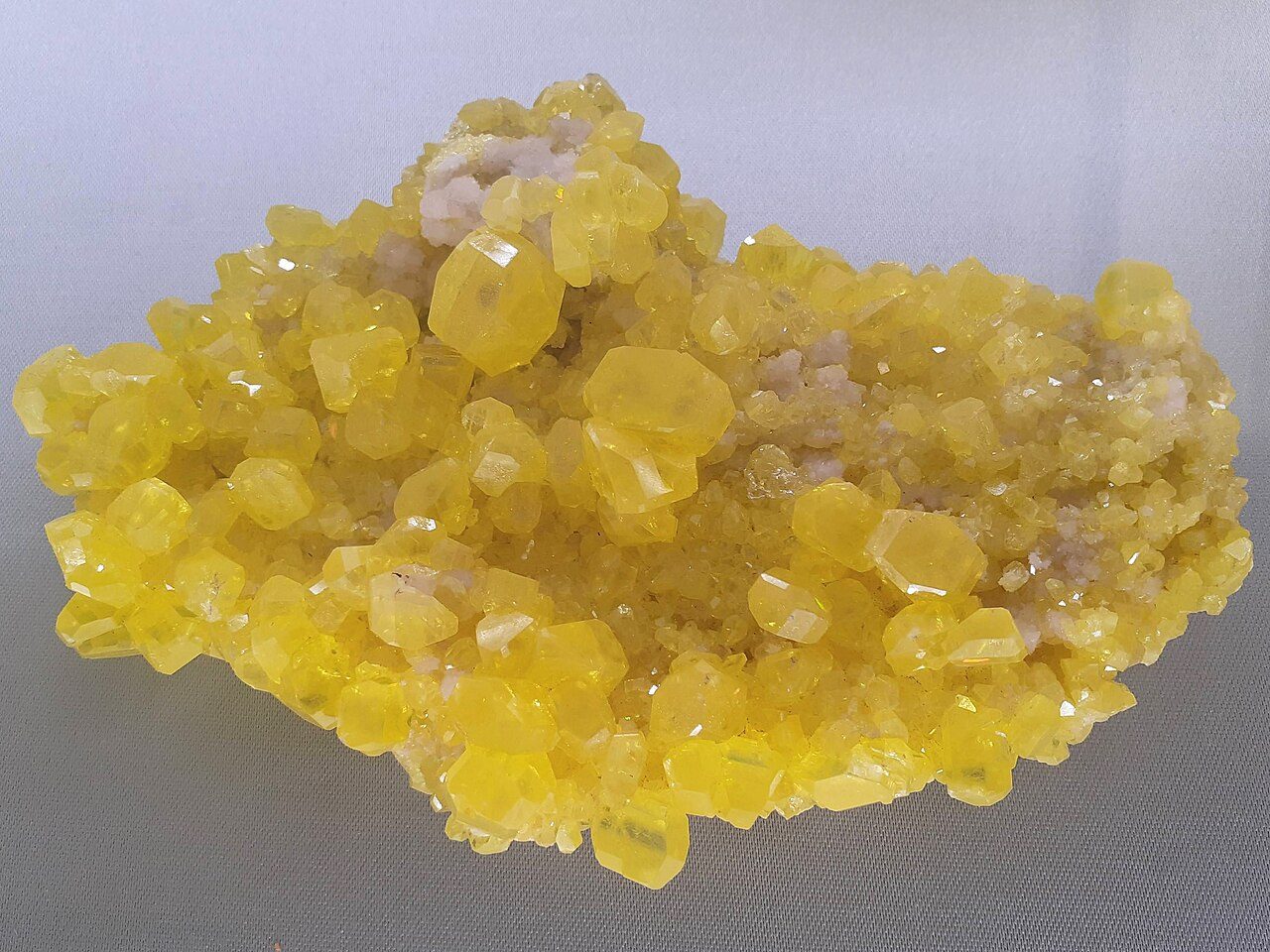
Sulfur, element S, is a yellow non-metal known since prehistory - brimstone in the Bible, a fumigant in Homer, and one of gunpowder's three ingredients. In the nineteenth century Sicily's mines supplied the sulfuric acid on which the chemical industry ran; in the 1890s Herman Frasch learned to melt sulfur out of Louisiana salt domes with superheated water, and the world's sulfur trade changed hands within a decade.
At a Glance
- What it is
- A non-metallic element, symbol S, atomic number 16; bright yellow, brittle, occurring native near volcanoes and in sedimentary deposits
- Brimstone
- Its old English name - the burning stone - from its use in ancient fumigation and its place in biblical images of fire and judgement
- An element since
- Recognised as an element by Antoine Lavoisier in 1777 and confirmed by Gay-Lussac and Thenard in 1810; known and used since prehistory
- Gunpowder
- One of black powder's three ingredients (with saltpetre and charcoal); the earliest written gunpowder formula is Chinese, 9th century
- Sicily
- The island's mines held a near-monopoly of mined sulfur in the 19th century, feeding British and French acid and soda works; its 1838 monopoly grant triggered the Sulfur Crisis of 1840
- Sulfuric acid
- Roebuck's lead-chamber process (1746) began large-scale manufacture; the contact process (patented 1831) is now universal; most sulfur produced goes to make this acid
- Frasch process
- Herman Frasch's method (patented 1890-91, working 1894) melts sulfur underground with superheated water and pumps it up - it collapsed the Sicilian trade within a decade
Introduction
Sulfur - spelled sulphur in older British usage - is element 16, symbol S: a brittle, bright-yellow non-metal that occurs native around volcanoes and hot springs, and in vast sedimentary deposits. It is one of the very few elements known to humanity from prehistory, because it needs no smelting: it can be picked up as yellow crystals, and it burns. It burns with choking fumes, and that - a stone that catches fire - fixed its place in the ancient imagination as brimstone, the stuff of divine punishment.
But sulfur's real history is industrial as much as theological. It fumigated Greek houses and treated Egyptian skin; it became one of the three ingredients of gunpowder; Sicily's mines supplied the world's chemical industry for a century; and its acid - sulfuric acid, made in larger quantities than any other industrial chemical - became so central that economists once read a nation's acid output as a measure of its industrial strength. In 1890 a German-American chemist patented a method of melting sulfur out of the ground with hot water, and the map of sulfur moved from Sicily to America's Gulf Coast.
Brimstone: Sulfur in the Ancient World
Sulfur appears in some of humanity's oldest medical writing: the Egyptian Ebers Papyrus records a sulfur ointment for granular eyelids, and sulfur preparations were used in ancient Egypt, Greece and China for fumigation, bleaching and medicine. Homer describes Odysseus fumigating his hall with burning sulfur after killing the suitors - sulfur dioxide is a genuine disinfectant, and the ritual had a practical core. In China, sulfur was known by the sixth century BCE under a name recorded as shiliuhuang.
In the Bible, English translations render burning sulfur as brimstone - literally the burning stone - and fire and brimstone became the standard image of judgement, an association strengthened by sulfur's volcanic sources: deposits crust the rims of volcanoes, and the fumes of an eruption smell of it. Pliny the Elder catalogued sulfur's uses in the first century CE and died in 79 CE during the eruption of Vesuvius, in all probability overcome by volcanic gases. For the alchemists, sulfur stood for combustibility itself - a principle in the sulfur-mercury theory and in Paracelsus's tria prima. Not until 1777 did Antoine Lavoisier recognise it as an element, a status confirmed by Gay-Lussac and Thenard in 1810.
Gunpowder and the Sicilian Century
Sulfur's first great industrial role was explosive. Chinese experimenters seeking elixirs mixed sulfur with saltpetre and charcoal; the earliest known written gunpowder formula dates to the ninth century, and gunpowder weapons followed in China before the knowledge spread west. Black powder - roughly three-quarters saltpetre, with charcoal and about a tenth sulfur - remained the world's only practical explosive and propellant for some six centuries, and every gunpowder state needed secure sulfur.
From the late eighteenth century, a second demand eclipsed the first: sulfuric acid and soda. The Leblanc process for soda ash (patented 1791) and the growing acid trade made Sicilian sulfur - dug from the gypsum-sulfur plateau of the island's centre, around Caltanissetta, Enna and Agrigento - a strategic commodity. Sicily held a near-monopoly of the world's mined sulfur through the nineteenth century; its exports ran to hundreds of thousands of tons a year at the industry's height, much of it refined by the crude calcarone method, in which part of the ore was burned to melt out the rest. The work, much of it by hand in deep, hot galleries, was notorious for its conditions, including the labour of child carriers, the carusi. When the Bourbon government granted a sulfur monopoly to a French company in 1838, Britain - whose chemical works depended on Sicilian supply - forced the issue in the Sulfur Crisis of 1840, an early lesson in resource geopolitics.
Timeline
- Ancient era
Sulfur ointments are recorded in Egypt's Ebers Papyrus; Greeks fumigate with burning sulfur, as Homer describes in the Odyssey.
- 6th century BCE
A natural sulfur, shiliuhuang, is known in China.
- 79 CE
Pliny the Elder, who catalogued sulfur's uses, dies during the eruption of Vesuvius, probably overcome by volcanic gases.
- 9th century
The earliest known written gunpowder formula appears in China; sulfur is one of its three ingredients.
- 1746
John Roebuck's lead-chamber process in Birmingham begins large-scale sulfuric acid manufacture from burning sulfur.
- 1777
Antoine Lavoisier recognises sulfur as an element; Gay-Lussac and Thenard confirm its elemental nature in 1810.
- 1831
Peregrine Phillips patents the contact process for sulfuric acid, later the universal method.
- 1838-1840
The Sulfur Crisis: a Bourbon sulfur monopoly in Sicily collides with British chemical industry's dependence on Sicilian supply.
- 1867
A large sulfur deposit is found in a Louisiana salt dome at Calcasieu Parish - rich, but buried under quicksand and unreachable by ordinary mining.
- 1890-1894
Herman Frasch patents his melting process (1890-91); in 1894 molten sulfur is first raised successfully in Louisiana.
- 1906
US Frasch production collapses Sicilian exports to America - from over 100,000 tons a year to a few thousand.
- 2000
The last US Frasch mine closes; most sulfur now comes from oil and gas refining, where it must be removed anyway.
The Acid at the Centre of Industry
Sulfuric acid turned sulfur from a commodity into a foundation. Large-scale manufacture began in 1746, when the English physician John Roebuck burned sulfur in lead-lined chambers in Birmingham - the lead-chamber process, which made acid by the hundredweight instead of the flask and served industry for almost two centuries, though it could not exceed about 78 percent concentration. The contact process, patented by Peregrine Phillips in 1831, passed sulfur dioxide over a catalyst to make sulfur trioxide and hence strong, concentrated acid; spreading widely in the late nineteenth century, especially in Germany, it had largely replaced the chamber process by the mid-twentieth century and remains the universal method.
The acid's uses explain the demand: fertiliser manufacture above all, but also petroleum refining, metal processing, detergents and chemicals of every kind. Millions of tons of sulfur are produced each year, mostly for sulfuric acid - a chemical so basic to industry that its production figures were long treated as an index of a country's industrial development. Sicily's mines existed, in their great century, largely to feed this acid hunger in Britain and France.
The Frasch Process: Melting a Mine
The Louisiana deposit of 1867 mocked conventional mining: the sulfur lay hundreds of feet down in a salt dome, under quicksand that swallowed shafts. Herman Frasch, a German-born chemist working on sulfur problems for the oil industry, solved it by not digging at all. His process, patented in 1890 and 1891 and first successful in 1894, sinks three concentric pipes into the deposit, pumps superheated water - about 170 degrees Celsius - down to melt the sulfur in place, and uses compressed air to lift the molten sulfur to the surface, where it solidifies in great vats at 99.5 percent purity or better, needing no refining.
Frasch sulfur broke Sicily. Within a decade the Union Sulfur Company was supplying the American market Sicily had owned; Sicilian exports to the United States fell from over 157,000 tons in 1903 to about 7,000 tons in 1906, and the island's industry entered a long decline. Frasch mining dominated world sulfur until the late twentieth century, when sulfur recovered from sour gas and oil refining - where it is an unwanted contaminant that must be stripped out - overtook it. The last American Frasch mine closed in 2000, though the process is still used in a few places, including Mexico and Poland.
Legacy
Sulfur's legacy is that the brimstone of sermons became the invisible base of the industrial world. It sits in fertiliser that feeds crops, in the acid that refines fuel and processes metals, in vulcanised rubber, and in medicines from ancient ointments to sulfa drugs. Its history also carries the recurring pattern of strategic materials: a Sicilian monopoly broken by diplomacy and then by technology, a Louisiana salt dome that redrew the trade, and a final irony - today most sulfur is not mined at all, but recovered because the fuel industry must remove it, turning a pollutant into a key industrial feedstock.
Sources
- Encyclopaedia Britannica - Sulfuric acid
- Chemistry LibreTexts - The Group 16 Elements: The Chalcogens
- University of Houston, Engines of Our Ingenuity - In Praise of Sulfur
- Chemical and Engineering News (ACS) - Sulfuric Acid: Pumping up the volume
- 1911 Encyclopaedia Britannica - Sulphur (Wikisource)
The facts on this page were checked against these sources on 19 November 2026. The History Trail's permanent pages are researched and written for this site; the live profiles elsewhere on The History Trail are assembled automatically from Wikipedia and Wikidata.
About the Author
Researched and written by the The History Trail Editorial Team — the accountable editorial function behind this site's permanent story pages. The team works from the published sources cited on each page; it does not invent historians, reviewers or credentials, and it corrects errors openly.
Fact Check
Every load-bearing fact on this page traces to one of the sources listed above, and significant claims link to their source in the text. Our checking method is described on the methodology page; errors can be reported via the corrections page.
Sources & Citations
Cite this page as: The History Trail Editorial Team, The History Trail — this article's title, publication and update dates are shown beneath its headline. The full source list appears under Sources above; the site's source standards are on the sources page.