
Things
Hurricane Katrina
Hurricane Katrina struck the northern Gulf Coast of the United States on 29 August 2005, after reaching Category 5 strength over the Gulf of Mexico. Its winds had eased to Category 3 by landfall, but its storm surge breached and overtopped the levees and floodwalls protecting New Orleans, flooding about 80 percent of the city. The official investigations that followed found the flooding was chiefly a failure of engineering, not simply of weather - and the rebuilding of the city's defences is Katrina's most concrete legacy.
At a Glance
- Dates
- 23-30 August 2005, in the National Hurricane Center's Tropical Cyclone Report
- Peak strength
- Category 5 on 28 August 2005, with maximum sustained winds of 150 knots (about 175 mph) and a minimum pressure of 902 millibars, according to the National Hurricane Center
- Gulf landfall
- Near Buras, Louisiana, on 29 August 2005 at the upper end of Category 3, with estimated winds of 110 knots; a final landfall followed near the Louisiana-Mississippi border
- The flooding
- More than 50 breaches in the hurricane protection system flooded about 80 percent of New Orleans, according to the investigations reviewed by the American Society of Civil Engineers
- Deaths
- Estimates differ by source and date: the National Hurricane Center long carried an estimate of 1,833 deaths, and in January 2023 revised its figure to 1,392 on the basis of Rappaport (2014)
- Damage
- More than 125 billion US dollars, according to Britannica - Katrina remains among the costliest hurricanes in United States history
- The rebuilt defences
- A redesigned hurricane protection system for New Orleans, built with about 14.5-15 billion dollars of federal funding; Britannica records that the defences held when Hurricane Ida struck in August 2021
Introduction
Katrina began, as the National Hurricane Center's report records, from the interaction of a tropical wave and the remnants of an earlier depression over the Bahamas, becoming a tropical depression on 23 August 2005. It crossed southern Florida as a Category 1 hurricane on 25 August, then entered the warm Gulf of Mexico and intensified with extraordinary speed. What followed on the Gulf Coast was, in the Hurricane Center's words, one of the most devastating natural disasters in United States history - though the investigations discussed below concluded that in New Orleans, the most devastated city, the decisive failures were made by engineers and institutions long before the storm arrived.
This page follows the documented record: the storm's measured course, the failure of the protection system as established by the two great official investigations, the response and the long rebuilding. Casualty and damage figures are given only with the sources that published them, because for Katrina the estimates have been revised more than once.
A city below sea level and its levee system
Much of New Orleans lies below sea level, between the Mississippi River and Lake Pontchartrain, kept dry by levees, floodwalls and pumps. After Hurricane Betsy flooded parts of the city in 1965, Congress authorised the Lake Pontchartrain and Vicinity Hurricane Protection Project, designed and built by the US Army Corps of Engineers. Four decades later the project was still unfinished - between 60 and 90 percent complete by the Corps' own accounting - when Katrina approached. The American Society of Civil Engineers' review panel would later conclude that the levees and floodwalls breached because of a combination of unfortunate choices and decisions, made over many years, at almost all levels of responsibility.
The storm: Florida, the Gulf and landfall
The National Hurricane Center's best-track account describes two periods of rapid intensification over the Gulf. Katrina became a Category 3 hurricane on the morning of 27 August, and in less than twelve hours on 28 August strengthened to Category 5, reaching its peak of 150-knot winds that afternoon, some 170 nautical miles south-east of the mouth of the Mississippi. It was also exceptionally large: by late on 28 August tropical-storm-force winds extended about 200 nautical miles from its centre. An eyewall replacement cycle then weakened it, and it came ashore near Buras, Louisiana, at 11:10 UTC on 29 August at the upper end of Category 3, its size almost undiminished - which is why its storm surge, built up over the Gulf at Category 5 strength, was so destructive along the Mississippi coast and into Lake Pontchartrain.
The levees fail
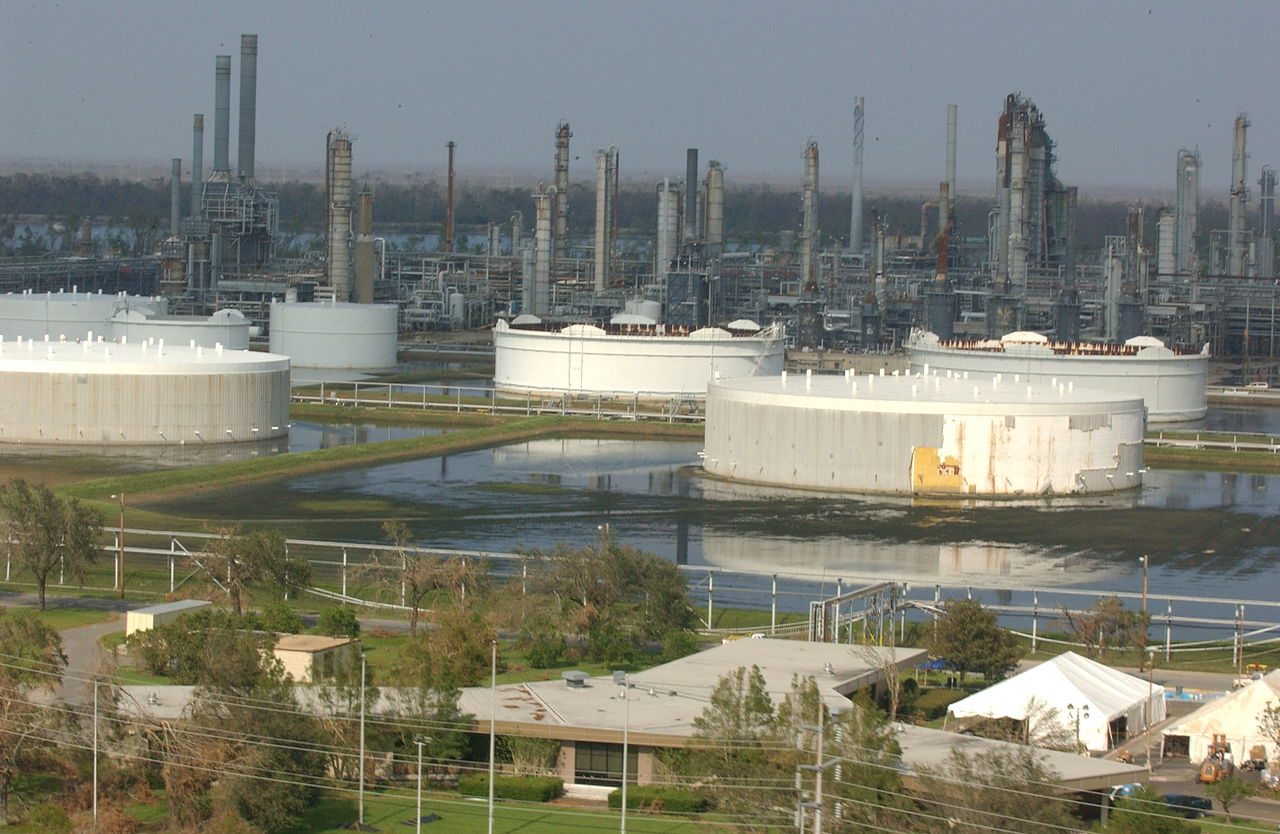
The surge pushed water into the canals that drain New Orleans towards Lake Pontchartrain, and the protection system failed in more than fifty places. The Interagency Performance Evaluation Task Force, the Army Corps' own investigation, found about 50 breaches in total: a small number, including the failures on the 17th Street and London Avenue canals, occurred through foundation failure before the water had even reached the top of the floodwalls, while the rest resulted from overtopping, where water poured over the crests and scoured the levees away from behind. The American Society of Civil Engineers' external review panel, reporting in June 2007, identified the direct causes in the canal failures as engineering oversights: the strength of the soft soils beneath the I-shaped floodwalls had been over-estimated, and the margin of safety used in their design was too low for a structure on which lives depended. About 80 percent of New Orleans flooded, and the ASCE panel calculated that two-thirds of the flooding was caused by the failures of the city's floodwalls rather than by water simply overtopping sound defences.
Timeline
- 23 August 2005
Katrina forms as a tropical depression over the south-eastern Bahamas, from a tropical wave merging with the remnants of Tropical Depression Ten.
- 25 August 2005
First US landfall in southern Florida as a Category 1 hurricane; Katrina crosses the peninsula in about six hours and enters the Gulf of Mexico.
- 28 August 2005
Katrina reaches Category 5 and its peak intensity of 150-knot winds over the central Gulf, then begins to weaken as its eyewall is replaced.
- 29 August 2005
Landfall near Buras, Louisiana, at the upper end of Category 3, and a final landfall near the Louisiana-Mississippi border; levees and floodwalls around New Orleans breach in more than 50 places.
- 2 September 2005
An effective military presence is established in New Orleans and National Guard troops distribute food and water, Britannica records; evacuations continue.
- 11 October 2005
The Army Corps of Engineers pumps the last of the floodwater out of New Orleans, 43 days after landfall.
- October 2005 onwards
The Interagency Performance Evaluation Task Force is commissioned to establish the facts of the protection system's failure.
- June 2007
The American Society of Civil Engineers' external review panel publishes its report on what went wrong and why.
- 2011
New Orleans' redesigned Hurricane and Storm Damage Risk Reduction System is substantially in place, built with federal funding of about 14.5 billion dollars.
- 29 August 2021
Hurricane Ida, a Category 4 storm, makes landfall in Louisiana on Katrina's anniversary; the rebuilt defences of New Orleans hold.
Significance
Katrina changed how the United States understands disaster. The storm itself was a meteorological extreme, but the official record - the ASCE panel's review of the IPET investigation - established that the drowning of New Orleans was a foreseeable engineering failure: a protection system authorised in 1965, still incomplete, designed with margins its reviewers called too low for a life-safety structure, and maintained by a patchwork of authorities. The disaster also exposed the response system: Britannica's account records that it was 2 September before an effective military presence was established in the city, a delay that reshaped the Federal Emergency Management Agency and American emergency law. And it displaced a population: New Orleans' population fell by 29 percent between the autumn of 2005 and 2011.
Questions readers ask
Was Katrina a Category 5 hurricane when it hit New Orleans? No. It reached Category 5 over the Gulf on 28 August, but the National Hurricane Center records its Louisiana landfall at the upper end of Category 3. The destruction came from its size and surge, and above all from the levee failures, not from Category 5 winds at landfall.
How many people died? There is no single uncontested figure, which is why this page attributes its numbers. The National Hurricane Center's report long gave an estimate of 1,833 deaths; in January 2023 it revised the toll to 1,392, adopting the analysis of Rappaport (2014), which re-examined direct, indirect and indeterminate deaths. Other published estimates fall in a range of roughly 1,200 to 1,800, depending on which categories of death are counted.
Was it a natural disaster or a man-made one? The investigations answer: both, in sequence. The ASCE panel concluded that the catastrophic flooding of New Orleans resulted from the failure of a man-made protection system under a storm it should have been designed to withstand - a conclusion the Army Corps itself later acknowledged in accepting that flaws in the system's construction had contributed.
Legacy
The rebuilt city is Katrina's living memorial. The Army Corps replaced the failed system with the Hurricane and Storm Damage Risk Reduction System - higher levees, stronger floodwalls, closable gates and the great surge barrier across the entrance to Lake Borgne - at a federal cost Britannica puts at 15 billion dollars; in August 2021 the defences held against Hurricane Ida, a stronger landfalling storm than Katrina at the coast. New Orleans' population, about 400,000 by 2020, remains below its pre-storm level, and some neighbourhoods rebuilt slowly or not at all; remembrance is built into the city in memorials and in the annual marking of 29 August. For engineering, the legacy is a standard: the ASCE's central lesson, that a life-safety structure must be designed and reviewed as one system with honest margins, is now part of how flood defences far beyond Louisiana are judged.
Sources
- National Hurricane Center - Tropical Cyclone Report: Hurricane Katrina, 23-30 August 2005
- American Society of Civil Engineers - The New Orleans Hurricane Protection System: What Went Wrong and Why
- Ingenia (Royal Academy of Engineering) - Investigating New Orleans
- Encyclopaedia Britannica - Hurricane Katrina: Aftermath
The facts on this page were checked against these sources on 19 November 2026. The History Trail's permanent pages are researched and written for this site; the live profiles elsewhere on The History Trail are assembled automatically from Wikipedia and Wikidata.
About the Author
Researched and written by the The History Trail Editorial Team — the accountable editorial function behind this site's permanent story pages. The team works from the published sources cited on each page; it does not invent historians, reviewers or credentials, and it corrects errors openly.
Fact Check
Every load-bearing fact on this page traces to one of the sources listed above, and significant claims link to their source in the text. Our checking method is described on the methodology page; errors can be reported via the corrections page.
Sources & Citations
Cite this page as: The History Trail Editorial Team, The History Trail — this article's title, publication and update dates are shown beneath its headline. The full source list appears under Sources above; the site's source standards are on the sources page.