
Things
Dragon
The dragon is a mythical creature of world folklore, and no such animal has ever lived. What is documented is a history of belief at least four thousand years long: Mesopotamian dragon-gods, the dragons of the Bible, China's benevolent long, Greek and Roman drakones, medieval bestiaries and saints' legends, the red dragon of Wales, and the dragons of modern books, film and games.
At a Glance
- What it is
- A mythical creature of world folklore - a large serpent- or lizard-like being, evil in some traditions and beneficent in others; no such animal has ever lived
- The word
- From Greek drakon, originally any large serpent, through Latin draco and Old French into English
- The oldest images
- Mesopotamia: Tiamat in the creation epic, and the mushhushshu dragon of Marduk on Babylon's Ishtar Gate, about 575 BC
- The Chinese long
- A benevolent rain divinity and king of animals; emblem of imperial power, on the Chinese flag until 1911
- The medieval dragon
- Catalogued as a real animal in the bestiaries, identified with the devil, and fought by St George, St Margaret and the archangel Michael
- The Welsh dragon
- The red dragon, linked with Wales since the Historia Brittonum of about AD 830, on the official flag of Wales since 1959
- Proposed origins
- Scholarly theories only: fossil bones, real reptiles such as crocodiles and monitors, and an ancient human fear of snakes
Introduction
Britannica defines the dragon, in the mythologies, legends and folktales of various cultures, as a large lizard- or serpent-like creature, conceived in some traditions as evil and in others as beneficent. In medieval Europe dragons were usually drawn with wings and a barbed tail, breathing fire. In Greece the word drakon, from which the English word comes, meant originally any large serpent, and the dragon of mythology, whatever shape it later took, remained essentially a snake.
No dragon has ever lived, and no single real animal stands behind the idea. The belief, by contrast, is documented richly for thousands of years - in temple brickwork and imperial flags, in the Bible and medieval manuscripts, in heraldry still in use, and in modern fantasy. This page traces that documented history of a creature that never existed.
Ancient Dragons: Babylon, Egypt and the Bible
Some of the oldest dragon-like beings in art and writing come from Mesopotamia, in modern Iraq. The Babylonian creation epic tells how the god Marduk defeated Tiamat, the dragon-goddess of the salt sea, and built the world from her body; Britannica describes the Chaldean dragon Tiamat as four-legged, scaly-bodied and winged. Marduk's own sacred animal, the mushhushshu, was a scaly serpent-dragon with a lion's forelegs and an eagle's hind talons, and rows of mushhushshu in glazed brick still stride across the Ishtar Gate of Babylon, built in the 6th century BC - a dragon placed by a king on his city's main gate.
Egypt told of Apep, the great serpent of darkness who attacked the sun god Ra. The Hebrew Bible knows Leviathan, the twisting sea serpent only God can master, and the book of Revelation gives Christian tradition its defining dragon: the great red dragon, 'that old serpent, called the Devil', many-headed like the Greek Hydra. In the Middle Eastern world, Britannica observes, where snakes are large and deadly, the serpent or dragon stood for the principle of evil - a judgement the West largely kept.
The Chinese Long: The Dragon as Blessing
China holds one of the longest unbroken dragon traditions in the world, and it points the other way. The Chinese dragon, the long, was originally a rain divinity. Britannica records rain rituals as early as the 6th century BC in which a dragon image was carried in procession by dancers - dances still performed in traditional Chinese communities to secure good fortune. Ancient cosmogonists distinguished kinds of dragon - celestial, treasure-guarding, earth and spiritual - and popular belief turned the water dragons into the Dragon Kings, gods of the four oceans who delivered rain and protected sailors.
Depicted as a four-legged animal with a scaled, snakelike body, horns, claws and large eyes, the long was considered the king of animals, and emperors took its image as a sacred symbol of imperial power; the dragon adorned the Chinese flag until the founding of the republic in 1911. Carried with Chinese culture to Japan, as ryu or tatsu, the dragon kept its prestige. East and West thus built opposite creatures from the same serpent shape: in Europe a monster to be killed, in East Asia a power to be honoured.
Medieval Dragons: Bestiaries, Saints and Heraldry
Medieval Europe wrote its dragons down as zoology. The bestiaries - books of beasts - taught that the dragon was a variety of serpent, larger than all other animals in the world, living in caves, with its great strength in its tail; nothing, not even the elephant, was safe from it, for it lay in wait and suffocated its prey in its coils. The British Library's manuscripts show dragons strangling elephants and facing saints, and the text made the meaning explicit: the dragon stood for the devil, evil and deception.
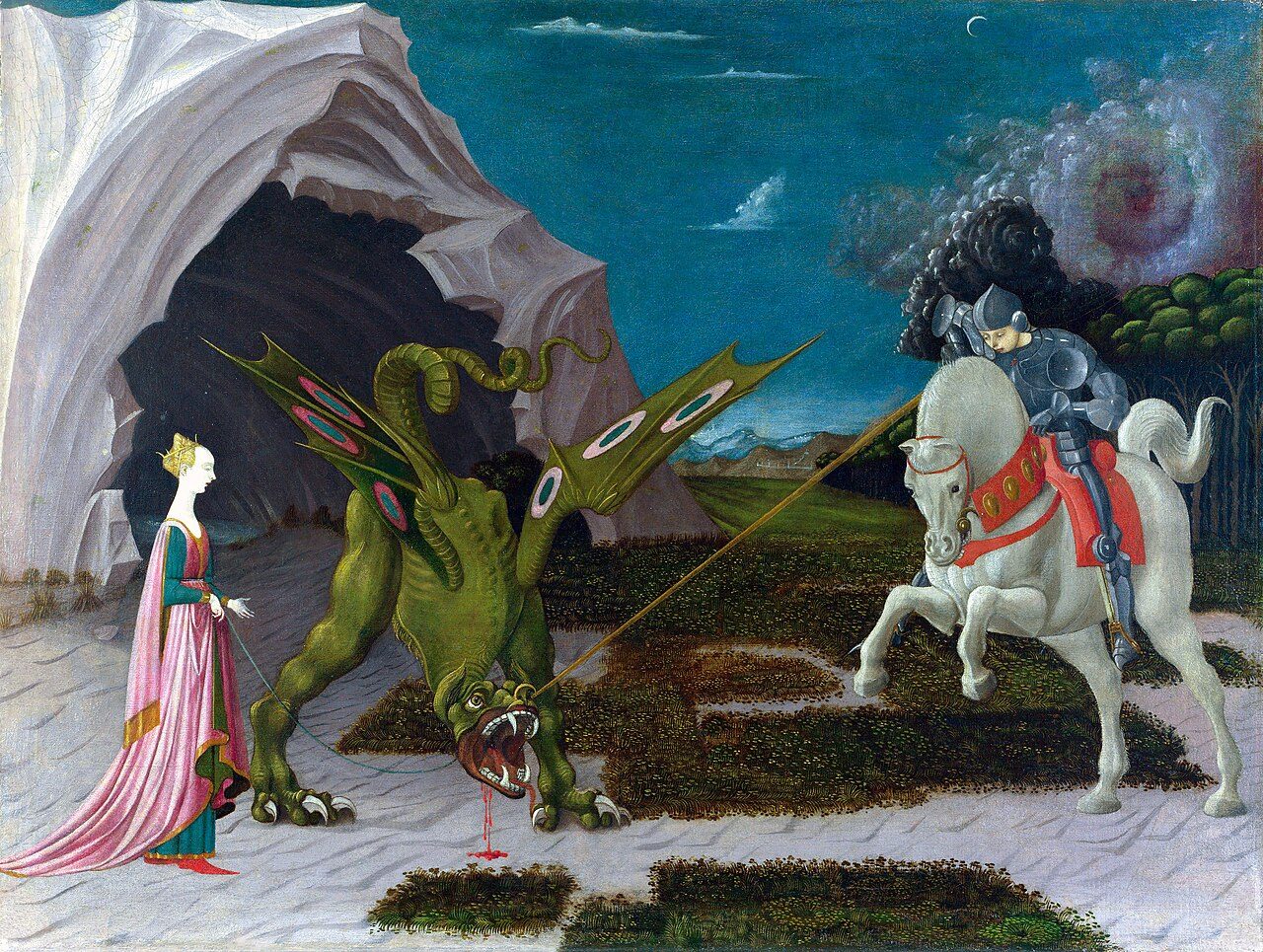
In Christian art the dragon became the symbol of sin and paganism, shown crushed beneath the heels of saints and martyrs: Michael the archangel, Margaret of Antioch, and above all George, whose dragon fight the Golden Legend of the 13th century spread across Europe. Dragons also went to war as emblems - on Norse shields and ship prows, and as the chief royal ensign in England before the Norman Conquest. In Wales the emblem became a nation: the Historia Brittonum, written about AD 830, tells of a red dragon and a white dragon fighting beneath Dinas Emrys, the red standing for the Britons and the white for the invading Saxons. Henry Tudor fought under the red dragon at Bosworth in 1485, and the red dragon on white and green became the official flag of Wales in 1959.
Timeline
- By the 6th century BC
Chinese rain rituals carry a dragon image in procession; the long is already a god of rain and waters.
- About 575 BC
Nebuchadnezzar II builds the Ishtar Gate of Babylon, its glazed bricks patterned with the mushhushshu, the serpent-dragon of the god Marduk.
- About AD 830
The Historia Brittonum tells of the red and white dragons fighting beneath Dinas Emrys in Wales - the earliest recorded link of the red dragon with the Welsh.
- About 1200-1210
An English bestiary, now in the British Library, pictures the dragon suffocating an elephant and teaches that its strength is in its tail.
- 13th century
The Golden Legend spreads the story of St George and the dragon across Europe; the English word dragon, from Greek drakon through Latin and French, is in use.
- 1485
Henry Tudor, of Welsh descent, fights under the red dragon standard at Bosworth and takes the English throne.
- 1564
The naturalist Conrad Gesner dies, having still included dragons in his great history of animals.
- 1911
The dragon leaves the Chinese flag with the founding of the republic, ending its centuries as the emblem of the imperial family.
- 1959
The red dragon on white and green is officially recognised as the flag of Wales.
- 2000
Adrienne Mayor publishes The First Fossil Hunters, arguing that some ancient dragon and monster lore was inspired by fossil bones.
Significance
The dragon is the world's most widespread invented animal, and its two great traditions measure a real difference between cultures. In the West, shaped by the Bible and the bestiaries, the dragon concentrated everything feared - chaos, sin, greed, the hostile deep - into one body that a god, a hero or a saint could defeat, which is why dragon-slaying became the standard proof of holiness and kingship. In East Asia the same serpent form gathered the opposite meanings: rain, rivers, fertility, luck and legitimate rule.
Questions readers ask
Did dragons ever exist? No. There is no fossil or zoological evidence for any fire-breathing, winged reptile of the kind the stories describe, and the word has no zoological meaning - though science has borrowed it, for the small gliding lizards of the genus Draco and for the Komodo dragon, the giant monitor lizard of Indonesia. Belief is not evidence, and no dragon bone has ever survived examination.
Where did the idea come from? Scholars have proposed several sources, and this page presents them as theories, not findings. Adrienne Mayor, a historian at Stanford, argues that some dragon and giant lore grew from ancient discoveries of fossil bones - the remains of dinosaurs and great extinct mammals, which people without a science of fossils explained as monsters; in China, fossil 'dragon bones' were collected and ground for medicine for centuries. Other proposed sources are real reptiles - crocodiles, great snakes and monitor lizards, swelling in travellers' tales - and the simple, ancient human fear of snakes. Mayor herself cautions that not all dragon stories come from fossils. Most likely several sources fed the same shape, in different places, over thousands of years.
Legacy
The dragon never died with the beliefs that made it. It flies today on the flag of Wales; it guards treasure and tests heroes through modern fantasy, from children's picture books to the dragons of bestselling novels, films and games - a debt science itself acknowledged when palaeontologists named a horned, dragon-skulled dinosaur Dracorex hogwartsia, after the Harry Potter books. A creature assembled from serpents, fossils and fear turned out to be one of the most durable inventions in human culture: four thousand years old, and still breathing fire.
Sources
- Encyclopaedia Britannica - Dragon
- Encyclopaedia Britannica - Long
- Stanford Humanities Center - Dinosaurs and Dragons, Oh My! Stanford Fossil Historian Links Dinosaur Bones to Mythological Creatures
- British Library - The Anatomy of a Dragon
- National Gallery, London - Paolo Uccello, Saint George and the Dragon
- Biodiversity Heritage Library - Ancient Myths Inspired by Fossils
The facts on this page were checked against these sources on 19 November 2026. The History Trail's permanent pages are researched and written for this site; the live profiles elsewhere on The History Trail are assembled automatically from Wikipedia and Wikidata.
About the Author
Researched and written by the The History Trail Editorial Team — the accountable editorial function behind this site's permanent story pages. The team works from the published sources cited on each page; it does not invent historians, reviewers or credentials, and it corrects errors openly.
Fact Check
Every load-bearing fact on this page traces to one of the sources listed above, and significant claims link to their source in the text. Our checking method is described on the methodology page; errors can be reported via the corrections page.
Sources & Citations
Cite this page as: The History Trail Editorial Team, The History Trail — this article's title, publication and update dates are shown beneath its headline. The full source list appears under Sources above; the site's source standards are on the sources page.