
Things
Australian dollar
The Australian dollar is young as currencies go — it replaced pounds, shillings and pence only in 1966 — but it has repeatedly been first: first to a bold decimal redesign, early to a free float, and in 1988 the issuer of the world's first polymer banknote, an Australian invention now used worldwide.
At a Glance
- Introduced
- 14 February 1966 ('C-Day'), replacing the Australian pound
- Conversion
- £1 = $2; $1 = 10 shillings = 100 cents
- Issuer
- Reserve Bank of Australia (banknotes); Royal Australian Mint (coins)
- Exchange rate
- Floated on 12 December 1983
- Banknotes
- $5, $10, $20, $50, $100 — all polymer
- First polymer note
- Commemorative $10, 1988 — the world's first
- Code
- AUD
Introduction
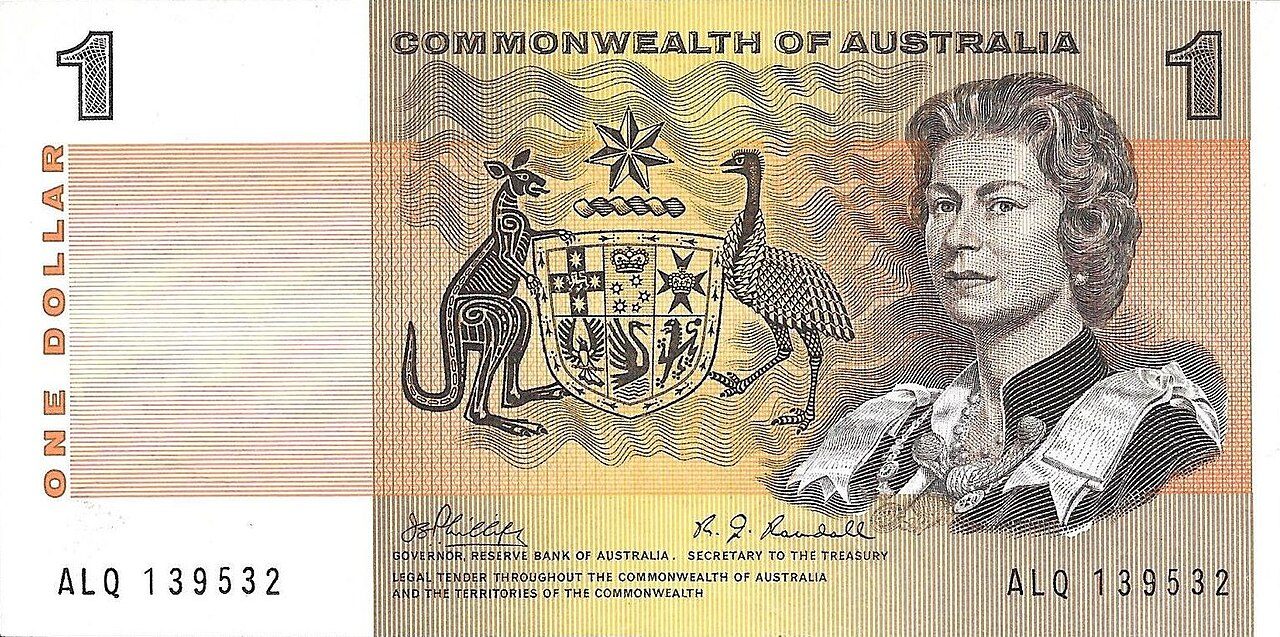
The Australian dollar is the currency of Australia, divided into 100 cents and issued as banknotes by the Reserve Bank of Australia and as coins by the Royal Australian Mint. It arrived on 14 February 1966, when Australia abandoned the imperial system of pounds, shillings and pence for decimal money. The changeover day became known as 'C-Day', Conversion Day, and it was prepared like a military operation: new notes printed in their millions, coins designed, and a national education campaign to teach the public the new arithmetic.
Decimalisation was debated in Australia from the beginning of the 20th century, and practical planning began in the late 1950s under the Decimal Currency Committee. The government's case was simple: decimal currency simplified calculations and increased financial efficiency. But it also asked every Australian to relearn the money in their pocket — prices, wages, machines and habits all had to convert on a single Monday morning.
Background
Before 1966 Australia used the Australian pound, modelled on British money: 12 pence to a shilling, 20 shillings to a pound. The Reserve Bank itself was new, having begun operations on 14 January 1960 as the country's separate central bank. In 1963 the government announced decimal currency for February 1966, on the committee's plan: the major unit would equal ten shillings, the minor unit would be one hundredth of it, and no fractions of the minor unit would be issued. A Decimal Currency Board oversaw the conversion.
Even the name was contested. The government first chose 'Royal' for the new unit in June 1963, hoping to keep a link with British tradition; the choice proved unpopular, and within three months, in September 1963, it settled on 'Dollar'. Design, meanwhile, went deliberately Australian. Gordon Andrews designed banknotes in bolder, more vivid colours than the subdued notes they replaced, and Stuart Devlin designed coins carrying Australian fauna — a feather-tailed glider, a frilled lizard, a platypus — beneath the portrait of Queen Elizabeth II.
Timeline
- 14 January 1960
The Reserve Bank of Australia begins operations as the separate central bank responsible for the note issue.
- 1963
The government announces decimal currency for February 1966; after public resistance to the proposed name 'Royal', it chooses 'Dollar' in September.
- 14 February 1966
C-Day: decimal currency launches with $1, $2, $10 and $20 notes and 1, 2, 5, 10, 20 and 50 cent coins; one pound converts to two dollars.
- 1967
The $5 note is introduced, pairing Sir Joseph Banks with social reformer Caroline Chisholm.
- 1973
The $50 note is issued, depicting medical researcher Lord Howard Florey and veterinary scientist Sir Ian Clunies Ross.
- 12 December 1983
The Australian dollar is floated: its exchange rate is set by the market rather than by official pegs.
- 1984
The $100 note arrives, and the $1 note is replaced by a $1 coin; a $2 coin follows in 1988.
- 1988
A commemorative $10 note for the Bicentenary becomes the world's first circulating polymer banknote.
- 1996
Australia completes the changeover to polymer, becoming the first country with a full circulating set of plastic notes.
- 2016–2020
A next-generation polymer series is issued denomination by denomination, with clear windows and tactile features.
Significance
The float of December 1983 transformed the dollar's role. The government decided on 9 December 1983 and the dollar began floating when markets reopened on Monday 12 December, ending decades in which its value was pegged — first to sterling, then managed against other currencies. From then on the exchange rate reflected trade, commodity prices and investor sentiment, and the dollar became one of the world's most traded currencies, a liquid proxy for the Asia-Pacific economy and for global risk appetite.
The polymer note was the dollar's gift to the world. Developed in Australia through work involving the Reserve Bank, the CSIRO and Note Printing Australia, polymer proved more durable than paper, harder to counterfeit and recyclable. The 1988 commemorative $10, marking the bicentenary of European settlement, carried a transparent window — a security feature paper could not offer. Within a decade every Australian note was polymer, and central banks from Canada to Britain later followed Australia's lead.
Legacy
The Australian dollar's legacy is disproportionate to its age. Decimalisation in 1966 gave Australia a modern, distinctively designed currency; the 1983 float made it a market currency of global standing; and the polymer revolution that began in 1988 changed how money itself is made, on every continent. The current next-generation notes, issued between 2016 and 2020, continue the pattern: clear windows, vivid colour and raised tactile bumps so people who are blind or have low vision can identify denominations by touch.
At home, the dollar also remains a small daily gallery of Australian identity — writers, aviators, inventors, social reformers and native animals chosen, from Gordon Andrews's first decimal designs onward, to say something about the country. Few currencies so young have been asked to carry so much reinvention, or managed it so visibly.
Sources
- Reserve Bank of Australia Museum — A New Currency
- Reserve Bank of Australia Museum — Introducing the Decimal Banknotes
- Reserve Bank of Australia — Annual Report 1966: Changeover to Decimal Currency
- Wikipedia — Australian dollar
The facts on this page were checked against these sources on 19 November 2026. The History Trail's permanent pages are researched and written for this site; the live profiles elsewhere on The History Trail are assembled automatically from Wikipedia and Wikidata.
About the Author
Researched and written by the The History Trail Editorial Team — the accountable editorial function behind this site's permanent story pages. The team works from the published sources cited on each page; it does not invent historians, reviewers or credentials, and it corrects errors openly.
Fact Check
Every load-bearing fact on this page traces to one of the sources listed above, and significant claims link to their source in the text. Our checking method is described on the methodology page; errors can be reported via the corrections page.
Sources & Citations
Cite this page as: The History Trail Editorial Team, The History Trail — this article's title, publication and update dates are shown beneath its headline. The full source list appears under Sources above; the site's source standards are on the sources page.