
Things
Achilles
Achilles is a hero of Greek myth, not a documented historical person, and no evidence shows that he ever lived. What is documented is the history of his story: Homer's Iliad, the lost poems of the epic cycle, his image in Greek art, the cult paid to him, Alexander the Great's devotion, and the surprisingly late Roman origin of the famous tale of his vulnerable heel.
At a Glance
- Who he is in the myth
- Son of the mortal king Peleus and the sea nymph Thetis; the greatest Greek warrior of the Trojan War
- The main source
- Homer's Iliad, which covers only a few weeks of the war's tenth year and ends before Achilles dies
- The wider cycle
- Lost epic-cycle poems such as Arctinus's Aethiopis told of his death at the hands of Paris
- The heel
- The Styx-dipping and the vulnerable heel appear in Statius's unfinished Achilleid, written in the late 1st century AD - not in Homer
- The cult
- Strabo records a temple and monument of Achilles near Sigeion, where the people of Ilium offered sacrifices to him as a hero
- The famous admirer
- Alexander the Great, who visited Troy in 334 BC and modelled himself on Achilles
- Troy
- Hisarlik in Turkey is a real, excavated city, but its ruins cannot prove that Achilles, or the war as Homer tells it, existed
Introduction
In Greek mythology, Achilles was the son of the mortal Peleus, king of the Myrmidons, and the Nereid, or sea nymph, Thetis. Britannica calls him the bravest, handsomest and greatest warrior of the army of Agamemnon in the Trojan War. Homer's Iliad centres on his quarrel with Agamemnon in the war's tenth year: insulted, Achilles withdraws from the fighting, returns only after his companion Patroclus is killed, and slays the Trojan hero Hector. The poem ends with Hector's funeral. Achilles' own death is not in it.
That distinction matters. Achilles belongs to poetry, not to the historical record. The Iliad was composed in the 8th century BC, centuries after the Bronze Age world it describes, and it reached its audience through oral tradition. This page therefore tells the documented history of the myth itself - the poems, the pictures, the worship and the readers who kept Achilles alive for nearly three thousand years.
The Poems: The Iliad and the Epic Cycle
The Iliad is not a life of Achilles and not a history of the whole war. It covers a few weeks of its tenth year and takes as its theme his wrath: his refusal to fight, the deaths that follow, and his grief and rage after Patroclus falls. In Homer's Odyssey the shade of Achilles appears in the underworld and discusses his death, telling Odysseus, in the poem's bleak judgement, that he would rather be a living labourer than a king among the dead.
Around the two Homeric poems stood a ring of other epics, the epic cycle, which filled in the war from its causes to its aftermath. Britannica notes the lost Aethiopis, written between the 8th and 6th centuries BC by the Greek poet Arctinus, as part of that cycle. It took up the story where the Iliad stops, telling how Achilles slew the Amazon Penthesilea and Memnon, king of the Ethiopians, and was himself killed by Paris. The cycle poems survive only in summaries and fragments, but for ancient readers they completed the tale.
Art, Cult and Alexander
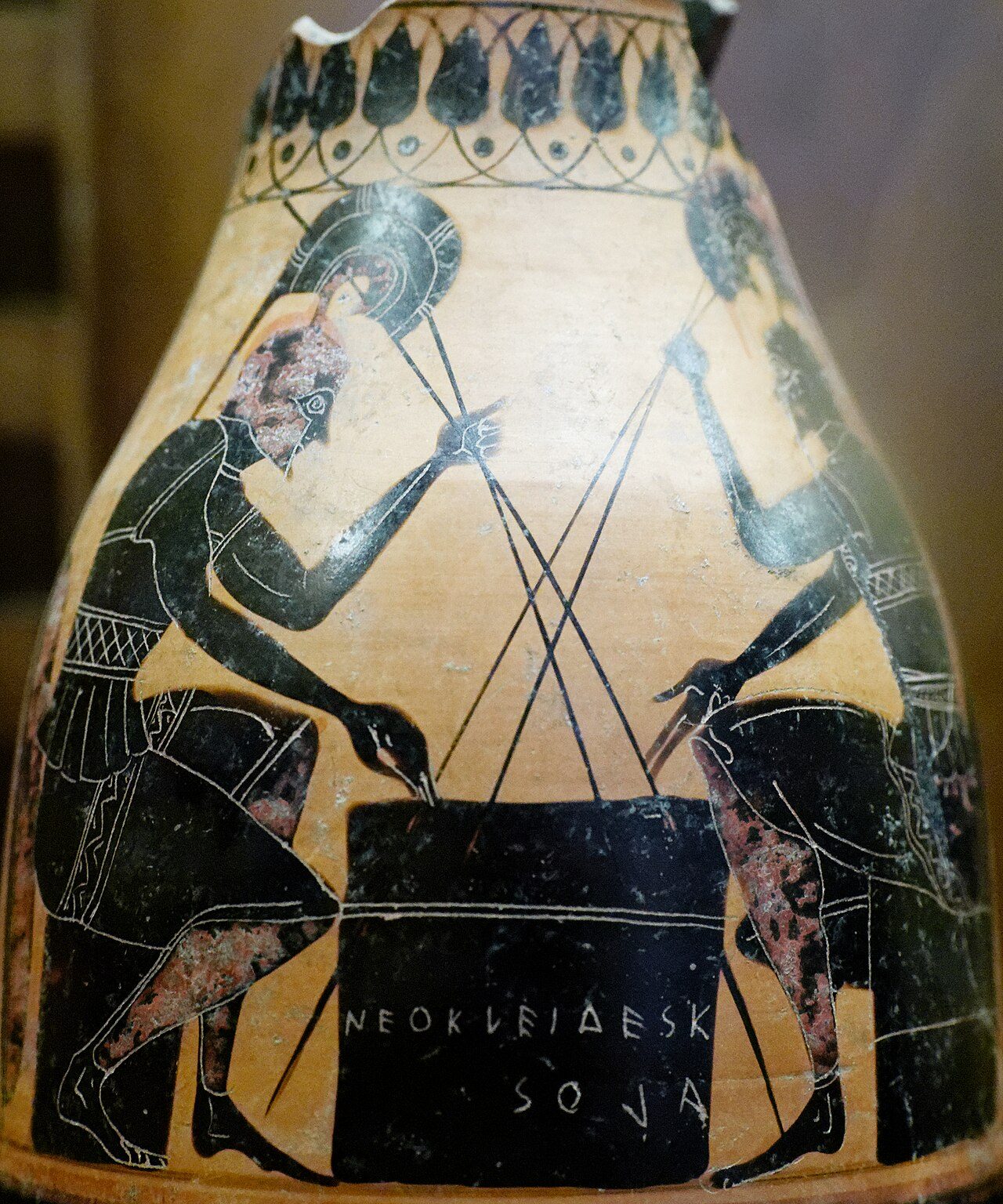
Greek artists made Achilles one of the most pictured figures of the ancient world. The most famous image is the black-figure amphora signed by the potter and painter Exekias, made in Athens about 540-530 BC and now in the Vatican Museums. It shows Achilles and Ajax, named in inscriptions, playing a board game in full armour on the battlefield of Troy, Achilles calling four and Ajax three. The quiet scene appears in no surviving literary text, yet vase-painters repeated it more than 150 times in the decades that followed.
Achilles was also worshipped. Writing in the early Roman period, the geographer Strabo describes a temple and monument of Achilles near Sigeion, at the mouth of the Hellespont, with monuments of Patroclus and Antilochus nearby, and records that the people of Ilium offered sacrifices to these heroes. Other traditions placed the hero on Leuke, the White Island, and hero-cult at his supposed tomb made the Iliad's landscape a place of pilgrimage.
His most famous worshipper was a king. Alexander the Great was taught that he descended from Achilles through his mother Olympias, kept a copy of the Iliad said to have been annotated by his tutor Aristotle, and, according to Plutarch, slept with it under his pillow beside a dagger. Crossing into Asia in 334 BC to invade Persia, he stopped at Troy, made offerings, and honoured the tomb of Achilles, while his closest companion Hephaestion honoured the tomb of Patroclus - a deliberate claim that the new campaign continued the old epic.
Timeline
- 12th or 13th century BC
Later Greek authors date the Trojan War to this period. It is the myth's setting, not a documented date for Achilles.
- 8th century BC
Homer's Iliad is composed, centring on the wrath of Achilles in the tenth year of the war.
- 8th-6th centuries BC
Poets of the epic cycle, among them Arctinus in the Aethiopis, tell the rest of the war, including the death of Achilles.
- About 540-530 BC
Exekias paints Achilles and Ajax playing a board game on his signed Vatican amphora; the scene is copied for fifty years.
- 334 BC
Alexander the Great visits Troy at the start of his Persian campaign and honours the tomb of Achilles.
- Early 1st century AD
Strabo's Geography records the temple and monument of Achilles near Sigeion and the sacrifices offered there.
- Late 1st century AD
The Roman poet Statius writes his unfinished Achilleid - the source of Thetis dipping Achilles in the Styx and of his vulnerable heel.
- 1870s
Heinrich Schliemann excavates the mound of Hisarlik in Turkey, identified with Troy, reopening debate about the poems' background.
- 19th century
The phrase Achilles heel enters common English use for a single, fatal weakness.
- 1998
UNESCO lists the archaeological site of Troy as a World Heritage site, honouring both its archaeology and its place in literature.
Significance
Achilles gave Greek culture its sharpest picture of the heroic bargain: a short life with undying fame, or a long life that no one remembers. The Iliad does not simply praise that bargain - it counts its cost in grief, rage and corpses - and that tension is why the poem, and its hero, have never stopped being read. Through Alexander, the myth also became a script for real ambition: a conqueror measured himself against a man who never existed, and said so in public, at the hero's tomb.
His name passed into everyday language and the body itself. An Achilles heel is now any single weakness in something otherwise strong, and anatomists named the great tendon at the back of the ankle, the Achilles tendon, after the hero whom legend said an arrow found there.
Myths and disputes
The heel story is not Homer's. No source before Statius, writing in Latin in the late 1st century AD, describes Achilles as invulnerable except in the heel where Thetis held him as she dipped him in the river Styx. In the Iliad he is a mortal who can be hurt: in Book 21 the warrior Asteropaios grazes his arm and draws blood. The dipping scene, the guided arrow and the one weak spot are Roman-era additions to a Greek story already eight centuries old - which is why this page dates the heel to Statius, not to Troy.
Was any of it real? The city is: excavations at Hisarlik, begun by Schliemann in the 1870s, revealed a real fortified settlement of many layers, and Hittite texts mention a place called Wilusa, plausibly the same city. One layer, Troy VIIa, was destroyed by fire around the end of the Bronze Age. But scholars remain divided over how much, if any, historical memory the poems preserve, and there is no consensus for or against a real Trojan War. Nothing at Hisarlik names Achilles, and no evidence can turn a hero of poetry into a documented person. The honest statement is the one this page began with: the debate concerns the background of the poems, never proof that Achilles lived.
Even Alexander's devotion comes with a warning label. The fullest accounts, by Plutarch and Arrian, were written some four centuries after Alexander's death, and historians debate how much of the Achilles performance at Troy is record and how much is later storytelling about a king who wanted to be an epic hero.
Legacy
Achilles survives wherever the Iliad is read, taught and retold, and in the art that has pictured him from Athenian vases to the present. He also survives as a warning about how myths grow: a Roman poet's unfinished epic added the detail the whole world now remembers best, and repeated retelling made it feel as old as Homer. The documented history - poems composed, vases painted, sacrifices offered, a king's pilgrimage, a city's ruins dug and argued over - is richer than the legend it supports, and unlike the legend, every part of it can be checked.
Sources
- Encyclopaedia Britannica - Achilles
- Encyclopaedia Britannica - Troy (Hisarlik)
- Harvard University, Center for Hellenic Studies - Conflicting Claims on Homer: The Tomb of Achilles
- Smarthistory - Exekias, Attic Black-Figure Amphora with Ajax and Achilles Playing a Game
- Brown University - Claiming the Right to Rule through Familiarity: Alexander and the Iliad
The facts on this page were checked against these sources on 19 November 2026. The History Trail's permanent pages are researched and written for this site; the live profiles elsewhere on The History Trail are assembled automatically from Wikipedia and Wikidata.
About the Author
Researched and written by the The History Trail Editorial Team — the accountable editorial function behind this site's permanent story pages. The team works from the published sources cited on each page; it does not invent historians, reviewers or credentials, and it corrects errors openly.
Fact Check
Every load-bearing fact on this page traces to one of the sources listed above, and significant claims link to their source in the text. Our checking method is described on the methodology page; errors can be reported via the corrections page.
Sources & Citations
Cite this page as: The History Trail Editorial Team, The History Trail — this article's title, publication and update dates are shown beneath its headline. The full source list appears under Sources above; the site's source standards are on the sources page.