
On This Day
September 27 in History
On 27 September 1822 the French scholar Jean-François Champollion's letter announcing that he could read ancient Egyptian hieroglyphs — his famous Lettre à M. Dacier, reporting the breakthrough he had announced to his brother days earlier with the cry 'Je tiens mon affaire!' — was read to the Académie des Inscriptions in Paris, unlocking three thousand years of Egyptian records. September 27 is also the day William of Normandy sailed for England and Rachel Carson's Silent Spring was published.
Choose another date: open the On This Day calendar to browse events, births and deaths for any day of the year.
At a Glance
- The stone
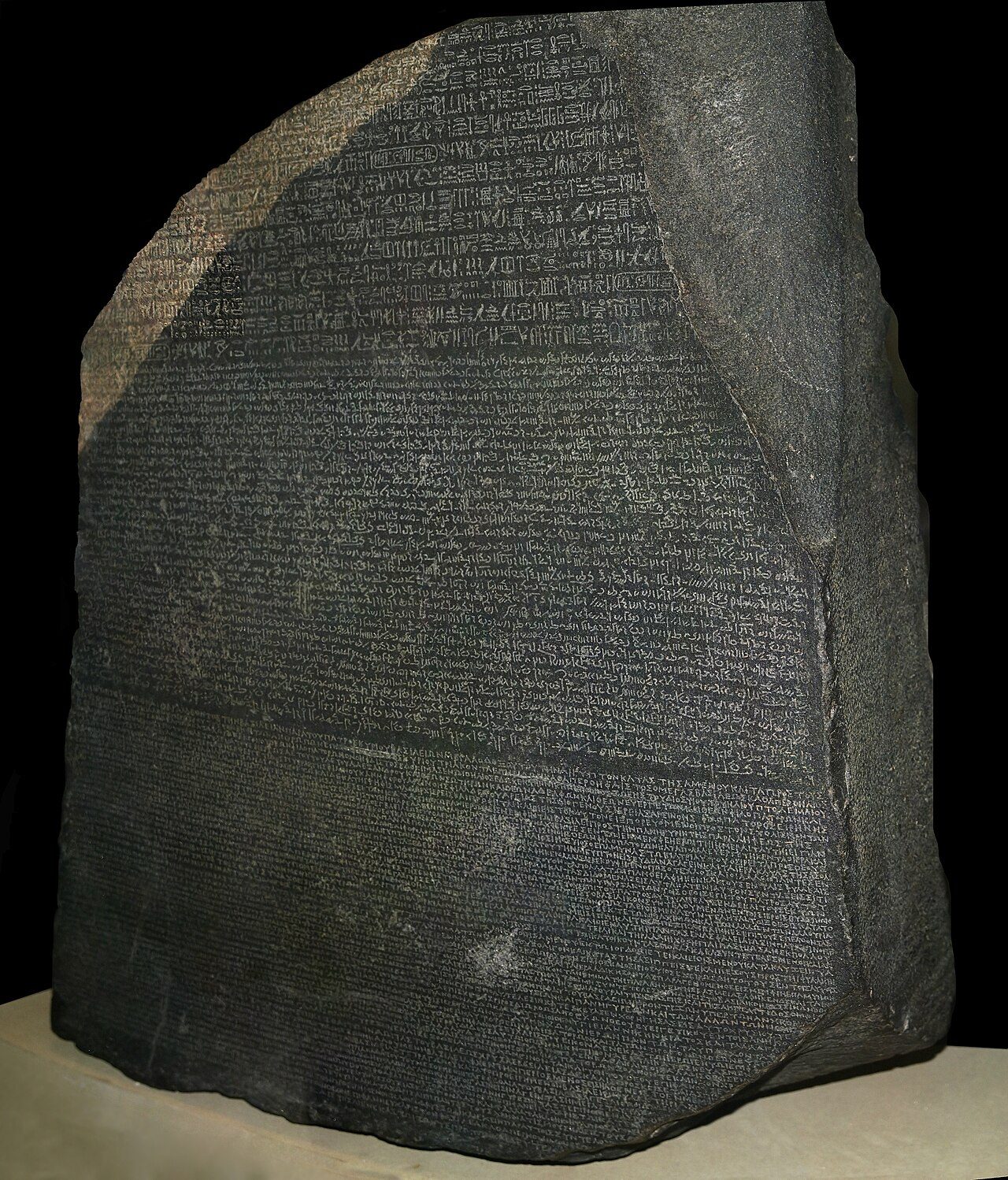
- The Rosetta Stone carries the same decree in hieroglyphs, demotic script and Greek; it was found by French soldiers in Egypt in 1799
- The rival
- Thomas Young in England had correctly read some signs and royal names before Champollion
- The key insight
- Hieroglyphs were not purely symbolic: signs could stand for sounds, syllables and whole words, and royal names were ringed in cartouches
- The announcement
- Champollion's Lettre à M. Dacier was read to the Académie des Inscriptions on 27 September 1822
- The scholar
- Champollion, 31, had taught himself Coptic — the late form of Egyptian — betting it held the language of the inscriptions
- The result
- Egyptology was born: within years, scholars could read temple walls, papyri and royal annals for the first time in over a millennium
Events on this day
- 1066William, duke of Normandy, finally embarks his invasion fleet and sails overnight for England, after weeks of waiting for a fair wind.
- 1777The Continental Congress sits at Lancaster, Pennsylvania — the United States capital for a single day — as the British occupy Philadelphia.
- 1822Champollion's decipherment of Egyptian hieroglyphs is announced in Paris — the featured story above.
- 1908The first production Ford Model T is completed at the Piquette Avenue plant in Detroit.
- 1918British and Canadian troops attack the Hindenburg Line at the Canal du Nord, beginning its breach in the First World War's last campaign.
- 1940Germany, Italy and Japan sign the Tripartite Pact in Berlin, formalising the Axis alliance.
- 1962Rachel Carson's Silent Spring is published in the United States, launching the modern environmental movement's argument against indiscriminate pesticide use.
- 1964The Warren Commission presents its report on the assassination of President John F. Kennedy to President Lyndon B. Johnson.
- 2008Zhai Zhigang performs China's first spacewalk, from the Shenzhou 7 spacecraft.
Born on this day
- 1601Louis XIII — king of France, whose reign with Cardinal Richelieu made France Europe's dominant power.
- 1840Thomas Nast — German-American cartoonist who popularised the Republican elephant, the Democratic donkey and the modern Santa Claus.
- 1947Meat Loaf — American rock singer of Bat Out of Hell, one of the best-selling albums ever made.
- 1972Gwyneth Paltrow — American actress, Academy Award winner for Shakespeare in Love.
Died on this day
- 1590Urban VII — pope whose reign of twelve days, ended by malaria, is the shortest in papal history.
- 1917Edgar Degas — French artist of dancers and racehorses, a founder of Impressionism who preferred to be called a realist.
- 1965Clara Bow — American film actress, the original 'It Girl' of the silent screen.
- 2023Michael Gambon — Irish-English actor, Albus Dumbledore in the Harry Potter films.
The featured story: the Rosetta Stone is deciphered, 27 September 1822
For fourteen centuries, no one alive could read ancient Egyptian. The last hieroglyphs were carved in the fourth century AD, and later ages treated the beautiful signs as pure mystic symbols — picture-writing full of secrets but empty of grammar. The chance to test that idea came in 1799, when French soldiers rebuilding a fort near Rosetta in the Nile Delta dug up a black slab carved with the same priestly decree of 196 BC in three scripts: hieroglyphs, the everyday Egyptian script called demotic, and Greek, which scholars could read. If the texts truly matched, the stone was a crib to a lost language.
The race to use it consumed two gifted men. In England, the polymath Thomas Young established that the demotic text corresponded to the Greek, identified several hieroglyphic values, and correctly read the name of Ptolemy inside its oval ring, or cartouche. In France, Jean-François Champollion — a prodigy who had mastered Coptic, the liturgical descendant of ancient Egyptian, precisely because he suspected it preserved the old language — went further. Comparing the cartouches of Ptolemy and Cleopatra, he saw that shared sounds were written with shared signs: the hieroglyphs were, in large part, a phonetic alphabet wearing ceremonial dress, mixed with signs for syllables and whole words.
In September 1822, working through the names of native pharaohs such as Ramesses and Thutmose — names no Greek text had given him — Champollion saw the whole system fall into place, and, by the famous story, rushed to his brother's office crying 'Je tiens mon affaire!' — 'I've got it!' — before collapsing in a faint that lasted days. His formal announcement, the Lettre à M. Dacier, was read to the Académie des Inscriptions et Belles-Lettres in Paris on 27 September 1822. Young, to his credit and occasional bitterness, acknowledged the scale of what Champollion had done.
The consequences were civilisational in the literal sense: a civilisation got its voice back. Within a generation, scholars were reading annals, letters, poems, tax receipts and tomb curses; Egypt ceased to be a mute landscape of monuments and became a documented history three thousand years deep. Champollion himself, made the Louvre's first curator of Egyptian antiquities and finally granted his expedition to Egypt, died in 1832 at only 41, having founded a science. The stone that made it possible sits in the British Museum, where the decipherment's raw material — one text, three scripts — still teaches its own lesson about how lost knowledge is recovered.
Why this date matters
September 27 is a day for crossings and decodings. A fleet crosses the Channel in the night and changes England forever; a scholar crosses between three scripts and gives a dead civilisation back its voice; a Chinese astronaut crosses out of his capsule into open space. Even Silent Spring is a kind of decipherment — reading, in dead birds and thinning eggshells, a message the chemical age had written without noticing. The date rewards anyone willing to learn a new language, literal or otherwise. A date that can hold both a decipherment and an invasion is really about attention: Champollion attended to signs everyone else had walked past for centuries, and England, attending to its own quarrels, barely noticed the sails until they were already in the Channel.
Sources
- Encyclopaedia Britannica — On This Day: September 27
- HISTORY — This Day in History: September 27
- Wikimedia — On This Day feed: September 27
- Wikimedia Commons — File: Rosetta Stone.JPG

The facts on this page were checked against these sources on 19 November 2026. The History Trail's permanent pages are researched and written for this site; the live profiles elsewhere on The History Trail are assembled automatically from Wikipedia and Wikidata.
About the Author
Researched and written by the The History Trail Editorial Team — the accountable editorial function behind this site's permanent story pages. The team works from the published sources cited on each page; it does not invent historians, reviewers or credentials, and it corrects errors openly.
Fact Check
Every load-bearing fact on this page traces to one of the sources listed above, and significant claims link to their source in the text. Our checking method is described on the methodology page; errors can be reported via the corrections page.
Sources & Citations
Cite this page as: The History Trail Editorial Team, The History Trail — this article's title, publication and update dates are shown beneath its headline. The full source list appears under Sources above; the site's source standards are on the sources page.