
On This Day
September 21 in History
On 21 September 1792, meeting for the first time, France's newly elected National Convention voted to abolish the monarchy — ending more than a thousand years of kingship and opening the way for the First French Republic, proclaimed the following day. September 21 is also the day The Hobbit was published, Malta and Belize won independence, and the Great New England Hurricane struck.
Choose another date: open the On This Day calendar to browse events, births and deaths for any day of the year.
At a Glance
- The vote
- On its first day, 21 September 1792, the National Convention abolished the French monarchy by decree
- The king
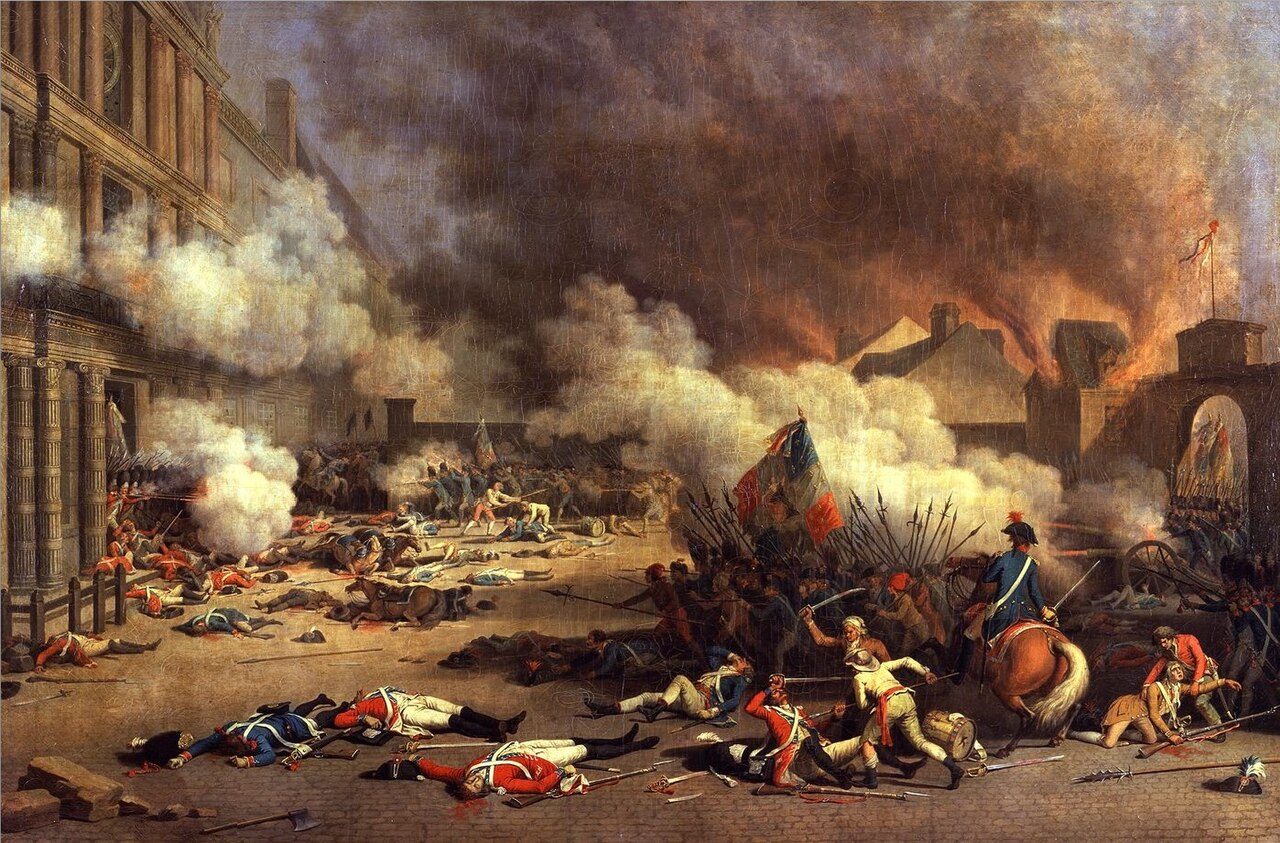
- Louis XVI, already suspended after the storming of the Tuileries on 10 August 1792, became simply 'Citizen Louis Capet'
- The republic
- The First French Republic was proclaimed the next day, 22 September 1792, and the revolutionary calendar later counted 1792 as Year I
- What followed
- Louis XVI was tried by the Convention and guillotined on 21 January 1793; his queen Marie Antoinette followed in October
- Why it mattered
- Abolition turned a constitutional crisis into a revolution against kingship itself, alarming every monarchy in Europe
Events on this day
- 1745Jacobite forces under Charles Edward Stuart rout government troops at the Battle of Prestonpans, near Edinburgh, in a fight lasting only minutes.
- 1792France's National Convention abolishes the monarchy, ending over a thousand years of kingship — the featured story above.
- 1897The New York Sun publishes its famous editorial answering a child's letter: 'Yes, Virginia, there is a Santa Claus.'
- 1921A storage silo explodes at Oppau in Germany; an estimated 500 to 600 people are killed in one of the worst industrial disasters of the age.
- 1937J.R.R. Tolkien's The Hobbit is published in London, introducing readers to Bilbo Baggins and Middle-earth.
- 1938The Great New England Hurricane makes landfall on Long Island; the death toll is estimated at 500 to 700 people.
- 1942The Boeing B-29 Superfortress, the long-range bomber of the later Pacific war, makes its first flight at Seattle.
- 1964Malta becomes independent of Britain, ending nearly two centuries of British rule over the Mediterranean island.
- 1972President Ferdinand Marcos signs the proclamation placing the Philippines under martial law, beginning fourteen years of authoritarian rule.
- 1981Belize, formerly British Honduras, becomes independent of Britain — the last British colony on the American mainland to do so.
- 2013Al-Shabaab militants attack the Westgate shopping centre in Nairobi, Kenya; more than 65 people are killed over three days.
Born on this day
- 1866H. G. Wells — English novelist of The Time Machine and The War of the Worlds, a founder of science fiction.
- 1874Gustav Holst — English composer of the orchestral suite The Planets.
- 1909Kwame Nkrumah — first leader of independent Ghana and a leading figure of African nationalism.
- 1934Leonard Cohen — Canadian singer-songwriter and poet of 'Hallelujah' and 'Suzanne'.
- 1947Stephen King — American novelist of horror and suspense, author of The Shining and It.
- 1950Bill Murray — American actor and comedian of Ghostbusters and Groundhog Day.
Died on this day
- 19 BCVirgil — Roman poet of the Aeneid, the epic of Rome's founding, left unfinished at his death.
- 1327Edward II — deposed king of England, who died in captivity at Berkeley Castle, in circumstances never fully explained.
- 1832Walter Scott — Scottish novelist and poet of Ivanhoe and the Waverley novels.
- 1860Arthur Schopenhauer — German philosopher of The World as Will and Representation.
- 1904Chief Joseph — Nez Perce leader who resisted removal from his people's homeland and died on the Colville reservation in Washington.
- 1998Florence Griffith Joyner — American sprinter, Olympic champion and still the world record holder at 100 and 200 metres.
The featured story: France abolishes the monarchy, 21 September 1792
The French monarchy did not fall in a single day, but 21 September 1792 was the day it was formally ended. Six weeks earlier, on 10 August, a Paris crowd had stormed the Tuileries Palace, massacred the king's Swiss Guards and forced the Legislative Assembly to suspend Louis XVI and lock his family in the Temple prison. Elections followed for a National Convention, chosen by near-universal male suffrage, and when the deputies assembled on 20 September — the same day French citizen-soldiers held off a Prussian invasion at Valmy — their first business was the fate of the crown itself.
On 21 September the Convention voted, amid applause, that royalty was abolished in France. There was no long debate: after a thousand years in which France and a king had been almost the same idea, monarchy was ended by a decree passed in an afternoon. Louis XVI ceased to be a king and became, in the Republic's new language, Citizen Louis Capet — Capet being the surname of the dynasty's medieval founder, Hugh Capet. The next day the Convention proclaimed the French Republic, and the revolutionaries later dated their new calendar from that moment: 1792 became Year I of the Republic.
Abolition solved one question and opened worse ones. A king who was merely suspended could be restored; a king abolished had to be disposed of, and within months the Convention put Louis on trial for treason, found him guilty, and sent him to the guillotine on 21 January 1793. Abroad, the decree announced that the Revolution was no longer asking Europe's monarchies for recognition — it was declaring war on the principle of kingship, and the wars that followed lasted, with pauses, for more than twenty years.
At home, ending the monarchy removed the last shared symbol above faction. What replaced it — republic, virtue, the nation — had to be invented as the Convention governed, through the Terror of 1793–94 and the purges that followed. Yet the decision of 21 September endured in a deeper sense: France has had kings and emperors since, but never again by unquestioned right. Every French regime after 1792 has had to claim, in some form, to rest on the will of the people — the claim the Convention made when it voted the crown away.
Why this date matters
September 21 keeps staging confrontations between old orders and new ones. A convention votes a thousand-year monarchy out of existence in 1792; colonial rule ends in Malta in 1964 and Belize in 1981; a president suspends democracy in the Philippines in 1972. Even its books mark beginnings — The Hobbit opening Middle-earth in 1937, a newspaper assuring a child about Santa Claus in 1897. It is a date of thresholds: things formally ended by vote, proclamation or publication, whose consequences then ran for decades.
Sources
- Encyclopaedia Britannica — On This Day: September 21
- HISTORY — This Day in History: September 21
- Wikimedia — On This Day feed: September 21
- Wikimedia Commons — File: Jacques Bertaux, Storming of the Tuileries (1793)

The facts on this page were checked against these sources on 19 November 2026. The History Trail's permanent pages are researched and written for this site; the live profiles elsewhere on The History Trail are assembled automatically from Wikipedia and Wikidata.
About the Author
Researched and written by the The History Trail Editorial Team — the accountable editorial function behind this site's permanent story pages. The team works from the published sources cited on each page; it does not invent historians, reviewers or credentials, and it corrects errors openly.
Fact Check
Every load-bearing fact on this page traces to one of the sources listed above, and significant claims link to their source in the text. Our checking method is described on the methodology page; errors can be reported via the corrections page.
Sources & Citations
Cite this page as: The History Trail Editorial Team, The History Trail — this article's title, publication and update dates are shown beneath its headline. The full source list appears under Sources above; the site's source standards are on the sources page.