
On This Day
May 5 in History
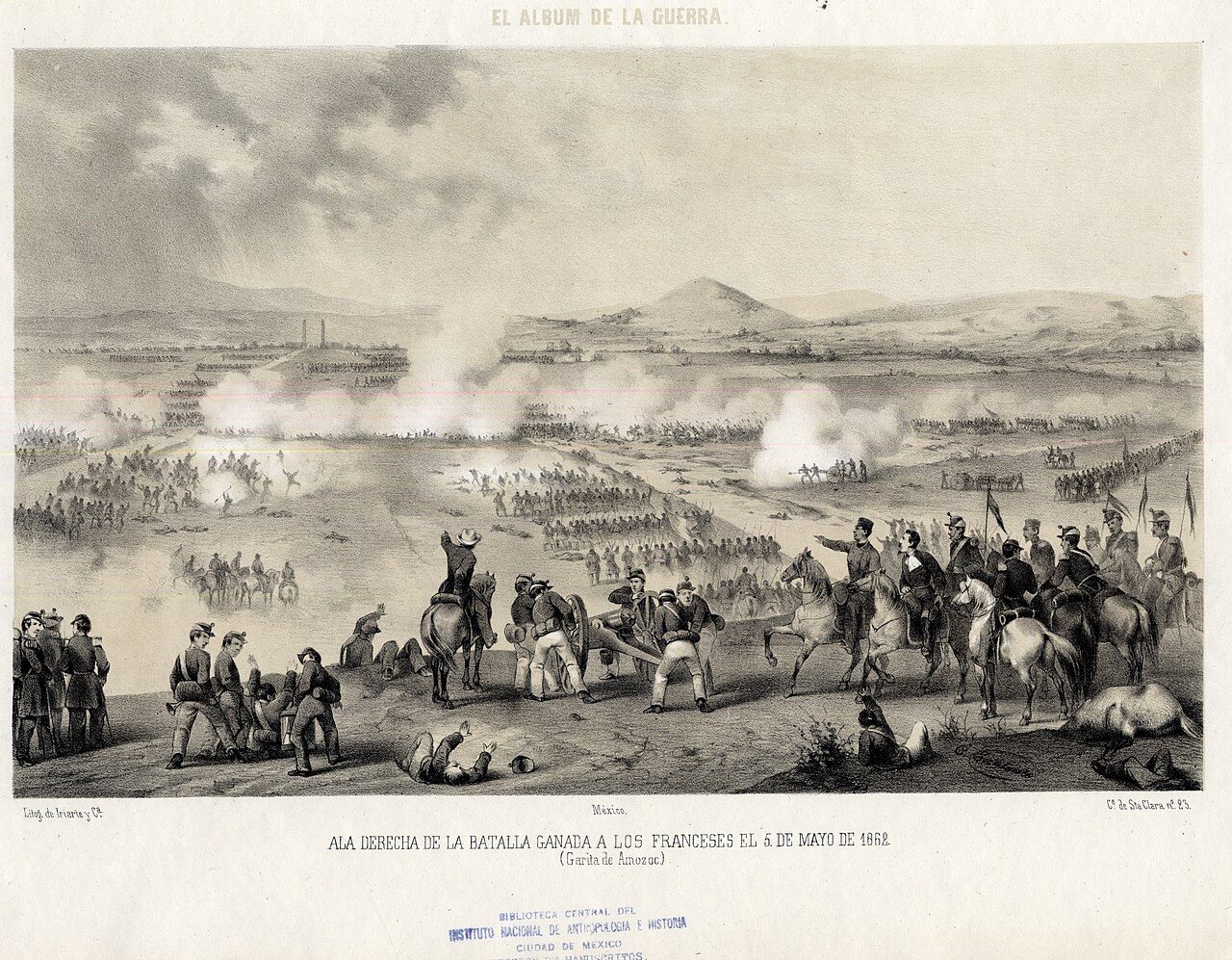
On 5 May 1862, outside the city of Puebla, a Mexican army of volunteers and regulars under General Ignacio Zaragoza defeated the finest expeditionary force France could send — the victory the world now celebrates as Cinco de Mayo. May 5 is also the day Napoleon died on St Helena in 1821, Karl Marx was born in 1818, and Alan Shepard became the first American in space in 1961.
Choose another date: open the On This Day calendar to browse events, births and deaths for any day of the year.
At a Glance
- The invader
- France under Napoleon III, intervening in Mexico over suspended debt payments, with designs on a French-aligned monarchy
- The defenders
- The army of President Benito Juarez's liberal government, commanded at Puebla by General Ignacio Zaragoza
- The odds
- About 6,000 French troops attacked a smaller, poorly supplied Mexican force fortified on the hills of Loreto and Guadalupe
- The result
- The French lost nearly 500 men; fewer than 100 Mexicans were killed, and the assaults broke by early evening
- The sequel
- France returned with 30,000 men, took Puebla in 1863 and installed Maximilian — who was executed when the republic triumphed in 1867
- The holiday
- Cinco de Mayo is observed chiefly in Puebla and, on a far larger scale, across the United States
Events on this day
- 1789The Estates-General convenes at Versailles for the first time since 1614 — the opening act of the French Revolution.
- 1821Napoleon Bonaparte dies in exile on St Helena, five years after his final defeat and abdication.
- 1862Mexican forces defeat the French at the Battle of Puebla — the featured story above.
- 1864The Battle of the Wilderness opens in Virginia, the first clash between Grant and Lee in the American Civil War.
- 1891Carnegie Hall opens in New York with Tchaikovsky as guest conductor.
- 1931Coal miners and company men fight the Battle of Evarts in Harlan County, Kentucky, leaving four dead in Bloody Harlan.
- 1945American soldiers and defecting German troops together defend Castle Itter in Austria against the Waffen-SS, freeing French prisoners.
- 1961Alan Shepard flies Freedom 7 on a 15-minute suborbital flight, becoming the first American in space.
- 1973Secretariat wins the Kentucky Derby in record time, on his way to the Triple Crown.
- 1981Bobby Sands, IRA prisoner and elected MP, dies on the 66th day of his hunger strike in the Maze Prison.
- 2023The World Health Organization declares the end of COVID-19 as a public health emergency of international concern.
Born on this day
- 1813Soren Kierkegaard — Danish philosopher, the melancholy founder of existentialism.
- 1818Karl Marx — German philosopher and economist whose Communist Manifesto and Capital reshaped world politics.
- 1846Henryk Sienkiewicz — Polish novelist, author of Quo Vadis and a Nobel laureate.
- 1914Tyrone Power — American film actor, swashbuckling star of The Mark of Zorro.
- 1943Michael Palin — English comedian of Monty Python and later a beloved travel presenter.
- 1988Adele — English singer-songwriter whose voice made her one of the best-selling performers of her generation.
Died on this day
- 1821Napoleon Bonaparte — emperor of the French, dead in exile on St Helena at 51.
- 1859Peter Gustav Lejeune Dirichlet — German mathematician who formalised the modern concept of a function, dead at 54.
- 1981Bobby Sands — Irish republican prisoner and MP, dead on hunger strike at 27; he is listed under events as well because his death was itself the event.
- 1995Mikhail Botvinnik — Soviet world chess champion and teacher of champions, dead in Moscow at 83.
- 2019Norma Miller — American Lindy Hop dancer, the Queen of Swing, dead at 99.
The featured story: the Battle of Puebla, 5 May 1862
The battle grew out of debt and ambition. Mexico's liberal government under Benito Juarez, bankrupted by civil war, had suspended payments on foreign loans in 1861. Britain, Spain and France landed troops to press their claims; but when it became clear that France's Napoleon III meant not repayment but empire — a Catholic monarchy in Mexico that would check the United States and restore French glory — the British and Spanish went home. The French marched inland toward Mexico City under General Charles de Lorencez, confident, as Lorencez wrote, that his men were racially and militarily superior to anything Mexico could field.
Puebla stood in their way, the second city of Mexico, fortified on its eastern approach by two hilltop forts, Loreto and Guadalupe. General Ignacio Zaragoza, a 33-year-old from Texas-born Mexican stock who had buried his wife only months before, disposed his few thousand men — regulars, national guardsmen and Indigenous volunteers from the surrounding sierra, many poorly armed — along the hills and waited. On the morning of 5 May, in heavy rain that turned the slopes to mud, Lorencez launched frontal assaults on the forts, expecting the position to collapse by noon.
It did not collapse. Three French attacks broke against the forts and the Mexican lines between them; a young brigadier, Porfirio Diaz, helped turn back a flanking column. By early evening the French, having lost nearly 500 soldiers against fewer than 100 Mexican dead, withdrew to their camp and, days later, retreated toward the coast. Zaragoza's telegram to the capital became a national heirloom: the national arms, he wrote, had covered themselves with glory. Juarez declared the date a national holiday, and the celebrations that Mexican communities in California began in 1863 grew, in time, into Cinco de Mayo.
The victory was symbolic rather than decisive, and everyone at the time knew it. Napoleon sent 30,000 reinforcements; Puebla fell after a siege in 1863, Mexico City followed, and the Archduke Maximilian arrived as emperor. But the republic never surrendered: Juarez's government survived in the north, the United States, freed of its civil war, pressed France to leave, and in 1867 Maximilian was executed and the republic restored. Puebla's real work had been done on its first day — it proved the intervention would be a war, not a parade, and gave a young nation the founding victory it still celebrates, above all in the city itself and across the Mexican diaspora in the United States.
Why this date matters
May 5 is a day when reputations invert. Napoleon, whose nephew's army was beaten at Puebla, died on this date in 1821 — and the army beaten at Puebla was fighting, in part, to restore the glory of his name. Marx, born on this date in 1818, spent his life arguing that such glory was a mask for economics; Shepard's fifteen minutes in space in 1961 announced a contest that was exactly both. Even the day's quiet entries rhyme: a hall for music opens in 1891, a hunger striker's fast ends in 1981. Victories here are rarely final, and defeats rarely are either.
Sources
- Encyclopaedia Britannica — On This Day: May 5
- HISTORY — What Happened on May 5
- Encyclopaedia Britannica — Battle of Puebla
- HISTORY — Cinco de Mayo
The facts on this page were checked against these sources on 19 November 2026. The History Trail's permanent pages are researched and written for this site; the live profiles elsewhere on The History Trail are assembled automatically from Wikipedia and Wikidata.
About the Author
Researched and written by the The History Trail Editorial Team — the accountable editorial function behind this site's permanent story pages. The team works from the published sources cited on each page; it does not invent historians, reviewers or credentials, and it corrects errors openly.
Fact Check
Every load-bearing fact on this page traces to one of the sources listed above, and significant claims link to their source in the text. Our checking method is described on the methodology page; errors can be reported via the corrections page.
Sources & Citations
Cite this page as: The History Trail Editorial Team, The History Trail — this article's title, publication and update dates are shown beneath its headline. The full source list appears under Sources above; the site's source standards are on the sources page.