
On This Day
May 17 in History
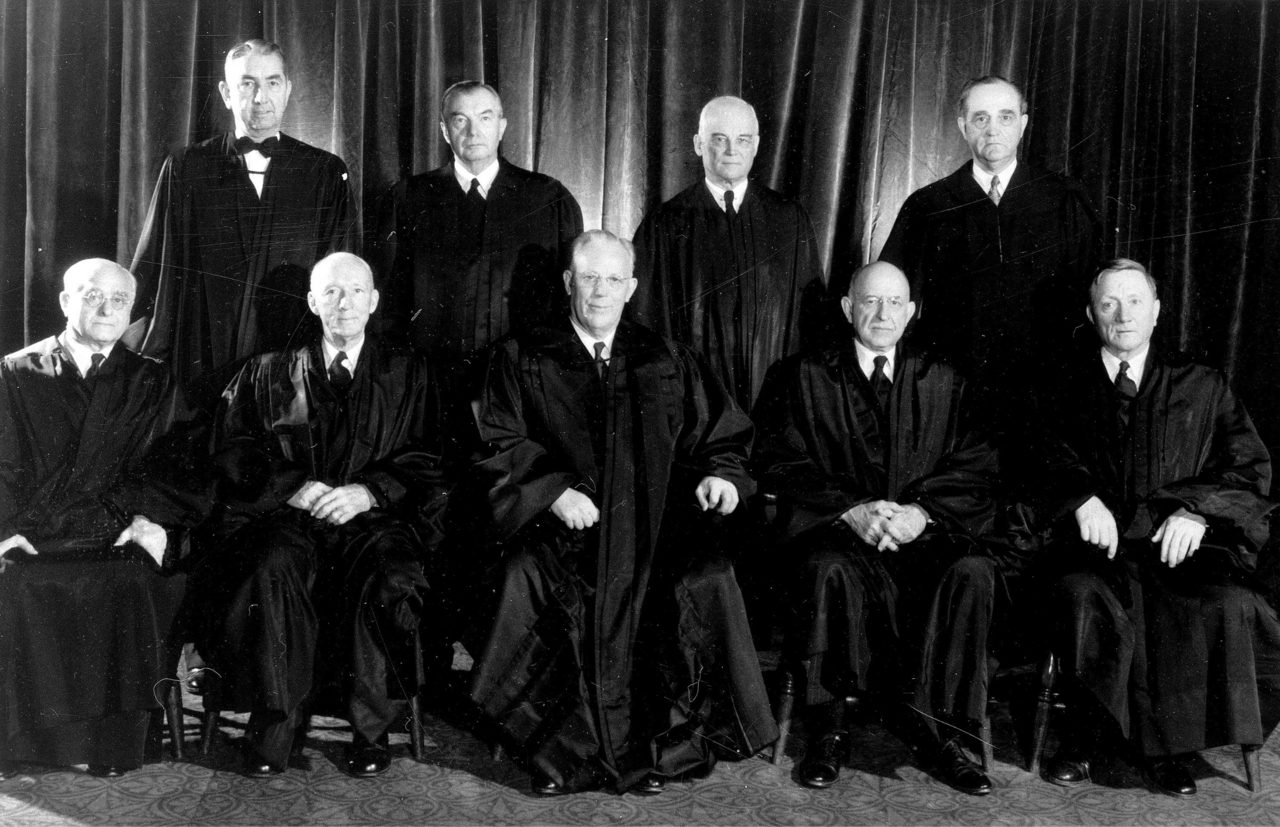
On 17 May 1954 the U.S. Supreme Court ruled unanimously in Brown v. Board of Education that racial segregation in public schools was unconstitutional, declaring that 'separate educational facilities are inherently unequal' and striking down the doctrine that had sheltered Jim Crow since 1896. May 17 is also the day the New York Stock Exchange was founded, the first Kentucky Derby was run, and the Watergate hearings opened.
Choose another date: open the On This Day calendar to browse events, births and deaths for any day of the year.
At a Glance
- The decision
- 17 May 1954 — Brown v. Board of Education of Topeka, decided 9–0, opinion by Chief Justice Earl Warren
- The holding
- 'Separate educational facilities are inherently unequal' — segregation in public schools violates the Fourteenth Amendment
- The plaintiffs
- Five combined cases from Kansas, South Carolina, Virginia, Delaware and Washington, D.C., argued by Thurgood Marshall for the NAACP
- The name on the case
- Oliver Brown of Topeka, whose daughter Linda was bused past her neighbourhood school to a segregated one
- What it overturned
- The 'separate but equal' doctrine of Plessy v. Ferguson (1896) — decided, by coincidence, on 18 May
- The remedy
- Brown II (1955) orders desegregation 'with all deliberate speed'; real change awaits the Civil Rights Act of 1964
Events on this day
- 1536George Boleyn and four other men are executed on Tower Hill, condemned in the case against Queen Anne Boleyn; her marriage to Henry VIII is annulled the same day.
- 1792Twenty-four brokers sign the Buttonwood Agreement under a tree on Wall Street, founding what becomes the New York Stock Exchange.
- 1865The International Telegraph Union is founded in Paris, the body that becomes the International Telecommunication Union, the world's oldest international organisation still working.
- 1875The first Kentucky Derby is run at Churchill Downs in Louisville; Aristides, ridden by Oliver Lewis, wins.
- 1939King George VI and Queen Elizabeth arrive in Quebec, beginning the first visit to Canada by a reigning British monarch.
- 1954The U.S. Supreme Court rules unanimously in Brown v. Board of Education that segregated public schools are unconstitutional — the featured story above.
- 1973The Senate Watergate Committee opens televised hearings into the Nixon administration's abuses, chaired by Sam Ervin.
- 1990The World Health Organization removes homosexuality from its International Classification of Diseases.
- 2004Massachusetts performs the first legal same-sex marriages in the United States, at Cambridge City Hall just after midnight.
Born on this day
- 1749Edward Jenner — English physician who performed the first vaccination and founded immunology.
- 1866Erik Satie — French composer of the Gymnopédies, a quiet revolutionary of modern music.
- 1873Dorothy Richardson — English novelist who pioneered the stream-of-consciousness technique later used by Joyce and Woolf.
- 1911Maureen O'Sullivan — Irish actress, Jane to Johnny Weissmuller's Tarzan.
- 1912Archibald Cox — American lawyer who became the first Watergate special prosecutor.
- 1956Sugar Ray Leonard — American boxer, world champion at five weights and Olympic gold medallist.
Died on this day
- 1510Sandro Botticelli — Florentine painter of The Birth of Venus and Primavera, dead at about 65.
- 1829John Jay — first chief justice of the United States and co-author of The Federalist Papers.
- 1875John C. Breckinridge — former U.S. vice president who became a Confederate general and the South's last secretary of war.
- 2011Harmon Killebrew — American baseball slugger whose 573 home runs made the Hall of Fame.
- 2012Donna Summer — American singer, the 'Queen of Disco', dead at 63.
The featured story: Brown v. Board of Education, 17 May 1954
On 17 May 1954 the chief justice of the United States, Earl Warren, read out one of the shortest and most consequential opinions in American law. In Brown v. Board of Education of Topeka, a unanimous Supreme Court held that separating children in public schools solely on the basis of race denied Black children the equal protection of the laws guaranteed by the Fourteenth Amendment. 'We conclude,' Warren wrote, 'that in the field of public education the doctrine of "separate but equal" has no place. Separate educational facilities are inherently unequal.' With that sentence, the legal foundation of American segregation, standing since 1896, was struck down.
The case was really five cases, combined from Kansas, South Carolina, Virginia, Delaware and the District of Columbia, and named for the first of them: Oliver Brown, a welder and assistant pastor in Topeka whose daughter Linda had to travel across town to a Black school although a white school stood blocks from her home. The NAACP's legal team, led by Thurgood Marshall, had spent two decades building toward this argument — chipping at segregation first in graduate schools, then presenting the Court with social-science evidence, including Kenneth Clark's doll studies, that separation stamped Black children with a sense of inferiority. Marshall would himself join the Court thirteen years later.
Unanimity was the decision's deliberate armour. Warren, a former governor of California appointed by President Eisenhower, worked for months to bring all nine justices — including men from segregated states — behind a single, unsigned-by-dissent opinion written in plain, non-accusatory language that newspapers could print and citizens could understand. The Court conspicuously did not order an instant remedy: a second decision, Brown II, followed in 1955, instructing desegregation 'with all deliberate speed' — a phrase whose vagueness Southern officials exploited for a decade of 'massive resistance', closed schools and token compliance.
The ruling did not desegregate America by itself; by 1964 barely one Southern Black child in a hundred attended school with white children, and it took the Civil Rights Act of that year and federal money and courts to move the numbers. But Brown changed what the law said the country was. It destroyed the constitutional shelter of Jim Crow, gave the young civil rights movement a legal weapon and a moral warrant, and reached far beyond schools — the reasoning that killed 'separate but equal' in education was soon turned on buses, parks, marriage laws and every other statute built on the same fiction. The schoolhouse door Warren opened in 1954 is still being walked through.
Why this date matters
May 17 is the calendar's day for doors opening that law had kept shut. In 1954 the Supreme Court unlocks the American schoolhouse; fifty years later to the day, Massachusetts marries its first same-sex couples; in between, in 1990, the world's doctors strike homosexuality from the list of diseases. Even its commercial founding fits: the brokers under the buttonwood tree in 1792 were opening a market. The day's counterweight is 1536, when Tower Hill showed what a state does to people it wants shut away — George Boleyn died on this date so that a king's marriage could be undone. May 17 measures societies by whom they let in.
Sources
- Encyclopaedia Britannica — On This Day: May 17
- HISTORY — What Happened on May 17
- National Archives — Brown v. Board of Education (1954)
- Cornell Law Institute — Brown v. Board of Education, 347 U.S. 483 (1954)
The facts on this page were checked against these sources on 19 November 2026. The History Trail's permanent pages are researched and written for this site; the live profiles elsewhere on The History Trail are assembled automatically from Wikipedia and Wikidata.
About the Author
Researched and written by the The History Trail Editorial Team — the accountable editorial function behind this site's permanent story pages. The team works from the published sources cited on each page; it does not invent historians, reviewers or credentials, and it corrects errors openly.
Fact Check
Every load-bearing fact on this page traces to one of the sources listed above, and significant claims link to their source in the text. Our checking method is described on the methodology page; errors can be reported via the corrections page.
Sources & Citations
Cite this page as: The History Trail Editorial Team, The History Trail — this article's title, publication and update dates are shown beneath its headline. The full source list appears under Sources above; the site's source standards are on the sources page.