
On This Day
May 15 in History
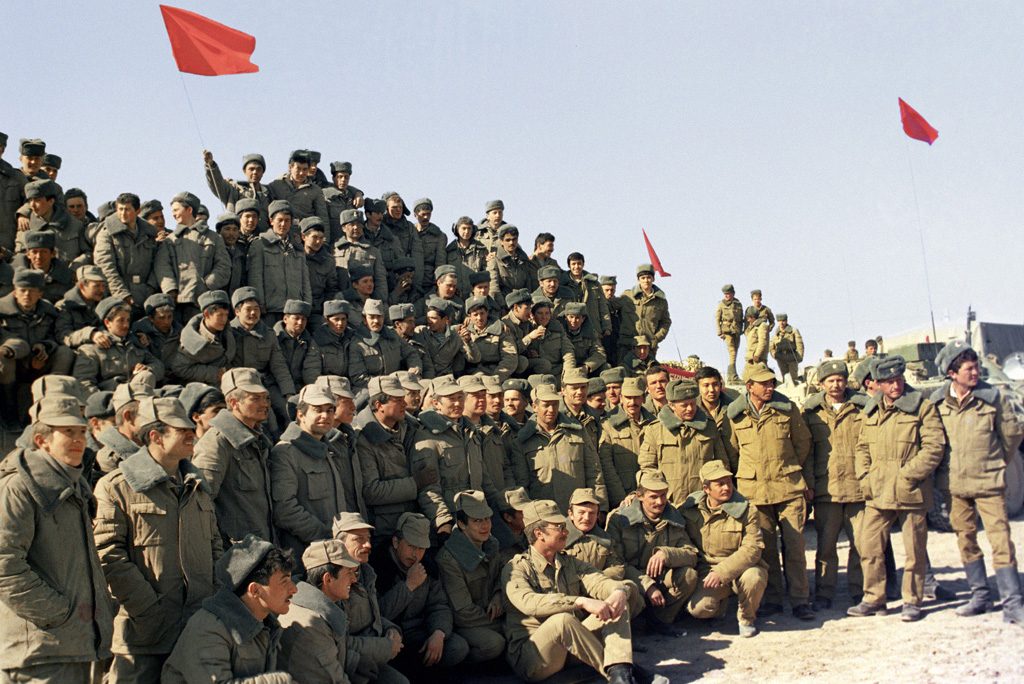
On 15 May 1988, under the Geneva Accords, the Soviet Union began withdrawing its army from Afghanistan, starting the nine-month exit that ended a nine-year war it had failed to win. May 15 is also the day the first McDonald's opened, nylon stockings went on sale, Mickey Mouse first appeared, and Arab armies invaded the new State of Israel.
Choose another date: open the On This Day calendar to browse events, births and deaths for any day of the year.
At a Glance
- The war
- Soviet forces enter Afghanistan in December 1979 to support its communist government; the intervention lasts nine years
- The forces
- Some 115,000 Soviet troops at the war's height, facing mujahideen backed by the US, Pakistan and Saudi Arabia
- The agreement
- The Geneva Accords, April 1988 — withdrawal to begin 15 May and finish within nine months
- The start
- 15 May 1988 — the first columns cross north toward the Soviet border
- The end
- 15 February 1989 — General Boris Gromov crosses the Friendship Bridge last, declaring no soldier left behind
- The cost
- More than 15,000 Soviet dead and an estimated one million Afghan dead, with millions more made refugees
Events on this day
- 1718London lawyer James Puckle patents his 'Defence Gun', an early machine gun designed for use against boarding parties at sea.
- 1869Susan B. Anthony and Elizabeth Cady Stanton found the National Woman Suffrage Association in New York to campaign for a constitutional amendment.
- 1918The first regular airmail service in the United States begins, between Washington, Philadelphia and New York.
- 1928Mickey and Minnie Mouse make their first appearance, in the silent cartoon Plane Crazy, screened as a test and released the following year.
- 1940Richard and Maurice McDonald open their first restaurant, in San Bernardino, California — a drive-in barbecue stand that becomes an empire.
- 1940Nylon stockings go on sale across the United States for the first time; in New York alone, some 780,000 pairs sell on the first day.
- 1948The armies of Egypt, Syria, Transjordan, Lebanon and Iraq invade the newly proclaimed State of Israel, beginning the first Arab-Israeli war.
- 1955The Austrian State Treaty is signed in Vienna, restoring Austria's independence after ten years of four-power occupation.
- 1958The Soviet Union launches Sputnik 3, a large scientific satellite carrying instruments to study the upper atmosphere.
- 1972Alabama governor George Wallace is shot five times while campaigning for the presidency in Laurel, Maryland; he survives, paralysed.
- 1988Soviet forces begin their withdrawal from Afghanistan under the Geneva Accords — the featured story above.
- 1991Édith Cresson becomes prime minister of France, the first woman to hold the office.
Born on this day
- 1856L. Frank Baum — American author of The Wonderful Wizard of Oz and its sequels.
- 1859Pierre Curie — French physicist whose work on radioactivity with Marie Curie won them a Nobel Prize.
- 1930Jasper Johns — American artist whose flags and targets remade postwar painting.
- 1937Madeleine Albright — Czech-born American diplomat, the first woman to serve as U.S. secretary of state.
- 1948Brian Eno — English musician and producer who pioneered ambient music.
- 1969Emmitt Smith — American football running back, the NFL's all-time leading rusher.
- 1987Andy Murray — Scottish tennis player, three-time Grand Slam champion and two-time Olympic gold medallist.
Died on this day
- 1886Emily Dickinson — American poet, dead at 55 in Amherst, having published almost nothing in her lifetime.
- 1967Edward Hopper — American painter of Nighthawks and the modern city's loneliness, dead at 84.
- 2003June Carter Cash — American country singer of the Carter Family and wife and duet partner of Johnny Cash.
- 2012Carlos Fuentes — Mexican novelist of The Death of Artemio Cruz, a central figure of the Latin American Boom.
The featured story: Soviet troops begin leaving Afghanistan, 15 May 1988
On 15 May 1988, Soviet armoured columns began rolling north out of Afghanistan toward the border river crossings, past Afghan children waving flags and soldiers riding on top of their vehicles with flowers in the barrels of their guns. It was the first stage of a withdrawal that would end, nine months later, one of the Cold War's defining failures: the Soviet Union's nine-year war in Afghanistan, begun in December 1979 to prop up a communist government in Kabul, was being abandoned in full view of the world.
The invasion had been meant to be quick. Instead the Soviet 40th Army — some 115,000 troops at its height — found itself fighting a guerrilla war across some of the most difficult terrain on earth, against mujahideen fighters supplied with money and weapons by the United States, Pakistan and Saudi Arabia, including, from 1986, Stinger anti-aircraft missiles that stripped the Soviets of command of the air. An estimated one million Afghans died, millions more fled as refugees, and more than 15,000 Soviet soldiers were killed — figures the Soviet public learned only slowly, as zinc coffins came home to a country told almost nothing.
The decision to leave belonged to Mikhail Gorbachev, who had called Afghanistan a 'bleeding wound' in 1986 and concluded that the war was unwinnable at any price the Soviet Union could still pay. Under the Geneva Accords of April 1988, signed by Afghanistan and Pakistan with the superpowers as guarantors, the withdrawal was scheduled to begin on 15 May and to be completed within nine months. Half the force was to leave by August. The columns that crossed the Friendship Bridge at Termez in the first days were leaving a client government in Kabul under President Najibullah that few expected to survive the year.
In fact Najibullah's government outlasted the Soviet Union itself, holding Kabul until 1992, when the mujahideen took the capital and the country descended into the civil war from which the Taliban emerged. The last Soviet soldier, General Boris Gromov, walked across the Friendship Bridge on 15 February 1989, declaring that not one soldier was left behind. Two years later the USSR was gone. Historians still argue over how much Afghanistan contributed to that collapse, but the images of May 1988 — an empire's army driving home in daylight, defeated by a war it could neither win nor explain — announced the Cold War's ending before the Wall fell.
Why this date matters
May 15 is a day of beginnings disguised as endings, and endings disguised as beginnings. An empire begins its retreat from Afghanistan on it in 1988 while insisting the mission was complete; the McDonald brothers open a barbecue stand on it in 1940 with no idea they are founding fast food; nylon stockings, airmail and Mickey Mouse all make first appearances on it, each the start of a mass culture. And in 1948, the day after a state is proclaimed, the war to decide whether it will live begins on this date. May 15 deals in first steps whose destinations nobody present could see.
Sources
- Encyclopaedia Britannica — On This Day: May 15
- HISTORY — What Happened on May 15
- HISTORY — Soviets begin withdrawal from Afghanistan
- Encyclopaedia Britannica — Soviet-Afghan War
The facts on this page were checked against these sources on 19 November 2026. The History Trail's permanent pages are researched and written for this site; the live profiles elsewhere on The History Trail are assembled automatically from Wikipedia and Wikidata.
About the Author
Researched and written by the The History Trail Editorial Team — the accountable editorial function behind this site's permanent story pages. The team works from the published sources cited on each page; it does not invent historians, reviewers or credentials, and it corrects errors openly.
Fact Check
Every load-bearing fact on this page traces to one of the sources listed above, and significant claims link to their source in the text. Our checking method is described on the methodology page; errors can be reported via the corrections page.
Sources & Citations
Cite this page as: The History Trail Editorial Team, The History Trail — this article's title, publication and update dates are shown beneath its headline. The full source list appears under Sources above; the site's source standards are on the sources page.