
On This Day
July 15 in History
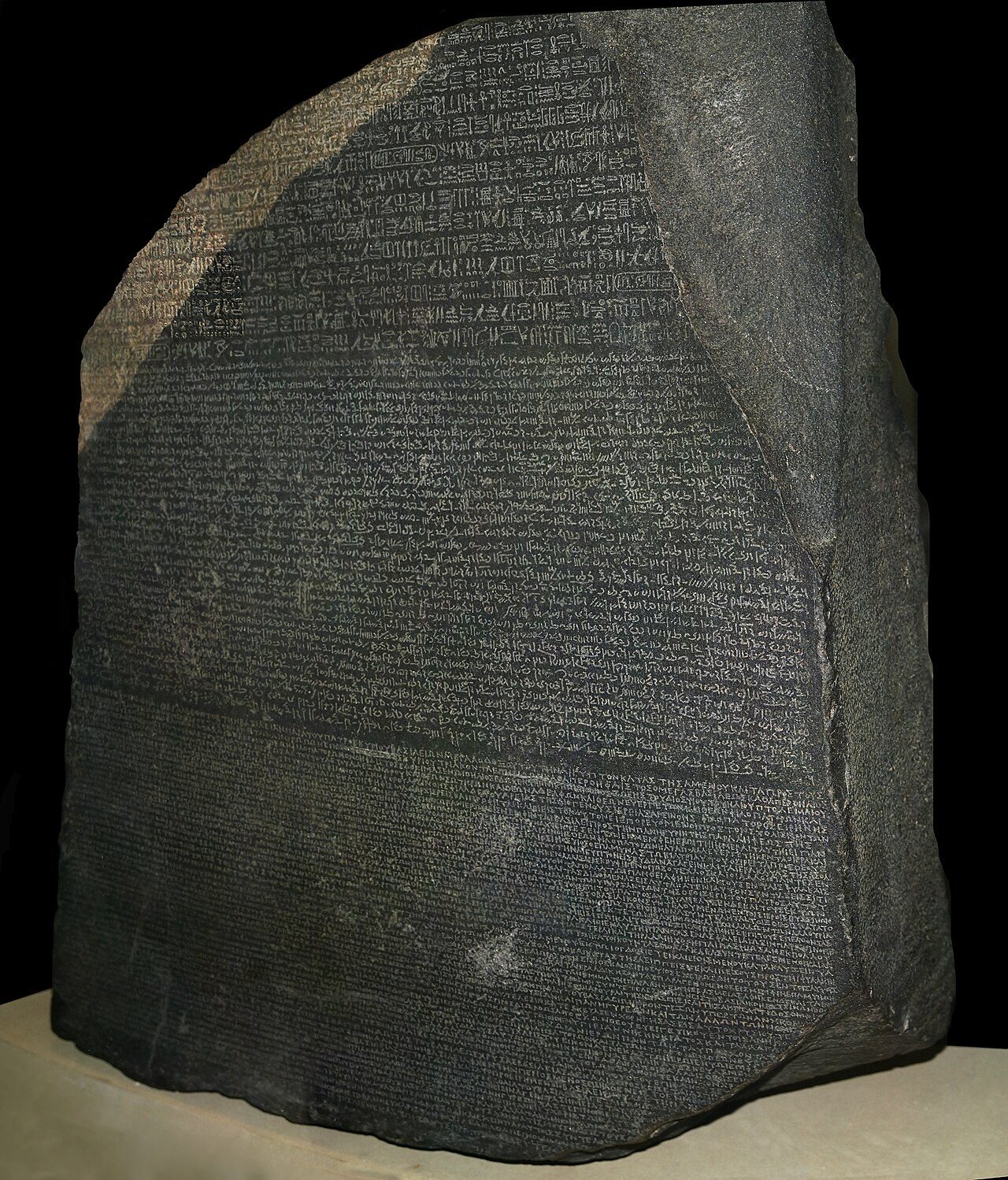
On 15 July 1799, French soldiers rebuilding a fort near Rosetta in the Nile Delta uncovered a black stone slab carved with the same decree in three scripts — the Rosetta Stone, which two decades later gave scholars the key to Egyptian hieroglyphs. July 15 is also the day Jerusalem fell to the First Crusade, Mariner 4 flew past Mars, and Nixon stunned America by announcing a visit to China.
Choose another date: open the On This Day calendar to browse events, births and deaths for any day of the year.
At a Glance
- The find
- 15 July 1799, at Fort Julien near Rosetta (Rashid), Egypt, during Napoleon's Egyptian campaign
- The finder
- Lieutenant Pierre-François Bouchard, a French engineering officer supervising repairs to the fort
- The stone
- A granodiorite stele fragment, about 112 cm tall, weighing some 760 kg
- The text
- A priestly decree of 196 BC honouring Ptolemy V, written in hieroglyphs, demotic script and Greek
- The decipherment
- Jean-François Champollion announced his breakthrough in reading hieroglyphs in 1822, building on Thomas Young's work
- The home
- The British Museum, London, since 1802, after the stone passed to Britain under the Capitulation of Alexandria
Events on this day
- 1099Crusaders capture Jerusalem after a five-week siege, ending the First Crusade's march with massacres of the city's Muslim and Jewish inhabitants.
- 1381John Ball, the radical priest of the Peasants' Revolt, is executed at St Albans in the presence of the young Richard II.
- 1799French soldiers uncover the Rosetta Stone near Rosetta, Egypt — the featured story above.
- 1806Zebulon Pike sets out from St Louis on his expedition to explore the American south-west and the headwaters of the Arkansas and Red rivers.
- 1903The newly formed Ford Motor Company takes its first order, for an $850 Model A, from Chicago dentist Ernst Pfenning.
- 1918The Second Battle of the Marne begins — Germany's last great offensive of the First World War, and the turning point toward Allied victory.
- 1965NASA's Mariner 4 flies past Mars and sends back the first close-up photographs of another planet's surface.
- 1971President Richard Nixon announces on live television that he will visit the People's Republic of China, ending a generation of hostility.
- 1979President Jimmy Carter delivers his 'crisis of confidence' address on energy and the nation's mood.
- 1997Fashion designer Gianni Versace is murdered by Andrew Cunanan on the steps of his Miami Beach mansion.
- 2006Twitter is launched to the public, with co-founder Jack Dorsey's test message already four months old.
Born on this day
- 1606Rembrandt van Rijn — Dutch master of light and portraiture, painter of The Night Watch and dozens of self-portraits.
- 1919Iris Murdoch — Irish-born novelist and philosopher, author of The Sea, The Sea.
- 1922Leon Lederman — American particle physicist who won the Nobel Prize for work on neutrinos and popularised the phrase 'the God particle'.
- 1946Linda Ronstadt — American singer whose voice crossed rock, country and the Great American Songbook.
- 1961Forest Whitaker — American actor, Oscar winner for playing Idi Amin in The Last King of Scotland.
Died on this day
- 1857Carl Czerny — Austrian pianist and composer, Beethoven's pupil and Liszt's teacher, whose exercises still train pianists.
- 1904Anton Chekhov — Russian playwright and master of the short story, dead of tuberculosis at 44.
- 2012Celeste Holm — American actress, Oscar winner for Gentleman's Agreement and the original Ado Annie in Oklahoma!.
- 2017Martin Landau — American actor of Mission: Impossible and an Oscar winner as Bela Lugosi in Ed Wood, dead at 89.
The featured story: the Rosetta Stone is found in Egypt, 15 July 1799
Napoleon's invasion of Egypt in 1798 was a military campaign with a scholarly army attached: more than 150 scientists, engineers and artists — the savants — travelled with the expedition to study a country whose ancient writing no one alive could read. Egyptian hieroglyphs had been silent for some fourteen centuries; the last dated hieroglyphic inscription was carved in AD 394, and everything the script had recorded was locked away. What the expedition needed, without knowing it existed, was a bilingual text — the same words in a known language and in the lost one.
On 15 July 1799, French soldiers under Colonel d'Hautpoul were strengthening the defences of Fort Julien, a crumbling stronghold a few miles north-east of the port of Rosetta, near where the western branch of the Nile meets the Mediterranean. Demolishing an old wall, they uncovered a slab of black granodiorite, roughly a metre tall, covered in dense carving. The officer in charge, Lieutenant Pierre-François Bouchard, saw that the carving fell into three distinct bands, and that the lowest band was Greek — a language scholars could read. He reported the find, and the stone was carried to the Institut d'Égypte in Cairo, where a report read on 19 July already suggested that the three inscriptions were versions of the same text.
They were. The stone is a fragment of a stele inscribed in 196 BC with a decree of a council of priests at Memphis, honouring the young king Ptolemy V on the first anniversary of his coronation. It states the decree three times: in hieroglyphs, the script of temples; in demotic, the everyday cursive of late Egypt; and in Greek, the language of Egypt's Macedonian rulers. Copies — ink impressions taken from the stone's surface — circulated to scholars across Europe within months.
The stone itself changed hands with the war. When Alexandria capitulated in 1801, the antiquities collected by the French passed to Britain, and the Rosetta Stone reached London in 1802, where the British Museum has displayed it ever since. The decipherment took another generation: Thomas Young recognised that the demotic text used phonetic signs and that the cartouches — the oval rings in the hieroglyphs — contained royal names; Jean-François Champollion, working from Coptic, the descendant language of ancient Egyptian, showed in 1822 that the hieroglyphic script spelled native Egyptian words phonetically too. With that, three thousand years of Egyptian records became readable — because a fort's wall in the Delta happened to be built out of a broken decree.
Why this date matters
July 15 is the calendar's day for messages crossing barriers. Its centrepiece is a stone that let the modern world read a civilisation that had been mute for 1,400 years; around it stand a probe sending the first close pictures from another planet, a president announcing a journey to a country his nation did not recognise, and a microblogging service launched to carry messages of 140 characters. Against those openings stand the day's closures — a holy city taken by storm, a revolt's priest executed, a designer shot on his own steps. The pattern is communication and its opposite, arriving on the same date.
Sources
- Encyclopaedia Britannica — On This Day: July 15
- HISTORY — What Happened on July 15
- Oxford University Press — This Day in History: Rosetta Stone Found
- Encyclopaedia Britannica — Gianni Versace
- Wikimedia Commons — Rosetta Stone

The facts on this page were checked against these sources on 19 November 2026. The History Trail's permanent pages are researched and written for this site; the live profiles elsewhere on The History Trail are assembled automatically from Wikipedia and Wikidata.
About the Author
Researched and written by the The History Trail Editorial Team — the accountable editorial function behind this site's permanent story pages. The team works from the published sources cited on each page; it does not invent historians, reviewers or credentials, and it corrects errors openly.
Fact Check
Every load-bearing fact on this page traces to one of the sources listed above, and significant claims link to their source in the text. Our checking method is described on the methodology page; errors can be reported via the corrections page.
Sources & Citations
Cite this page as: The History Trail Editorial Team, The History Trail — this article's title, publication and update dates are shown beneath its headline. The full source list appears under Sources above; the site's source standards are on the sources page.