
On This Day
April 29 in History
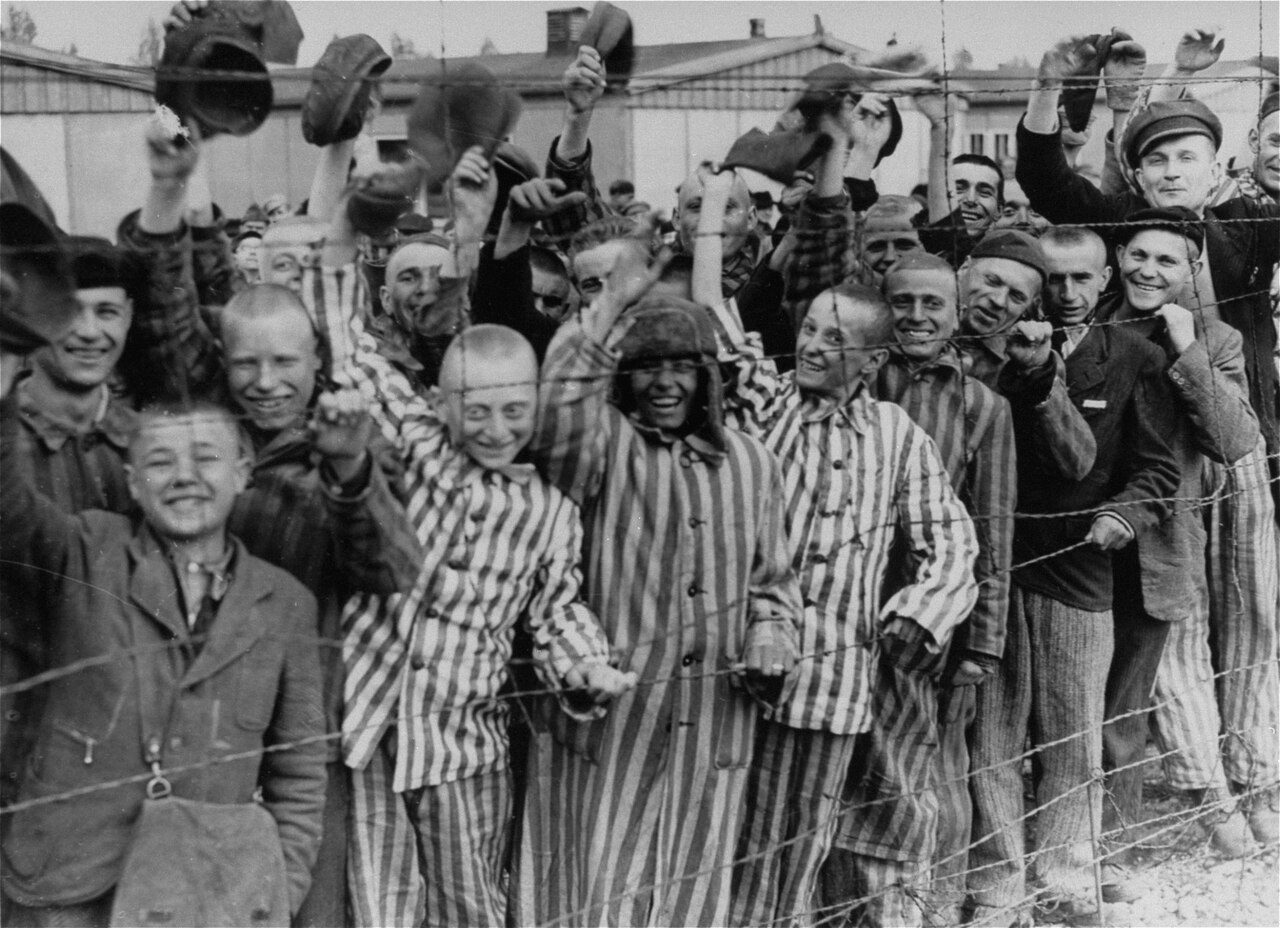
On 29 April 1945, soldiers of the U.S. Seventh Army entered Dachau, the first concentration camp the Nazi regime had built, and freed some 32,000 prisoners — while outside the wire they found a train of boxcars filled with the dead. The liberation, twelve years after the camp opened, exposed the system to the world's cameras. April 29 is also the day Joan of Arc reached Orléans in 1429 and the Los Angeles riots began in 1992.
Choose another date: open the On This Day calendar to browse events, births and deaths for any day of the year.
At a Glance
- The camp
- Dachau, opened in March 1933 near Munich — the first regular Nazi concentration camp and the model for the system that followed
- The liberators
- Units of the U.S. Seventh Army: the 42nd and 45th Infantry Divisions and the 20th Armored Division
- The freed
- Approximately 32,000 prisoners in the main camp, most starving and many desperately ill
- The evidence
- Dozens of railway cars of corpses at the camp siding; over 200,000 people had been imprisoned at Dachau across its twelve years, and at least 41,500 died
- The week before
- Some 7,000 prisoners had been forced out on a death march south on 26–27 April; American troops freed its survivors in early May
- The memory
- Dachau became a memorial site in 1965, on the initiative of survivors who fought to preserve it
Events on this day
- 1429Joan of Arc enters besieged Orléans with a relief convoy; within nine days the English siege collapses, turning the Hundred Years' War.
- 1862Union naval forces under David Farragut take formal possession of New Orleans, the Confederacy's largest city and port.
- 1945American troops liberate the Dachau concentration camp — the featured story above.
- 1945In the Berlin bunker in the night of 28–29 April, Adolf Hitler marries Eva Braun; both will be dead by suicide the following afternoon.
- 1946The Tokyo war crimes tribunal opens, putting 28 former Japanese leaders on trial for their part in the Second World War.
- 1968The musical Hair, with its rock score, nudity and anti-war message, opens on Broadway and defines an era of theatre.
- 1991A catastrophic cyclone strikes Bangladesh, killing an estimated 138,000 people in one of the deadliest storms ever recorded.
- 1992After a jury acquits four police officers in the videotaped beating of Rodney King, riots erupt across Los Angeles; more than 50 people die in days of violence.
- 2004The National World War II Memorial in Washington, D.C. opens to the public, honouring the 16 million Americans who served.
Born on this day
- 1863William Randolph Hearst — American newspaper magnate whose media empire reshaped journalism and politics.
- 1899Duke Ellington — American composer and bandleader, among the greatest figures in jazz.
- 1958Michelle Pfeiffer — American actor of Scarface and The Fabulous Baker Boys.
- 1970Uma Thurman — American actor of Pulp Fiction and Kill Bill.
Died on this day
- 1951Ludwig Wittgenstein — Austrian philosopher, born two days earlier in the calendar in 1889, dead in Cambridge at 62.
- 1980Alfred Hitchcock — English director of Psycho, Vertigo and Rear Window, the 'Master of Suspense', dead at 80.
- 1992Mae Clarke — American actor, the bride in Frankenstein (1931) and recipient of James Cagney's famous grapefruit, dead at 81.
- 2020Irrfan Khan — Indian actor of Life of Pi and Slumdog Millionaire, dead in Mumbai at 53.
The featured story: the liberation of Dachau, 29 April 1945
Dachau was where the camp system began. Opened in March 1933, weeks after Hitler took power, in a former munitions factory outside Munich, it was built for political prisoners — Communists, Social Democrats, trade unionists — and became the template and training ground for the SS camp empire, the place where the rules, the punishments and the personnel of the later camps were formed. Across twelve years more than 200,000 people from across Europe passed through its gates: clergy, Jews, Roma, homosexuals, resistance fighters, prisoners of war. At least 41,500 of them died of hunger, disease, experiments and execution.
By April 1945 the camp was a city of the dying. Evacuation transports from camps in the path of the Allied advance had poured in until some 67,000 prisoners were registered in Dachau and its subcamps; in the main camp more than 30,000 people were packed into barracks built for a fraction of the number, with typhus raging and, in the first months of 1945, deaths running into the thousands each month. On 26 April the SS forced some 7,000 prisoners, most of them Jews, onto a death march toward the Tyrol. The commandant and most guards slipped away on the night of 28 April, leaving the camp to a skeleton staff and to the prisoners' own secret committee, which worked to prevent a final massacre.
The Americans who arrived on 29 April — advance units of the 42nd and 45th Infantry Divisions and the 20th Armored Division of the Seventh Army — came on the camp from two sides, and what they found has never left the record of the war. At the railway siding stood a train of boxcars filled with the bodies of prisoners who had starved and frozen on an evacuation transport from Buchenwald. Inside the wire, thousands of emaciated survivors surged to the fences. A young SS officer formally surrendered the camp to Brigadier General Henning Linden of the 42nd Division. In the fury of the day, American soldiers killed a number of captured SS guards — an episode the Army investigated and historians still document carefully, neither hiding it nor letting it obscure the crime scene that provoked it.
Journalist Marguerite Higgins, among the first correspondents through the gate, reported the liberation around the world; within days, generals were ordering German civilians from the town of Dachau to walk through the camp and bury its dead, and film of what the cameras found became evidence at Nuremberg. Some 32,000 prisoners were freed in the main camp; the death march's survivors were liberated in the following days. Dachau's barracks later housed refugees, then, from 1965, the memorial that survivors fought to build on the site — its museum, its chapels, and its injunction, repeated in five languages: never again.
Why this date matters
April 29 holds liberation in both its medieval and modern dress. In 1429 a teenage girl rides into a besieged city and lifts its siege; in 1945 soldiers open the gates of the first concentration camp and find what the twentieth century did when no one rode to the rescue. The date also carries the century's aftershocks — a dictator's bunker wedding, a cyclone's hundred thousand dead, a city's rage at an acquittal in 1992. Freedom on this date is never abstract: it arrives late, at a gate, and counts its dead on the way in.
Sources
- Encyclopaedia Britannica — On This Day: April 29
- HISTORY — What Happened on April 29
- United States Holocaust Memorial Museum — Liberation of Dachau
- The National WWII Museum — The Liberation of Dachau Concentration Camp
The facts on this page were checked against these sources on 19 November 2026. The History Trail's permanent pages are researched and written for this site; the live profiles elsewhere on The History Trail are assembled automatically from Wikipedia and Wikidata.
About the Author
Researched and written by the The History Trail Editorial Team — the accountable editorial function behind this site's permanent story pages. The team works from the published sources cited on each page; it does not invent historians, reviewers or credentials, and it corrects errors openly.
Fact Check
Every load-bearing fact on this page traces to one of the sources listed above, and significant claims link to their source in the text. Our checking method is described on the methodology page; errors can be reported via the corrections page.
Sources & Citations
Cite this page as: The History Trail Editorial Team, The History Trail — this article's title, publication and update dates are shown beneath its headline. The full source list appears under Sources above; the site's source standards are on the sources page.