
On This Day
April 2 in History
On 2 April 1982 Argentine forces invaded the Falkland Islands, overwhelming the small British garrison at Stanley and starting the Falklands War — a gamble by Argentina's ruling junta that ended, ten weeks later, in defeat and the junta's fall. April 2 is also the day Wilson asked Congress for war in 1917 and Pope John Paul II died in 2005.
Choose another date: open the On This Day calendar to browse events, births and deaths for any day of the year.
At a Glance
- The claim
- Argentina had claimed the islands, which it calls the Malvinas, since the 19th century; Britain had held them since 1833
- The landing
- Argentine amphibious forces land near Stanley before dawn and force the Royal Marines garrison to surrender
- The response
- Britain dispatches a naval task force; the UN Security Council demands Argentine withdrawal
- The end
- Argentine forces in Stanley surrender on 14 June 1982, after 74 days of war
- The cost
- 649 Argentine servicemen, 255 British servicemen and 3 islanders killed
- The fallout
- Argentina's junta falls and democracy returns in 1983; the sovereignty dispute remains unresolved
Events on this day
- 1792The United States Mint is founded, giving the young republic its own official source of coinage in place of foreign money and barter.
- 1863Hungry residents of Richmond, Virginia, riot for food in the Confederate capital, crying 'Bread or blood!' before Jefferson Davis faces them down and more than 60 are arrested.
- 1917President Woodrow Wilson asks Congress to declare war on Germany, and Jeannette Rankin, the first woman elected to Congress, takes her seat the same day.
- 1968Stanley Kubrick's 2001: A Space Odyssey has its world premiere in Washington, D.C., redefining science-fiction cinema.
- 1978The television drama Dallas premieres on CBS as a five-part miniseries; it becomes one of the defining prime-time soaps of its era.
- 1979An accident at a Soviet biological-weapons plant in Sverdlovsk releases anthrax spores; according to official records 66 people die in the ensuing outbreak.
- 1982Argentine forces invade and seize the Falkland Islands from Britain, beginning the Falklands War — the featured story above.
- 1992New York mob boss John Gotti, the 'Teflon Don', is finally convicted of murder and racketeering and is later sentenced to life in prison.
Born on this day
- 742Charlemagne — king of the Franks and Lombards and Holy Roman emperor, who united most of Christian western Europe (born about this year).
- 1805Hans Christian Andersen — Danish storyteller whose fairy tales, from The Little Mermaid to The Ugly Duckling, conquered the world.
- 1891Max Ernst — German artist, a founder of Dada and a leading figure of Surrealism.
- 1914Alec Guinness — English actor, from Kind Hearts and Coronets to Star Wars, one of the great screen performers of his century.
Died on this day
- 1872Samuel Morse — American inventor of the single-wire telegraph and co-inventor of Morse code, dead at 80.
- 1974Georges Pompidou — president of France since 1969, dead in office in Paris at 62.
- 2005John Paul II — the Polish pope, the first non-Italian to hold the office in more than four centuries, dead at the Vatican at 84 after a 26-year pontificate.
- 2015Manoel de Oliveira — Portuguese film director, still making films past the age of 100, dead at 106.
The featured story: Argentina invades the Falkland Islands, 2 April 1982
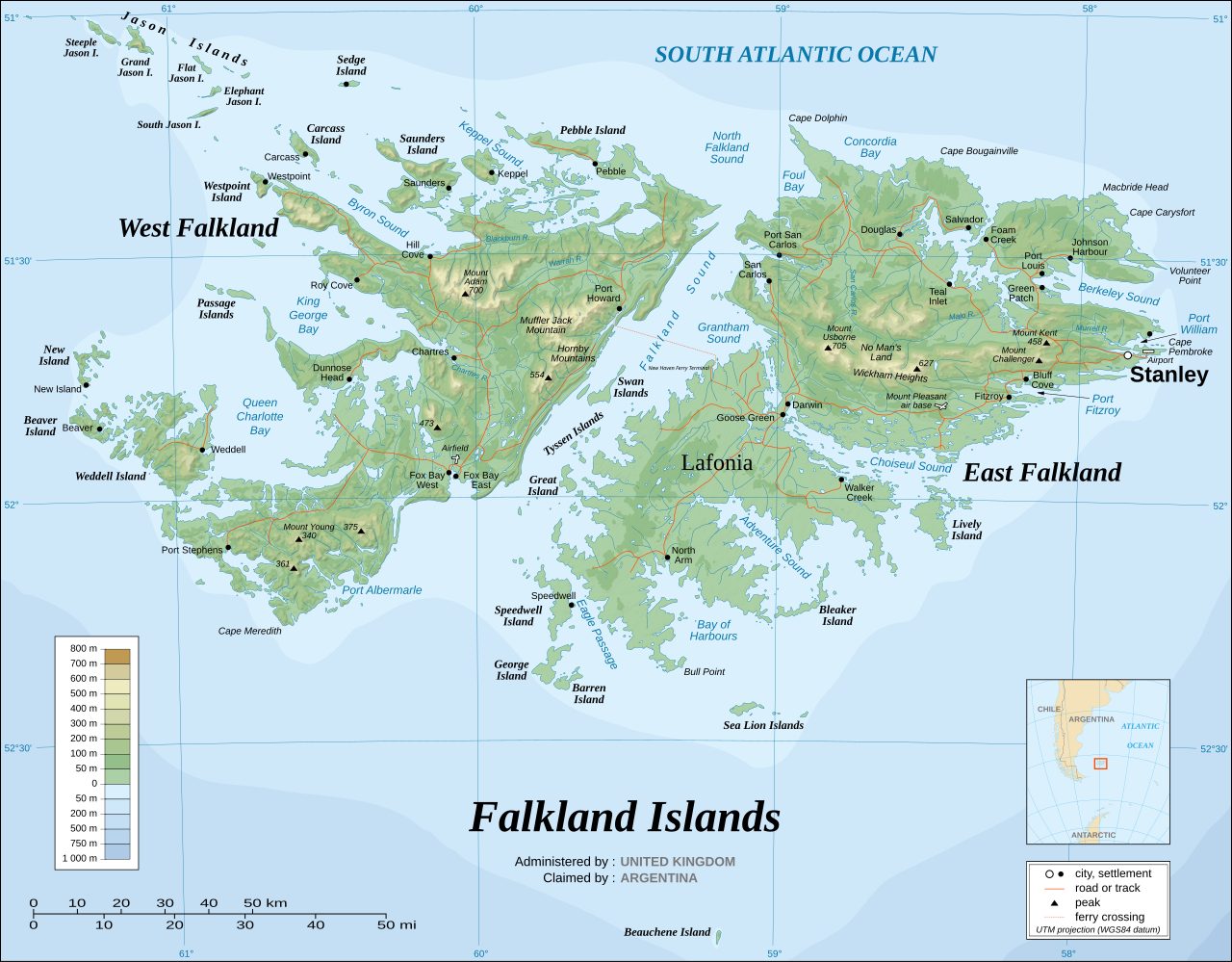
In the early hours of 2 April 1982, Argentine amphibious forces landed near Stanley, the small capital of the Falkland Islands, and overwhelmed the tiny garrison of Royal Marines defending Government House. By morning the islands, a British territory since 1833, were in Argentine hands, and the next day Argentine forces seized South Georgia and the South Sandwich Islands as well. As HISTORY records, the invasion opened a ten-week war in the South Atlantic that almost nobody had expected and that neither government could afford to lose.
Argentina had claimed the islands it calls the Malvinas since the nineteenth century, and by 1982 its military junta, led by General Leopoldo Galtieri, was presiding over economic collapse and growing unrest at home. The seizure was meant to rally the country behind a patriotic cause and to force Britain into negotiations from a position of strength. In Buenos Aires it worked, at first: huge crowds filled the Plaza de Mayo, cheering a recovery they had been taught since childhood was a national duty.
The junta's central calculation, that Britain would protest but not fight for a windswept territory 8,000 miles away, proved wrong. Prime Minister Margaret Thatcher's government dispatched a naval task force within days, and the United Nations Security Council demanded Argentina's withdrawal. British forces retook South Georgia in late April, landed at San Carlos in May, losing ships to Argentine air attack in the fierce fighting around the beachhead, and fought their way across East Falkland in a campaign of night marches and hill battles, Goose Green, Mount Longdon and Wireless Ridge among them, that ended at the gates of Stanley. On 14 June the Argentine commander in Stanley surrendered. The war had cost 649 Argentine and 255 British servicemen and three islanders their lives.
The consequences ran in both directions, and they were permanent. The islands' defences, a token Royal Marines detachment before 1982, were replaced by a permanent garrison and an airfield at Mount Pleasant, built so that the mistake of distance could never be repeated. In Argentina, defeat discredited the junta, which fell within days; democratic elections followed in 1983, and the generals faced trial for the crimes of the dictatorship as well as for the war. In Britain, victory transformed Thatcher's political fortunes and fixed the islands' status for a generation: the islanders' wish to remain British became the stated basis of policy. The sovereignty dispute itself was never resolved, and it is argued over, in quieter ways, to this day.
Why this date matters
April 2 is a day of thresholds crossed in public: a mint founded and a woman seated in Congress, a film premiere that changed what cinema could imagine, and two very different kinds of ending, a pope's long pontificate closing in 2005 and a dictatorship gambling itself into destruction in 1982. Its featured story is the century's clearest lesson in miscalculation, taught in a classroom of cold ocean and peat bog eight thousand miles from London: a regime that mistook a distant, distracted Britain for an indifferent one, and discovered, ten weeks and hundreds of lives later, how wrong it had been.
Sources
- Encyclopaedia Britannica — On This Day: April 2
- HISTORY — What Happened on April 2
- Wikipedia — April 2
- Encyclopaedia Britannica — Falkland Islands War
The facts on this page were checked against these sources on 19 November 2026. The History Trail's permanent pages are researched and written for this site; the live profiles elsewhere on The History Trail are assembled automatically from Wikipedia and Wikidata.
About the Author
Researched and written by the The History Trail Editorial Team — the accountable editorial function behind this site's permanent story pages. The team works from the published sources cited on each page; it does not invent historians, reviewers or credentials, and it corrects errors openly.
Fact Check
Every load-bearing fact on this page traces to one of the sources listed above, and significant claims link to their source in the text. Our checking method is described on the methodology page; errors can be reported via the corrections page.
Sources & Citations
Cite this page as: The History Trail Editorial Team, The History Trail — this article's title, publication and update dates are shown beneath its headline. The full source list appears under Sources above; the site's source standards are on the sources page.