
On This Day
April 18 in History
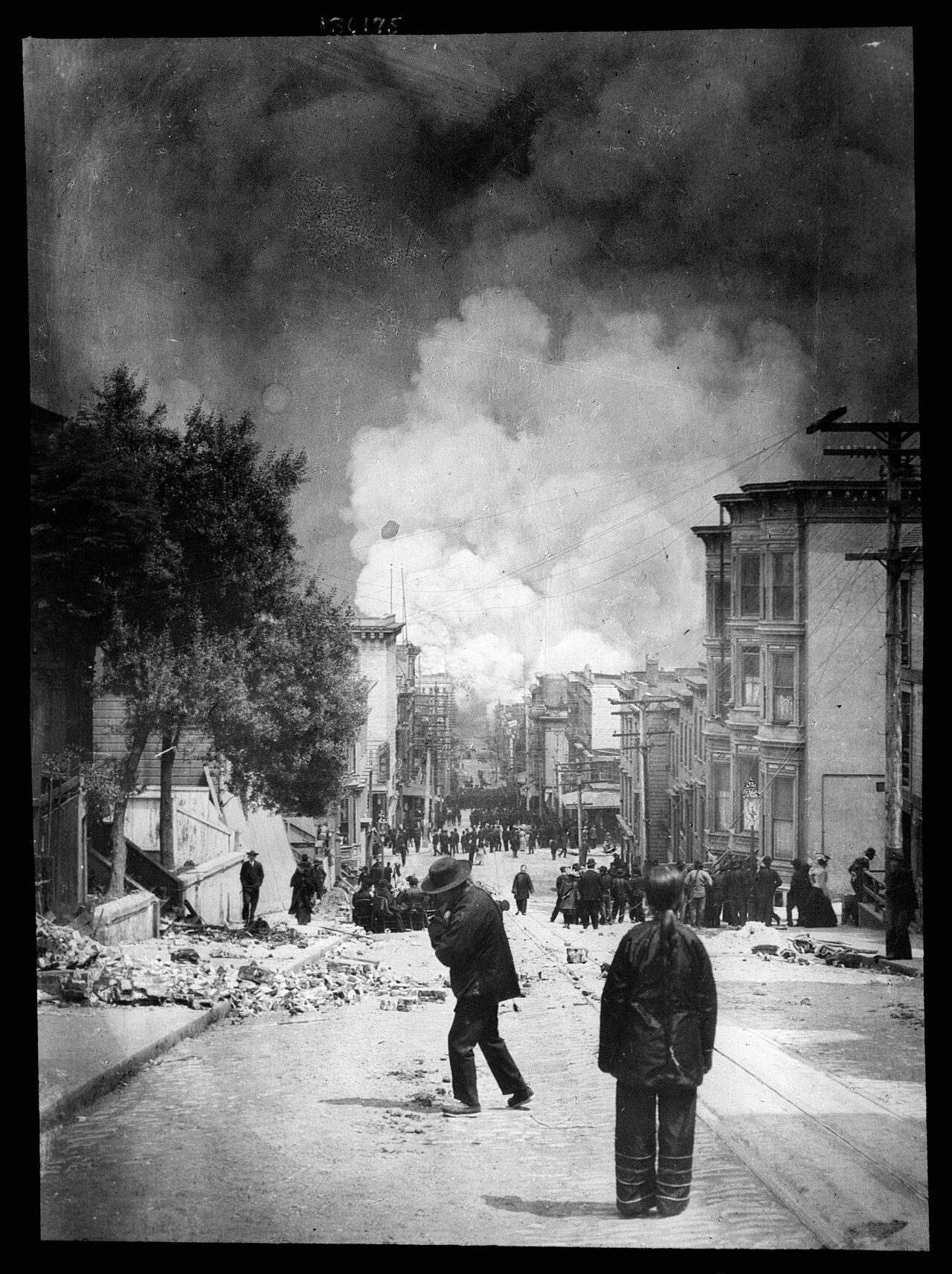
At 5:12 on the morning of 18 April 1906 the San Andreas Fault ruptured along nearly 300 miles of northern California, and San Francisco — then the great city of the American West — shook for almost a minute. The fires that followed did worse than the shaking: over three days they destroyed most of the city and left some 250,000 people homeless. April 18 is also the day of Paul Revere's ride, the Doolittle Raid, and Albert Einstein's death.
Choose another date: open the On This Day calendar to browse events, births and deaths for any day of the year.
At a Glance
- The moment
- 5:12 a.m. local time, 18 April 1906, with the epicentre just off San Francisco
- The size
- Magnitude estimated at 7.9; the San Andreas Fault ruptured along about 296 miles (477 km)
- The shaking
- Some 45–60 seconds of violent motion, felt from Oregon to Los Angeles and inland to Nevada
- The fire
- Dozens of fires, fed by broken gas lines and fought without water after the mains broke, burned for three days and destroyed more than 500 city blocks
- The toll
- More than 3,000 people are thought to have died — early official counts of a few hundred are now considered a large underestimate — and about 250,000 were left homeless
- The legacy
- Study of the quake produced the elastic-rebound theory of earthquakes, still the standard model, and the city rebuilt itself within a decade
Events on this day
- 1506Pope Julius II lays the first stone of the new St Peter's Basilica in the Vatican, the largest church in Christendom.
- 1775Paul Revere rides from Boston to warn that British troops are marching on Lexington and Concord, on the eve of the American Revolution.
- 1906The San Francisco earthquake and fire — the featured story above.
- 1942Sixteen American B-25 bombers under James Doolittle raid Tokyo from the carrier Hornet, the first attack on the Japanese home islands.
- 1945War correspondent Ernie Pyle is killed on Ie Shima during the battle for Okinawa.
- 1956Actress Grace Kelly marries Prince Rainier III of Monaco in a civil ceremony at the palace, becoming Princess Grace.
- 1980Zimbabwe becomes independent of Britain, with Robert Mugabe as its first prime minister.
- 1999Wayne Gretzky plays his last NHL game, retiring as ice hockey's greatest scorer.
- 2023Apple opens its first retail store in India, in Mumbai, forty-seven years after the company's founding.
Born on this day
- 1590Ahmed I — Ottoman sultan who commissioned Istanbul's Blue Mosque.
- 1797Adolphe Thiers — French statesman and historian, first president of the Third Republic.
- 1857Clarence Darrow — American defence lawyer of the Scopes 'Monkey Trial' and the Leopold and Loeb case.
- 1954Gary Carter — American baseball catcher, a World Series champion with the 1986 New York Mets.
- 1958Malcolm Marshall — West Indian fast bowler, among the most feared and skilful of all time.
Died on this day
- 1945Ernie Pyle — America's most beloved war correspondent, killed by Japanese fire on the island of Ie Shima at 44.
- 1955Albert Einstein — German-born physicist who revolutionised physics with relativity, dead in Princeton at 76.
- 2002Thor Heyerdahl — Norwegian explorer who sailed the Kon-Tiki raft across the Pacific, dead at 87.
- 2012Dick Clark — American television host of American Bandstand, 'America's oldest teenager', dead at 84.
The featured story: the San Francisco earthquake, 18 April 1906
San Francisco in April 1906 was the queen city of the Pacific coast — 400,000 people, the busiest port in the West, grand hotels, theatres and the mansions of Nob Hill. At 5:12 on a Wednesday morning a foreshock woke light sleepers across the Bay Area. Twenty to twenty-five seconds later the main shock arrived. The northern 296 miles of the San Andreas Fault tore loose at once; in places the ground shifted sideways by twenty feet. In San Francisco the shaking lasted less than a minute, and it sorted the city by geology: buildings on solid rock mostly stood, while those on filled ground along the waterfront and in the Mission lurched, sank and collapsed. The Valencia Street Hotel dropped into the street, killing dozens inside.
The earthquake broke the city; the fire consumed it. Stoves overturned, chimneys fell into hearths, gas lines and electrical wires snapped — and the water mains broke with the ground, leaving the fire department with dry hydrants. Fire Chief Dennis Sullivan, who had long warned the city was unprepared, was mortally injured by a falling dome in the first minutes. Over three days some thirty fires merged into a single advancing front. Firefighters and soldiers dynamited whole streets to make firebreaks, sometimes spreading the blaze instead; the Army's General Funston put the city under effective martial law. Refugees streamed to the parks, the Presidio and the ferries, and watched from the hills as the fire took the downtown, Chinatown and the waterfront.
When the fire burned itself out on 21 April, more than 500 blocks — some 28,000 buildings across 4.7 square miles — were gone. The human count was falsified at the time, deliberately: city officials, fearing for investment and insurance, reported fewer than 600 dead. Later research, notably by archivist Gladys Hansen, established that more than 3,000 people died, most of them never named. About 250,000 people, over half the city, were homeless, living in tent camps in the parks for years.
San Francisco rebuilt with famous speed — by the Panama-Pacific Exposition of 1915 it presented itself as reborn — but the earthquake's deepest legacy was scientific. Surveyors found fences and roads offset across the fault along its whole length, and from those measurements Harry Fielding Reid formulated the elastic-rebound theory: strain accumulates in rock until the fault snaps it back. It remains the foundation of earthquake science. The city that was destroyed in a minute became the place where earthquakes were first understood.
Why this date matters
April 18 is a day of signals sent into the dark. Paul Revere rode through it in 1775 carrying a warning; the Doolittle Raiders crossed the Pacific on it in 1942 carrying an answer to Pearl Harbor; and in 1906 San Francisco learned that the most dangerous signal is the one the ground itself sends, unannounced at dawn. Einstein, who taught the century to read the universe's signals, died on this date in 1955. The day's events share a single quality: each was the first moment of something — a revolution, a science, a city's second life — arriving without permission.
Sources
- Encyclopaedia Britannica — On This Day: April 18
- HISTORY — What Happened on April 18
- U.S. Geological Survey — The Great 1906 San Francisco Earthquake
- Encyclopaedia Britannica — San Francisco earthquake of 1906
The facts on this page were checked against these sources on 19 November 2026. The History Trail's permanent pages are researched and written for this site; the live profiles elsewhere on The History Trail are assembled automatically from Wikipedia and Wikidata.
About the Author
Researched and written by the The History Trail Editorial Team — the accountable editorial function behind this site's permanent story pages. The team works from the published sources cited on each page; it does not invent historians, reviewers or credentials, and it corrects errors openly.
Fact Check
Every load-bearing fact on this page traces to one of the sources listed above, and significant claims link to their source in the text. Our checking method is described on the methodology page; errors can be reported via the corrections page.
Sources & Citations
Cite this page as: The History Trail Editorial Team, The History Trail — this article's title, publication and update dates are shown beneath its headline. The full source list appears under Sources above; the site's source standards are on the sources page.