
Animals
Goat
Second only to the dog in the order of domestication, the goat learned to turn scrub, weeds and hillsides into milk, meat, leather and luxury fibre. It has been the poor farmer's complete livelihood for ten thousand years — and there are now nearly a billion of them.
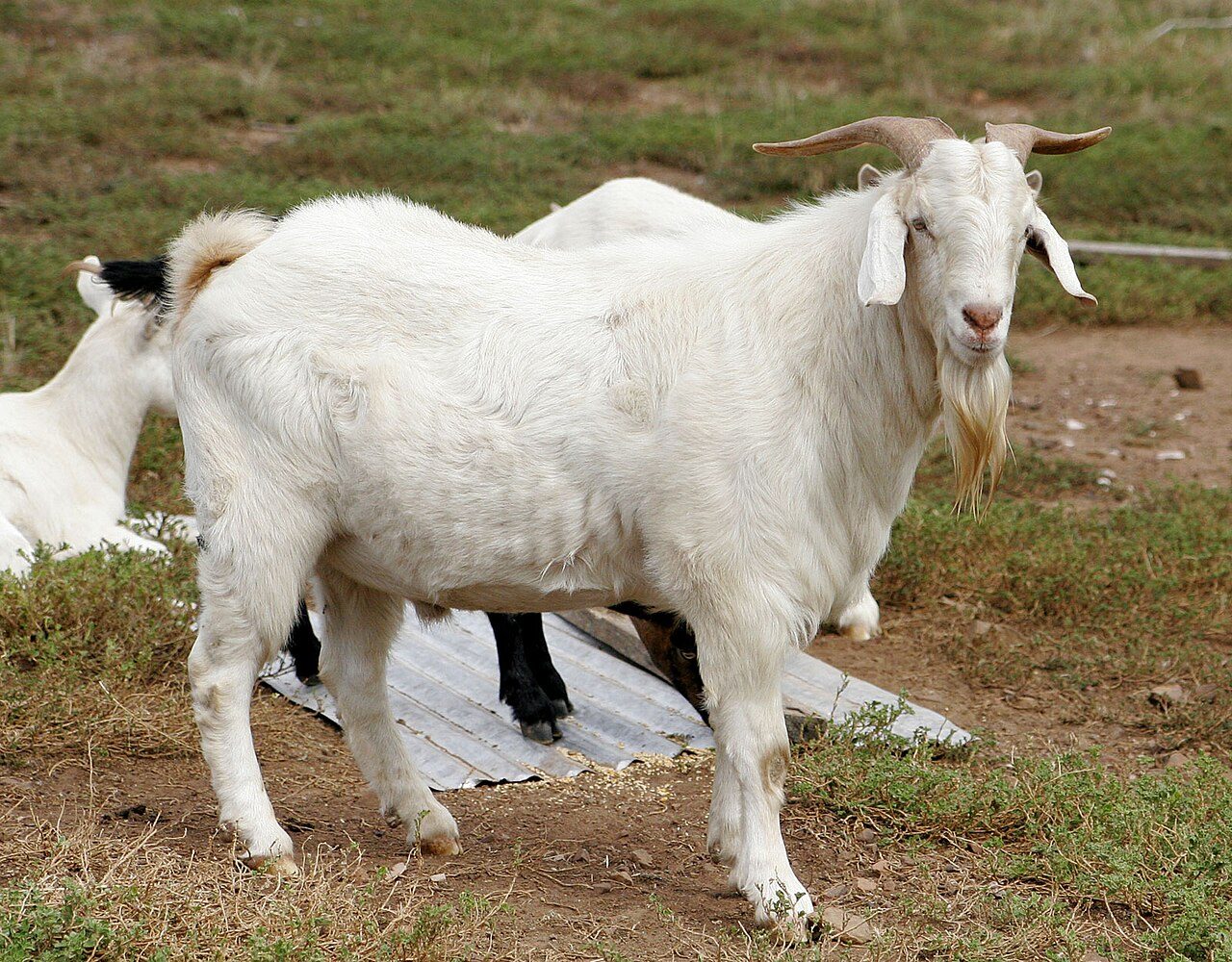
At a Glance
- Scientific name
- Capra hircus (Linnaeus, 1758)
- Wild ancestor
- The bezoar, Capra aegagrus, of Southwest Asia
- Domesticated
- About 10,000 years ago, in Eastern Anatolia and the Zagros Mountains
- Breeds
- More than 200 breeds of domestic goat
- Provides
- Milk, meat, hides, kid leather, mohair (Angora) and cashmere
- Feeding style
- A browser — eats foliage, woody plants and weeds other livestock refuse
- Names
- Males are bucks or billys, females does or nannies, young are kids
- World population
- More than 924 million (UN FAO, 2011)
Introduction
The goat was among the very first animals humans domesticated, and it has been travelling with us ever since. The domestic goat, Capra hircus, descends from the bezoar — the wild goat Capra aegagrus of Southwest Asia — and genetic evidence traces almost all of today's goats to domestication centres in Eastern Anatolia and the Zagros Mountains around ten thousand years ago. Only the dog was selectively bred by humans earlier.
What the goat offered the first farmers was a complete livelihood in a small, hardy package. Britannica notes that one or two goats will supply a family's milk for a year and can be kept in small quarters where a cow would be uneconomical. Add meat, hides, dung for fuel, and fibre — the Angora's mohair and the cashmere goat's soft undercoat — and the goat became the livestock of people farming land too steep, dry or poor for anything else.
Background
A goat is a ruminant of the genus Capra, related to the sheep but lighter in build, with horns that arch backwards, a short upturned tail and straighter hair; males, called bucks or billys, usually carry a beard, while females are does or nannies and the young are kids. Goats are browsers rather than grazers: they hold their heads up to strip foliage, and they are especially valued for eating the woody plants and weeds that other livestock refuse, partially digesting the meal and then chewing it again as cud.
That browsing independence, and a famous talent for climbing and escaping, made the goat the ideal pioneer animal — and sometimes an ecological liability when herds were turned loose on fragile islands and hillsides. Selective breeding has since produced more than 200 breeds, from miniature pets to meat animals approaching 300 pounds, in a diversity of colour, coat and form that Britannica compares to that of the dog. Dairy breeds such as the Saanen and Toggenburg, fibre breeds such as the Angora and Cashmere, and meat breeds such as the Boer each carry the same bezoar inheritance tuned to a different human need.
Timeline
- About 11,000 years ago
Settlers of the Fertile Crescent begin selectively breeding the bezoar, the wild goat — the second animal domesticated by humans, after the dog.
- About 10,500 years ago
Archaeological evidence traces goat domestication to the high Euphrates valleys of southeastern Anatolia, among the earliest farming communities.
- 9,900–9,500 years ago
Goats are being managed and domesticated in the Zagros Mountains, where the earliest remains of domestic goats are later found at Ganj Dareh in Iran.
- 1758
Linnaeus formally names the domestic goat Capra hircus in the tenth edition of Systema Naturae.
- 2000
Zeder and Hesse publish their landmark study of goat bones from the Zagros, pinning the initial domestication of goats to about 10,000 years ago.
- 2008
A large-scale mitochondrial DNA study of 473 bezoars confirms the wild ancestor and locates the main domestication centres in Eastern Anatolia and the northern and central Zagros.
- 2011
The UN Food and Agriculture Organization counts more than 924 million live goats worldwide — the Neolithic experiment now spans every inhabited continent.
Significance
The goat's significance is written into the geography of farming itself. Because goats convert sparse, scrubby vegetation into milk, meat and hides, they allowed Neolithic herders to live from land that could support nothing else — the dry hills, thin soils and mountain margins where settlement would otherwise have failed. Goat dung served as fuel, and bone, hair and sinew supplied clothing, building material and tools. Where the goat could go, permanent villages could follow; livestock like the goat were, as Britannica puts it, among the key factors that let nomadic ancestors form settlements and eventually cities.
The relationship also ran in the other direction: the goat was a probe for science. Goat bones from sites such as Ganj Dareh gave archaeologists some of the earliest hard evidence of animal domestication anywhere, and goat DNA — with its six maternal lineages — became a model for how geneticists reconstruct the geography of domestication, distinguishing a major Anatolian centre from smaller, older experiments on the Iranian Plateau whose contribution to today's herds is only about 1.4 percent.
Legacy
Ten thousand years on, the goat remains the world's most democratic livestock: cheap to keep, quick to breed, and productive on land and fodder that no other domestic animal can use. Its milk feeds families directly and becomes cheese across Europe, the Middle East and Asia; its fibre becomes mohair and cashmere; its meat is the most widely eaten red meat on Earth by population, even where beef dominates headlines.
The same hardiness carries a warning the goat's own history teaches. Feral goats, descendants of animals deliberately released on islands as a living larder, have stripped vegetation from fragile ecosystems worldwide — a reminder that the partnership between humans and this animal has always been powerful in both directions. Managed well, the goat is still what it was in the Zagros: the animal that makes marginal land, and marginal livelihoods, work.
Sources
- Encyclopaedia Britannica — Goat
- Encyclopaedia Britannica — 6 Domestic Animals and Their Wild Ancestors
- Proceedings of the National Academy of Sciences (PMC) — The goat domestication process inferred from large-scale mitochondrial DNA analysis
- Wikipedia — Goat
The facts on this page were checked against these sources on 19 November 2026. The History Trail's permanent pages are researched and written for this site; the live profiles elsewhere on The History Trail are assembled automatically from Wikipedia and Wikidata.
About the Author
Researched and written by the The History Trail Editorial Team — the accountable editorial function behind this site's permanent story pages. The team works from the published sources cited on each page; it does not invent historians, reviewers or credentials, and it corrects errors openly.
Fact Check
Every load-bearing fact on this page traces to one of the sources listed above, and significant claims link to their source in the text. Our checking method is described on the methodology page; errors can be reported via the corrections page.
Sources & Citations
Cite this page as: The History Trail Editorial Team, The History Trail — this article's title, publication and update dates are shown beneath its headline. The full source list appears under Sources above; the site's source standards are on the sources page.